
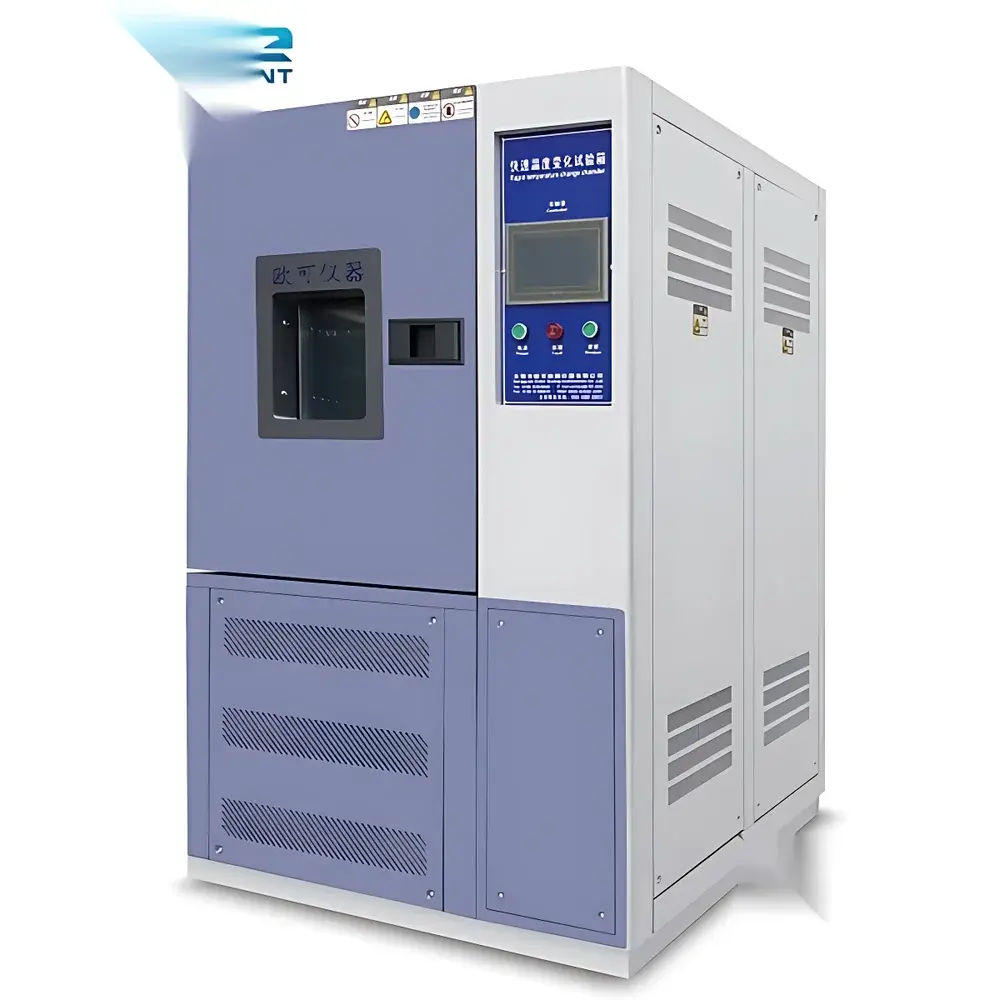
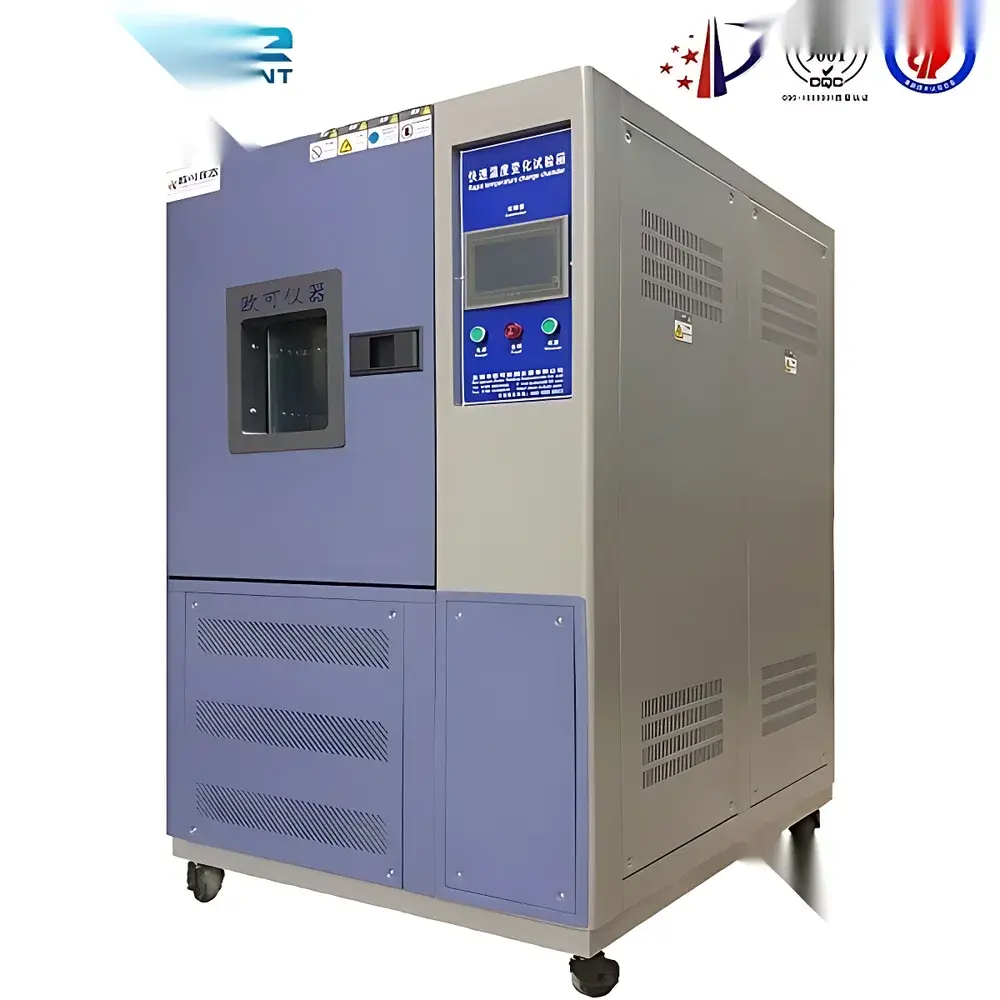
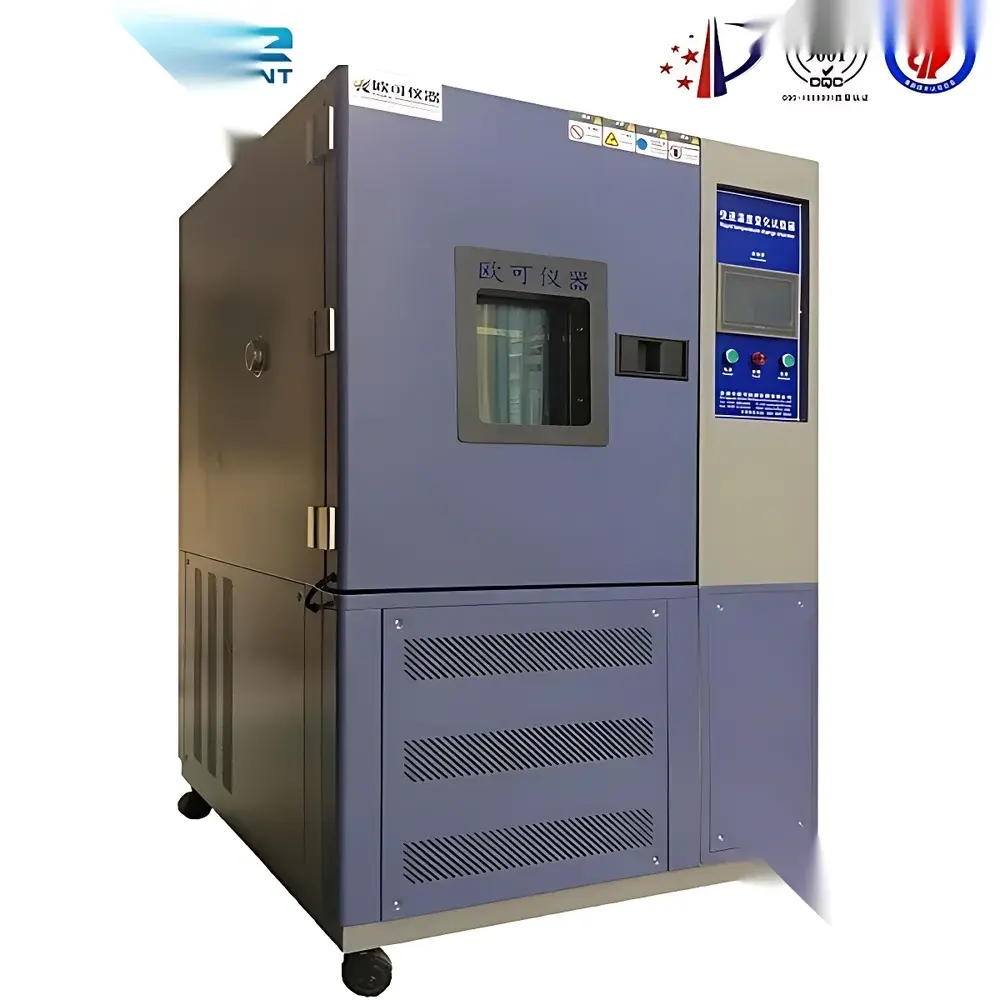
Quick Temperature Ramp Test Chamber
| Brand | Other Brands |
|---|---|
| Origin | Imported |
| Manufacturer Type | General Distributor |
| Price | USD 14,500 (approx.) |
| Temperature Range | –70 °C to +150 °C |
| Rapid Thermal Transition Range | –45 °C to +85 °C |
| Max Linear Ramp Rate | 15 °C/min |
| Temp. Resolution/Accuracy | 0.1 °C / ±0.5 °C |
| Humidity Range (Optional) | 5–98% RH |
| Humidity Accuracy | ±2.5% RH |
| Interior Material | SUS304 Stainless Steel |
| Insulation | High-Density Polyurethane Foam (HCFC-Free) |
| Refrigeration | Air-Cooled or Water-Cooled |
| Compressor | Tecumseh (France) |
| Refrigerant | R-404A / R-507A (EPA SNAP-Approved) |
| Controller | Imported LCD Touchscreen with Multi-Step Programmable Profile Support (Ramp/Soak, Linear/Slope Mode) |
| Viewing Window | Double-Layer Tempered Glass with Anti-Fog Heater & LED Illumination |
| Test Port | Ø50 mm (standard), configurable |
Overview
The Quick Temperature Ramp Test Chamber is a precision-engineered environmental stress screening (ESS) system designed for accelerated thermal cycling, HALT/HASS qualification, and reliability validation of electronic components, automotive modules, aerospace subsystems, and medical devices. It operates on a dual-refrigeration circuit architecture with independent high- and low-temperature stages, enabling rapid, linear, and repeatable temperature transitions across an extended operational range of –70 °C to +150 °C. Unlike conventional thermal chambers relying on single-stage compression, this unit integrates a Tecumseh (France) hermetic scroll compressor paired with EPA SNAP-compliant R-404A/R-507A refrigerants and an optimized oil management system—ensuring stable performance under extreme thermal load conditions and eliminating lubricant carryover into capillary tubes or evaporators. The chamber’s thermodynamic design supports both linear ramp control (with programmable slope from 3.0 °C/min up to 15 °C/min within the –45 °C to +85 °C band) and non-linear transient profiles, making it suitable for IEC 60068-2-14, MIL-STD-810H Method 503.7, and JEDEC JESD22-A104D test execution.
Key Features
- High-strength SUS304 stainless steel interior and exterior housing with matte-finish electropolished surface treatment for corrosion resistance and cleanroom compatibility
- Dual-layer, low-emissivity tempered glass viewing window with integrated anti-condensation heating film and high-lumen LED illumination for real-time sample observation under thermal stress
- Patented door sealing system featuring dual silicone gaskets and pneumatic-assisted compression for sustained thermal integrity (<0.8 K/hr heat leakage at –70 °C)
- Modular test port configuration (standard Ø50 mm, optional multi-port kits) supporting feedthrough of power, signal, or fluid lines without compromising chamber vacuum integrity
- Multi-segment programmable controller with intuitive LCD touchscreen interface; supports up to 999 cycles, 99 segments per program, and user-defined ramp/soak/slope logic
- Integrated leveling casters with industrial-grade locking screws for facility repositioning and seismic anchoring compliance
- Energy-efficient insulation using closed-cell polyurethane foam (density ≥40 kg/m³, λ ≤0.022 W/m·K) with zero ozone-depleting potential (ODP = 0)
Sample Compatibility & Compliance
This chamber accommodates standard test specimens up to 600 × 600 × 600 mm (W×D×H) and supports mounting fixtures for PCB assemblies, battery packs, sensor housings, and sealed enclosures. Optional humidity control (5–98% RH, ±2.5% RH accuracy) extends applicability to combined environmental stress testing per IEC 60068-2-30 and MIL-STD-810H Method 507.5. All electrical and refrigeration systems conform to CE, UL 61010-1, and RoHS directives. Firmware includes audit-trail logging, password-protected parameter editing, and timestamped event records—fully aligned with GLP/GMP documentation requirements and FDA 21 CFR Part 11 data integrity standards when connected to validated LIMS platforms.
Software & Data Management
The embedded controller provides native CSV export of time-stamped temperature/humidity profiles, alarm logs, and cycle completion reports via USB 2.0 or Ethernet (Modbus TCP). Optional PC-based software (Windows/Linux compatible) enables remote monitoring, automated report generation (PDF/Excel), statistical process control (SPC) charting, and integration with MES/QMS systems through OPC UA or RESTful API endpoints. All data files include cryptographic hash signatures and support digital signature verification for regulatory submissions.
Applications
- Thermal shock validation of solder joints and conformal coatings per IPC-J-STD-020
- Pre-conditioning of lithium-ion battery cells prior to electrochemical cycling tests
- Qualification of avionics enclosures under DO-160 Section 4 (Temperature Variation) and Section 5 (Altitude/Temperature)
- Accelerated life testing of optical sensors exposed to diurnal thermal gradients
- Material coefficient-of-thermal-expansion (CTE) characterization via in-situ dimensional metrology
- Environmental screening of IoT edge devices deployed in outdoor infrastructure
FAQ
What is the minimum dwell time between ramp phases in multi-step programs?
The controller supports dwell times as short as 1 second, with resolution down to 0.1 seconds for precise thermal transient sequencing.
Can the chamber operate continuously at –70 °C with full humidity control enabled?
Humidity control is not active below 0 °C; condensation management is achieved via desiccant-based dehumidification only within the 5–98% RH band above freezing.
Is water-cooling mandatory for achieving maximum ramp rates?
Water-cooling is recommended for sustained operation at >10 °C/min ramp rates above ambient, especially in ambient temperatures exceeding 30 °C or when installed in confined mechanical rooms.
Does the system support third-party calibration traceability?
Yes—built-in PT100 Class A sensors are certified to NIST-traceable standards; optional on-site calibration services include ISO/IEC 17025-accredited certificates with uncertainty budgets.
How is firmware updated, and is version rollback supported?
Firmware updates are performed via encrypted USB drive with SHA-256 signature verification; full version history and rollback capability are retained in non-volatile memory.



