
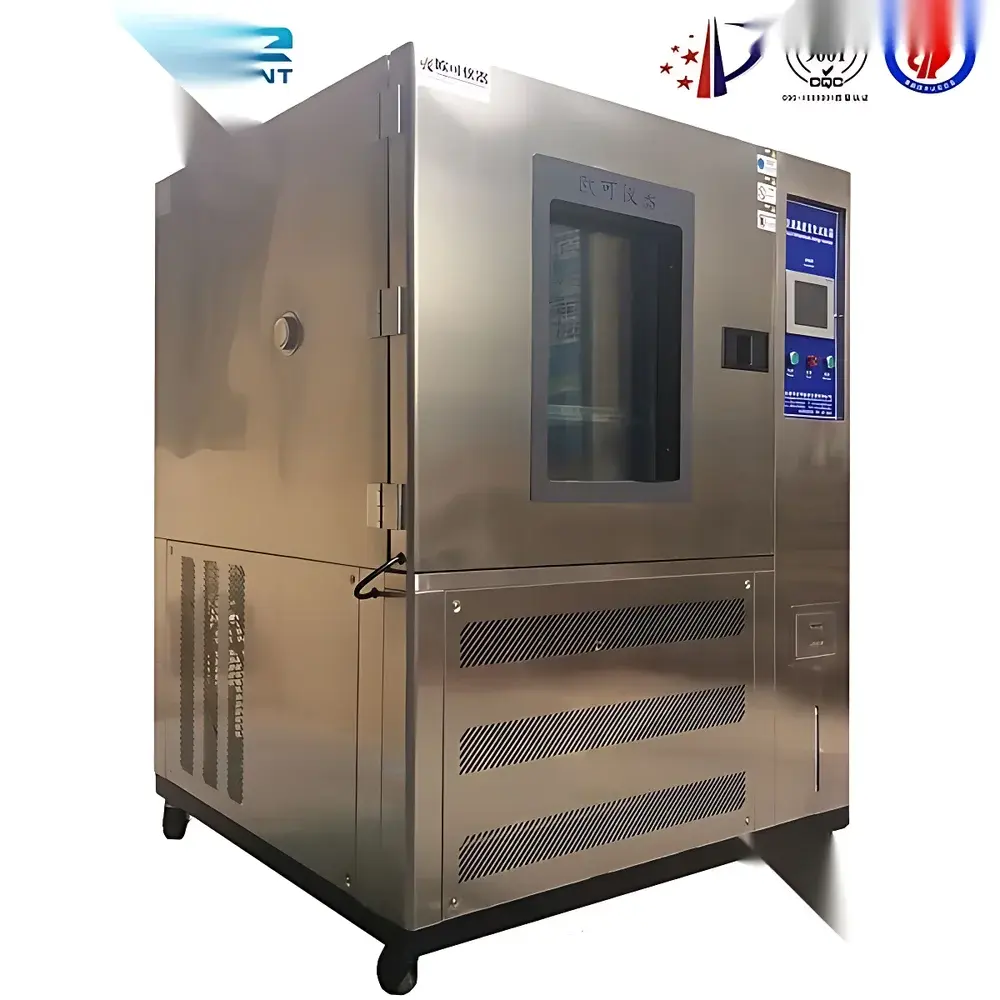
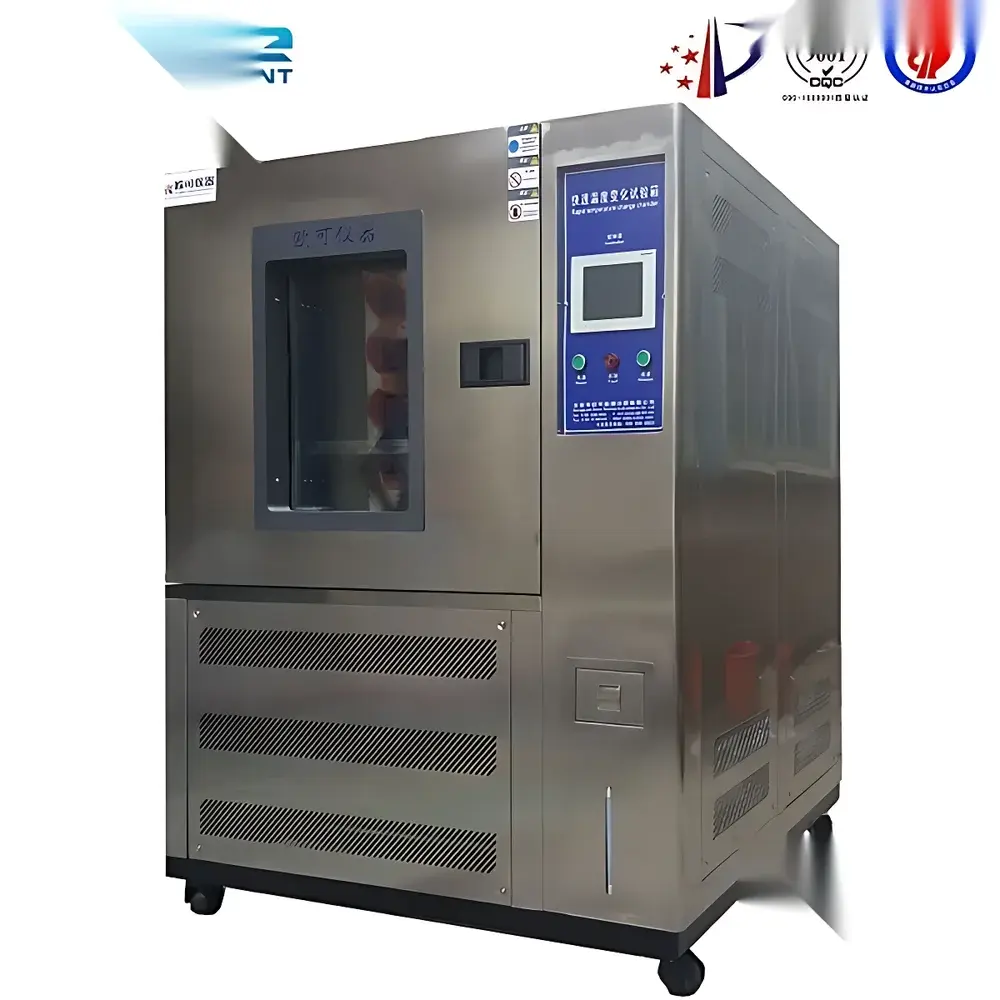
Quick Temperature Transition Aging Test Chamber
| Brand | Other Brands |
|---|---|
| Origin | Imported |
| Manufacturer Type | General Distributor |
| Temperature Range | –70 °C to +150 °C |
| Rapid Transition Range | –45 °C to +85 °C |
| Heating/Cooling Rate (Linear) | 3.0–15 °C/min (adjustable) |
| Heating/Cooling Rate (Non-linear) | 3.0–20 °C/min (adjustable) |
| Temperature Control Accuracy | ±0.5 °C |
| Humidity Range (Optional) | 20–98% RH (extendable to 5–98% RH on special request) |
| Humidity Control Accuracy | ±2.5% RH |
| Temperature Resolution | 0.1 °C |
| Humidity Resolution | 0.1% RH |
| Temperature Uniformity | ±2.0 °C |
| Humidity Uniformity | ±3.0% RH |
| Construction | Interior and exterior stainless steel (SUS304), brushed finish |
| Insulation | High-density polyurethane foam with ethyl chloroformate formulation |
| Cooling Method | Air-cooled or water-cooled |
| Refrigeration Compressor | Tecumseh (France) |
| Refrigerant | R-404A / R-501 (EPA-approved, ozone-friendly) |
| Controller | Intelligent LCD touchscreen with multi-segment programmable logic for temperature/humidity ramp-and-soak profiles |
| Observation Window | Double-layer tempered glass with anti-fog heater and LED illumination |
| Test Port | Standard Ø50 mm port with silicone gasket for external cabling |
| Mobility | Integrated casters with locking screws |
Overview
The Quick Temperature Transition Aging Test Chamber is an engineered environmental stress screening (ESS) system designed for accelerated thermal aging, reliability validation, and qualification testing of electronic components, automotive modules, aerospace hardware, and polymer-based materials. It operates on the principle of controlled, high-rate thermal cycling—enabling precise simulation of real-world thermal shock conditions without mechanical shock loading. Unlike conventional thermal chambers, this unit achieves linear ramp rates up to 15 °C/min across its rapid transition range (–45 °C to +85 °C), supporting both standardized test protocols (e.g., JEDEC JESD22-A104, MIL-STD-810H Method 503.5) and custom profile development. Its dual-zone refrigeration architecture—featuring a Tecumseh compressor and EPA-compliant R-404A/R-501 refrigerant blend—ensures stable thermal performance under repeated load cycling and long-duration operation. The chamber’s structural integrity, corrosion-resistant SUS304 construction, and high-density polyurethane insulation minimize thermal leakage and energy drift over extended test cycles.
Key Features
- Programmable linear and non-linear temperature ramping (3.0–20 °C/min), with independent rate control for heating and cooling phases
- Multi-segment LCD controller supporting up to 999 cycles, 99 segments per program, and slope/quick-mode switching for gradient or step-profile execution
- Dual-layer observation window with embedded anti-condensation heater and high-lumen LED lighting—enabling real-time visual monitoring without thermal disturbance
- Standard 50 mm test port with silicone-sealed feedthrough, rated for signal/power cable routing under full thermal load
- Full-suspension internal shelf system with height-adjustable, load-rated stainless steel trays (up to 30 kg per shelf)
- Integrated caster assembly with industrial-grade locking screws for secure repositioning in ISO-classified labs or production floors
- Self-diagnostic controller with fault logging, refrigeration system parameter display (suction/ discharge pressure, coil temperature), and alarm-triggered data freeze
Sample Compatibility & Compliance
The chamber accommodates samples ranging from PCB assemblies and battery packs to molded plastic housings and sealed sensor enclosures. Internal dimensions support standard test fixtures compliant with IEC 60068-2-14 (Test N: Change of Temperature) and ASTM D3045 (Standard Practice for Heat Aging of Plastics). Optional humidity control (20–98% RH, extendable to 5% RH) permits combined temperature-humidity stress testing aligned with IPC-9701A and Telcordia GR-468-CORE. All electrical systems conform to IEC 61000-6-2 (immunity) and IEC 61000-6-4 (emission) standards. Structural design meets CE Machinery Directive 2006/42/EC and carries UL/cUL recognition for North American deployment. Full traceability logs—including temperature/humidity setpoints, actual readings, ramp rates, and alarm events—are timestamped and exportable via USB for GLP/GMP audit readiness.
Software & Data Management
The embedded controller supports CSV export of time-stamped measurement data (temperature, humidity, ramp rate, cycle count) directly to USB storage. Optional PC-based software (sold separately) enables remote monitoring, real-time graphing, statistical process control (SPC) charting, and automated report generation per ISO/IEC 17025 requirements. Audit trail functionality records all user actions—including profile edits, manual overrides, and calibration adjustments—with operator ID and timestamp. Data encryption and password-protected access levels align with FDA 21 CFR Part 11 compliance for regulated industries. Firmware updates are delivered via signed binary packages to ensure system integrity and version control.
Applications
- Accelerated life testing of lithium-ion battery cells under thermal cycling stress
- Thermal fatigue evaluation of solder joints in high-reliability electronics (e.g., avionics, medical devices)
- Material degradation analysis of elastomers, adhesives, and encapsulants per ASTM D573
- Qualification of automotive ECUs per ISO 16750-4 (Environmental Conditions and Testing for Electrical and Electronic Equipment)
- Validation of packaging integrity for sterile medical devices under cyclic temperature-humidity exposure
- Pre-screening of components prior to HALT/HASS testing sequences
FAQ
What is the maximum allowable sample mass per test cycle without compromising ramp rate accuracy?
For sustained 15 °C/min linear ramping within the –45 °C to +85 °C range, total loaded mass should not exceed 25 kg. Higher loads require derating; consult the Thermal Load Derating Table in the operator manual.
Can the chamber operate continuously at –70 °C for extended periods?
Yes—the refrigeration system is rated for continuous operation at –70 °C. However, prolonged sub-zero operation requires periodic defrost cycle scheduling (automatically managed by the controller) to maintain evaporator efficiency.
Is third-party calibration certification available?
NIST-traceable calibration certificates (per ISO/IEC 17025) are available upon request, including as-found/as-left data for temperature and humidity sensors at three spatial points.
Does the controller support Ethernet connectivity for lab network integration?
Ethernet interface is optional (model-specific); standard configuration includes RS-232 and USB host ports. Ethernet-enabled variants support Modbus TCP and HTTP API for SCADA integration.
How is condensation prevented on internal surfaces during rapid cooldown?
The chamber employs a combination of dew-point-controlled dehumidification pre-cycle, internal surface heating elements, and dynamic airflow management to suppress condensation—even during transitions from high-humidity soak to deep-cold ramp.



