
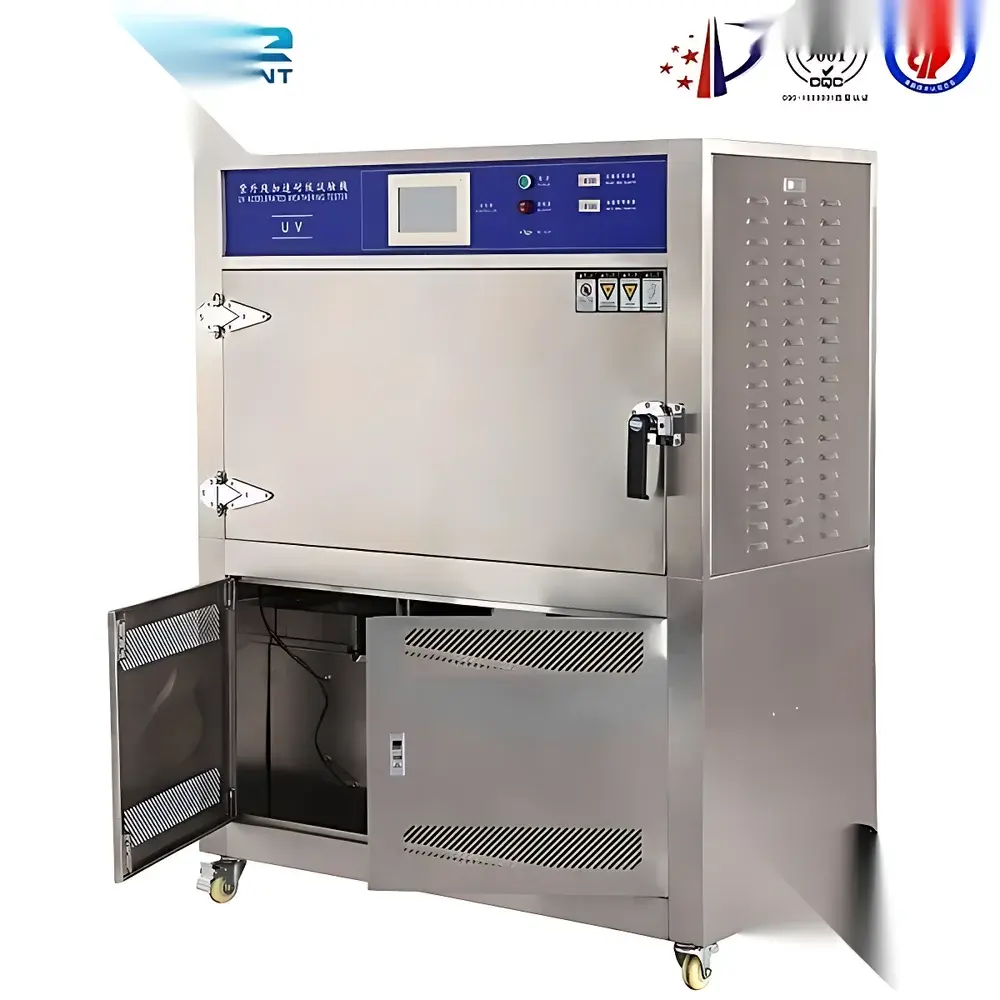
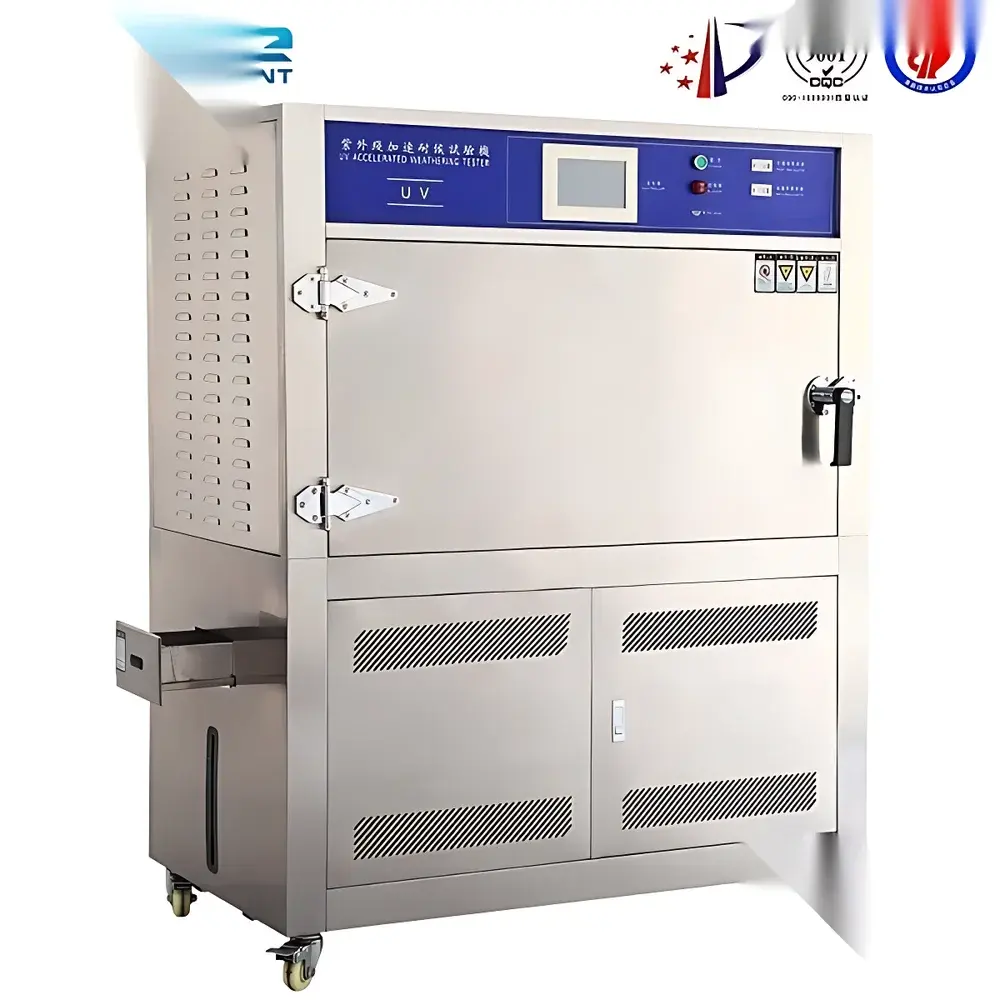
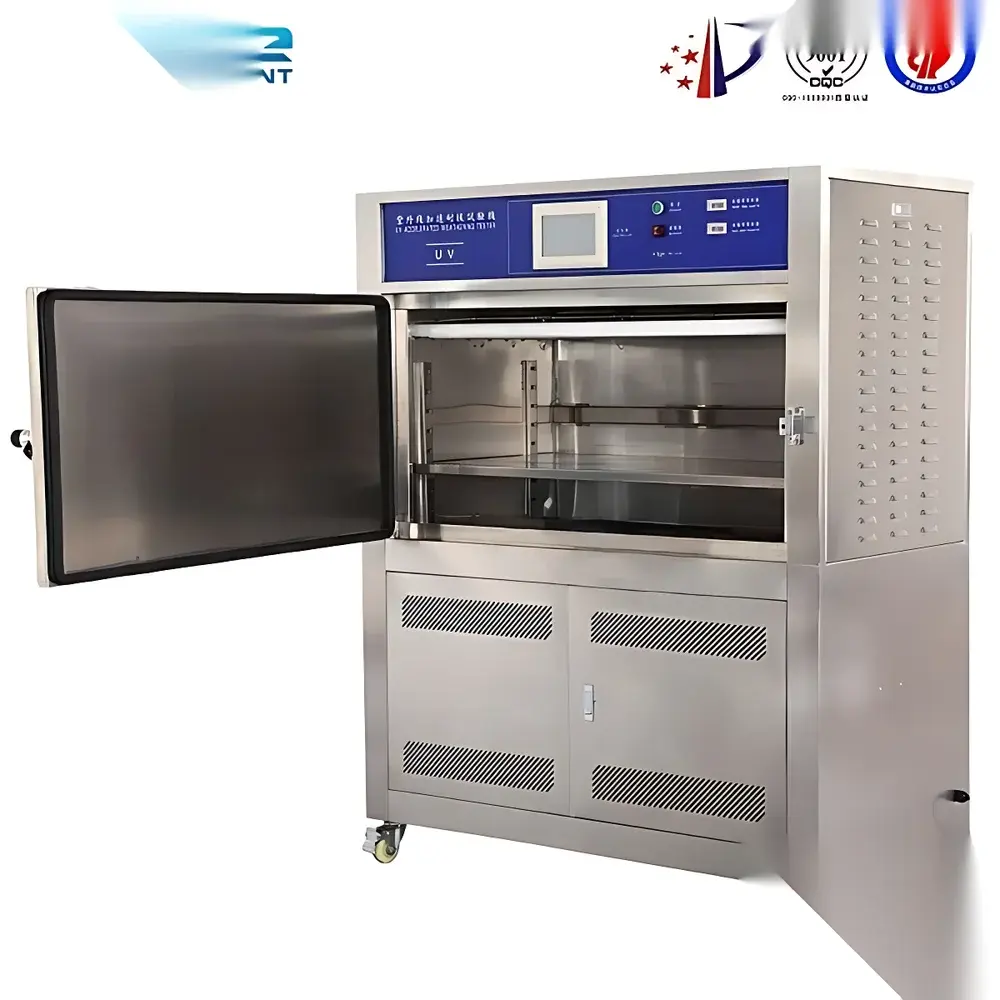
QUV UV Aging Test Chamber – Standard Model OK-UV-290
| Brand | OEM / Industrial Grade |
|---|---|
| Origin | Imported |
| Manufacturer Type | Authorized Distributor |
| Pricing | USD 3,150 (FOB) |
| Temperature Range | Ambient to 70 °C |
| Humidity Range | ≥95% RH |
| Temp. Control Accuracy | ≤±0.5 °C |
| Temp. Uniformity | ≤±2 °C or ≤±3% |
| UV Wavelength Range | 280–400 nm |
| UV Lamp Type | Fluorescent UVA-340 / UVB-313 (typical) |
| Lamp Lifetime | ~2,000 h |
| Exposure Time Range | 0–999 h (adjustable) |
| Interior Dimensions (W×H×D) | 114×40×40 cm |
| Exterior Dimensions (W×H×D) | 135×140×65 cm |
| Construction Material | SUS#304 Stainless Steel (interior & exterior) |
| Heating System | U-shaped Titanium Alloy Heaters |
| Safety Features | Door-interlocked UV cutoff, Over-temperature Protection, Low-water Level Cut-off |
Overview
The QUV UV Aging Test Chamber (Model OK-UV-290) is an industrial-grade accelerated weathering instrument engineered for precision simulation of solar ultraviolet radiation, condensation, and thermal cycling effects on polymeric, coated, and composite materials. Based on the ASTM G154 and ISO 4892-3 standards, it employs fluorescent UV lamps—primarily UVA-340 (mimicking terrestrial sunlight down to 295 nm) and optionally UVB-313 (for aggressive, short-wavelength stress)—to deliver reproducible irradiance profiles. Unlike xenon arc testers, the QUV system isolates UV-driven degradation mechanisms by eliminating visible and infrared components, enabling focused study of photochemical bond scission, oxidation, and chromophore breakdown. The chamber integrates a controlled condensation cycle via saturated water vapor at elevated temperature (typically 50 °C), replicating dew formation and surface hydration critical to hydrolytic degradation pathways. This dual-stress architecture—UV irradiation + high-humidity condensation—enables correlation with real-world outdoor exposure in coatings, automotive trim, architectural sealants, and medical device polymers.
Key Features
- Stainless steel construction (SUS#304) ensures long-term corrosion resistance and compliance with ISO 17025 laboratory environmental requirements.
- Precise temperature control (±0.5 °C accuracy; ±2 °C uniformity) across both irradiation and condensation phases supports repeatable test protocols per ASTM D4329 and ISO 11507.
- Interlocked UV lamp circuitry automatically de-energizes all lamps upon door opening—meeting IEC 61000-4-2 ESD safety requirements and preventing operator UV exposure.
- Dual-mode operation: Standard UV/condensation cycling (e.g., 4 h UV at 60 °C followed by 4 h condensation at 50 °C) or optional water spray mode for simulating rain erosion (per ISO 4892-2 Annex B).
- Integrated titanium alloy heating elements provide rapid thermal response and stable setpoint maintenance without hot-spot formation.
- Real-time monitoring of chamber temperature and UV irradiance (via optional calibrated radiometer) enables traceable data logging compliant with FDA 21 CFR Part 11 when paired with validated software.
Sample Compatibility & Compliance
The OK-UV-290 accommodates flat-panel specimens up to 110 cm wide × 40 cm tall × 25 cm deep, supporting standard ASTM G154 specimen racks (25.4 mm spacing) and custom fixtures for 3D parts. It is routinely deployed in laboratories operating under GLP (Good Laboratory Practice) and ISO/IEC 17025 accreditation frameworks. Test reports generated from this system support regulatory submissions for automotive OEMs (e.g., GMW14872, Ford CETP), paint manufacturers (AAMA 2605), and medical packaging (ISO 11607-1). All UV lamp spectral output is characterized per CIE S 012/E and traceable to NIST-calibrated reference detectors.
Software & Data Management
While the base model features manual timer-based cycling, optional PC interface modules enable automated protocol execution, real-time graphing of temperature/irradiance trends, and export of CSV-formatted datasets compatible with JMP, Minitab, or MATLAB. Audit trails—including user login, parameter changes, and alarm events—are retained for ≥18 months, satisfying electronic record retention mandates under 21 CFR Part 11 when configured with digital signature and role-based access controls. Firmware updates are delivered via secure HTTPS, with version history logged in non-volatile memory.
Applications
- Accelerated evaluation of UV stabilizers (HALS, UVAs) in polyolefins and PVC formulations.
- Correlation studies between QUV exposure hours and field performance of automotive clearcoats (e.g., gloss retention, DOI loss).
- Qualification testing of adhesives and laminates used in photovoltaic module backsheet systems per IEC 61215.
- Stability assessment of pharmaceutical primary packaging under ICH Q1B photostability guidelines (using UVB-313 lamps).
- Failure analysis of outdoor signage materials subjected to combined UV + moisture cycling per ASTM D4587.
FAQ
What UV lamp types are supported, and how are they selected?
The standard configuration uses UVA-340 lamps for realistic sunlight simulation; UVB-313 lamps are available for enhanced degradation rates in R&D screening. Lamp selection must align with test standard requirements (e.g., ISO 4892-3 mandates UVA-340 for “Xenon-like” correlation).
Is calibration of UV irradiance required, and how often?
Yes—calibration using a NIST-traceable UV radiometer is recommended before each test campaign or every 100 operational hours, per ASTM G154 Section 8.3.
Can the chamber operate continuously for extended durations (e.g., 500+ hours)?
Yes, provided routine maintenance is performed: lamp replacement every ~2,000 h, condensate tank refills every 24–48 h depending on cycle settings, and quarterly verification of temperature uniformity per ISO 17025 procedures.
Does the system meet CE or UKCA marking requirements?
The OK-UV-290 complies with EN 61000-6-2 (immunity) and EN 61000-6-4 (emissions); CE marking is applied following EU Declaration of Conformity issued by the authorized EU representative.



