
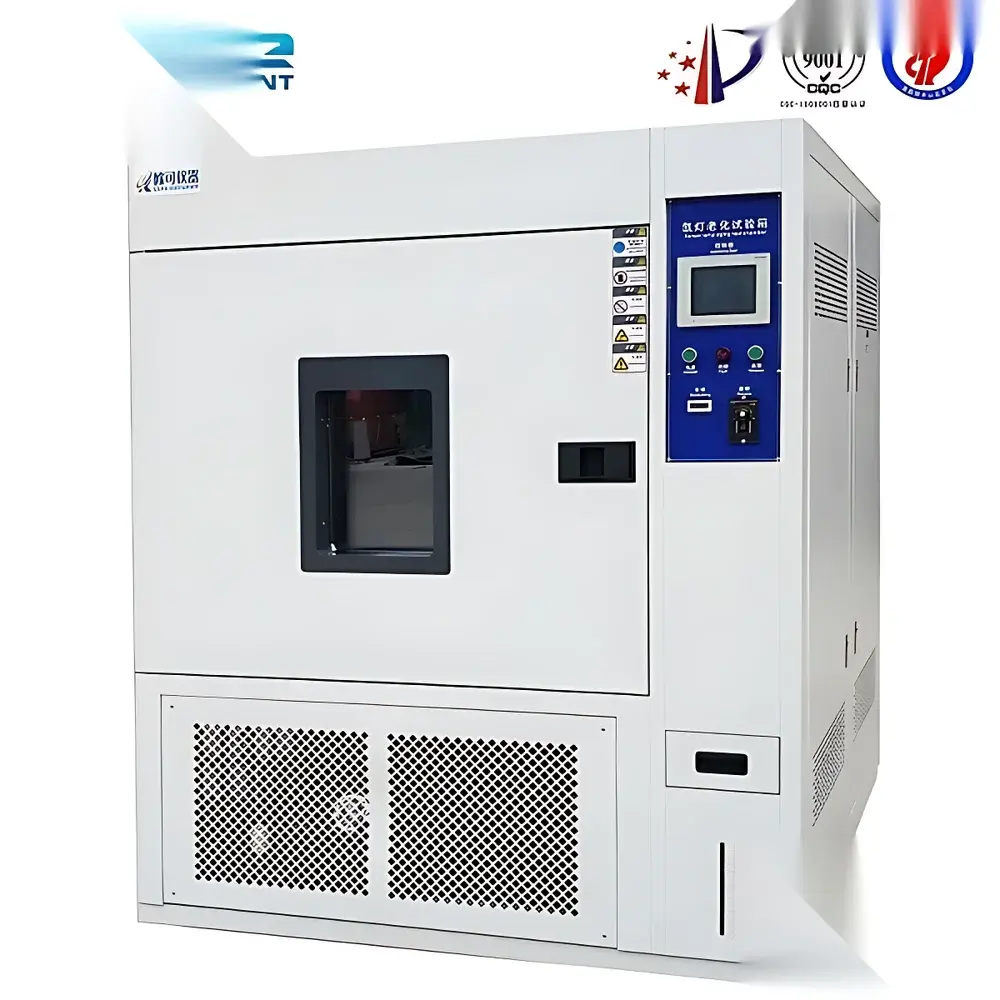
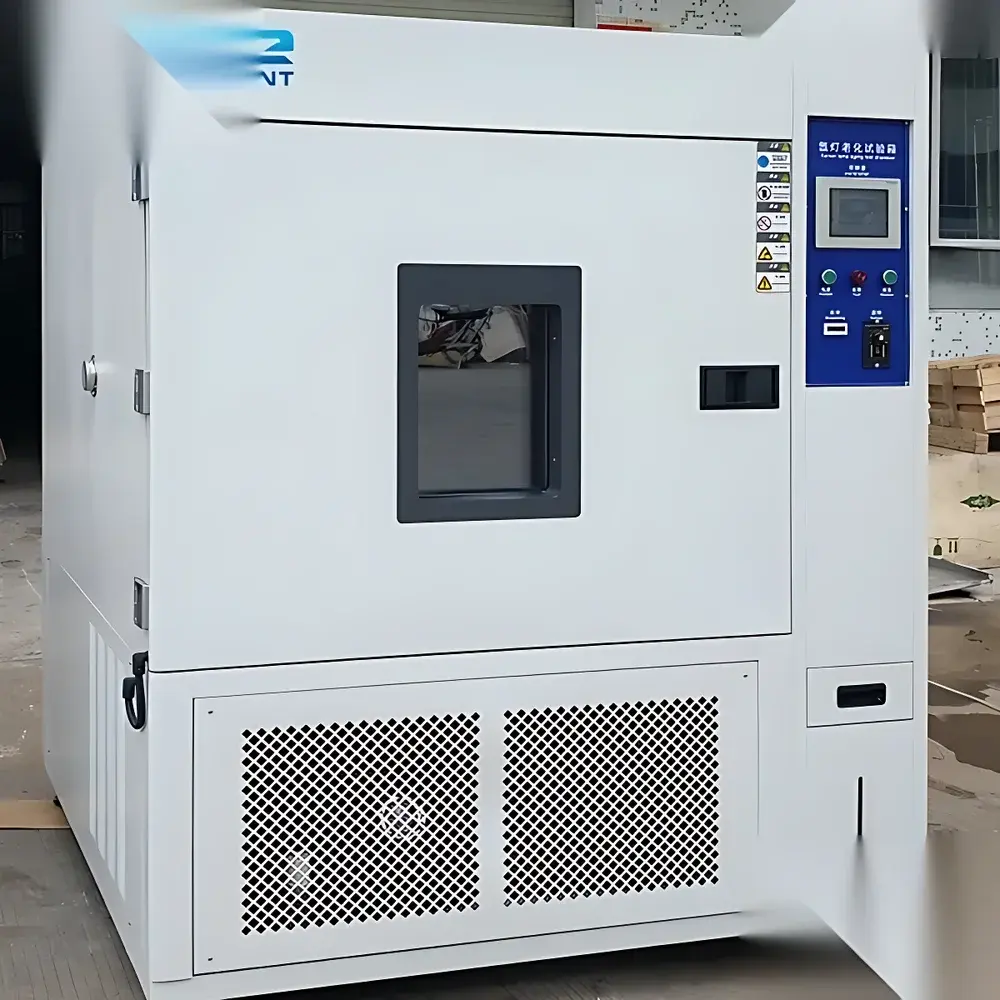
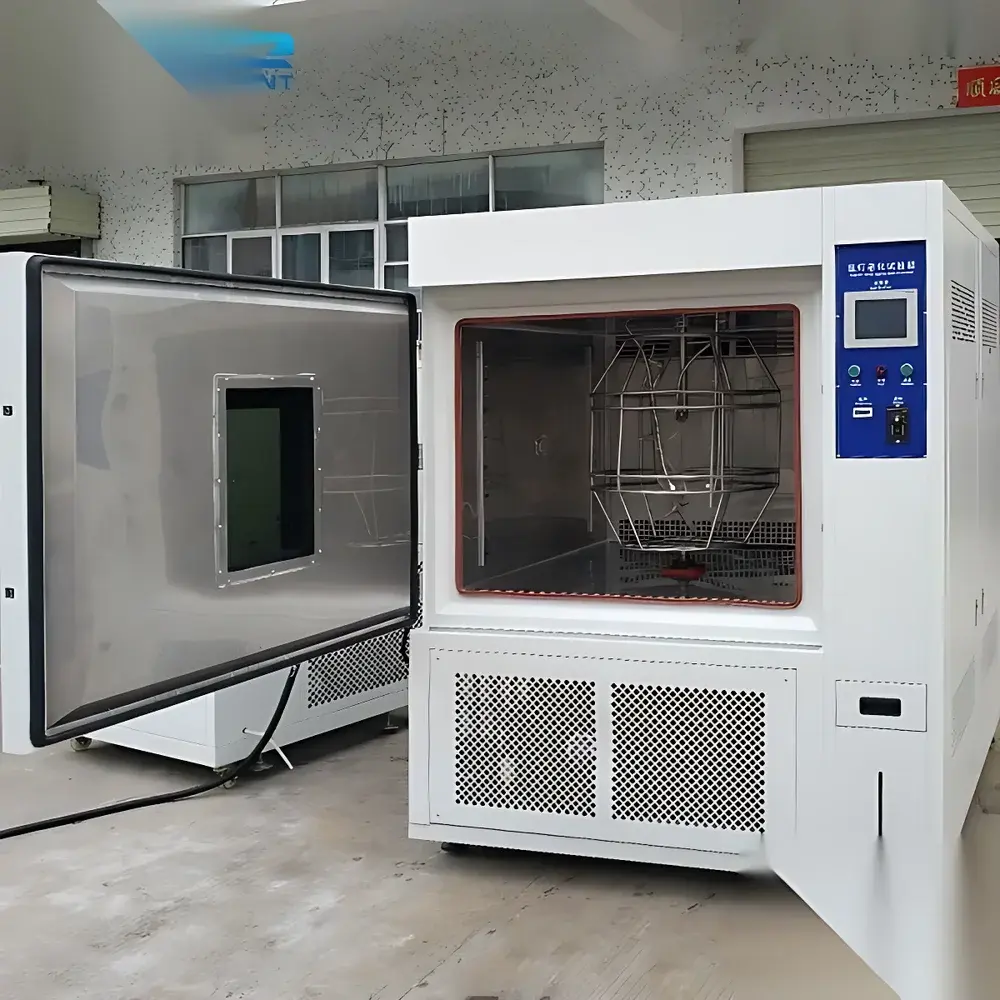
QUV Xenon Arc Weathering Test Chamber OK-XD Series
| Brand | OK Instruments |
|---|---|
| Origin | Imported |
| Manufacturer Type | Authorized Distributor |
| Price | USD 5,300–12,800 (FOB Shanghai |
| Internal Dimensions (L×W×H, cm) | 50×50×40 |
| Temperature Range | 0–150°C (chamber), 40–85°C (black panel) |
| Humidity Range | 20–75% RH (light cycle), 20–98% RH (dark cycle) |
| Control Accuracy | ±0.5°C / ±2.0% RH |
| Uniformity | ±2.0°C / ±3.0% RH |
| Irradiance | 550 W/m² ±10% (300–800 nm) or 1000 W/m² ±10% (300–1200 nm) |
| Xenon Lamp Power | 1.8 kW / 2.5 kW / 6 kW |
| Lamp Life | ≥1,500 h at standard irradiance setpoint |
| Spray Cycle | 1–999 min (programmable intermittent/continuous) |
| Spray Pressure | 70–127 kPa |
| Sample Mounting | Dual-layer flat mesh rack or 500 mm diameter rotating carousel (0–3 rpm) |
| Construction | Interior — SUS304 stainless steel |
| Power Supply | AC 380 V ±5%, 50 Hz ±0.5 Hz |
Overview
The QUV Xenon Arc Weathering Test Chamber OK-XD Series is an engineered environmental simulation system designed to replicate the full solar spectrum—including UV, visible, and near-infrared radiation—using long-arc, air-cooled xenon lamps. Unlike fluorescent UV-based testers, this chamber employs a broadband xenon arc source filtered through precision optical filters to closely match natural sunlight (CIE No. 85, ASTM G155, ISO 4892-2). It is calibrated to deliver controlled irradiance levels across standardized spectral bands (300–800 nm and 300–1200 nm), enabling accelerated assessment of photodegradation, color fading, gloss loss, chalking, cracking, and embrittlement in polymeric, textile, coating, and automotive materials. The chamber integrates simultaneous control of temperature (via black panel and chamber air sensors), relative humidity, and water spray cycles—mimicking real-world diurnal weathering conditions including solar exposure, thermal cycling, condensation, and rain erosion.
Key Features
- Full-spectrum xenon arc lamp system with spectral output traceable to NIST-traceable reference standards; optional Daylight, Window Glass, and Extended UV filters available per ISO 4892-2 Annex A.
- Independent black panel thermometer (BPT) and chamber air temperature control, compliant with ASTM D7869 and ISO 4892-2 requirements for specimen surface temperature monitoring.
- Programmable water spray subsystem with adjustable pressure (70–127 kPa) and duration (1–999 min), supporting both continuous and intermittent modes to simulate natural rainfall or dew formation.
- Rotating sample carousel (Ø500 mm, 0–3 rpm) and dual-layer flat mesh racks accommodate irregularly shaped specimens while ensuring uniform irradiance distribution and thermal exposure.
- High-stability microprocessor-based controller with real-time logging, alarm history, and password-protected parameter lockdown—designed for GLP/GMP environments requiring audit-ready operation records.
- Modular filter assembly with long-life quartz and borosilicate optical filters ensures consistent spectral output over lamp lifetime (≥1,500 h at nominal irradiance); lamp replacement requires no optical recalibration.
- Stainless steel (SUS304) construction throughout internal chamber and wetted components prevents corrosion and meets ISO 17025-compliant laboratory hygiene standards.
Sample Compatibility & Compliance
The OK-XD series accommodates diverse specimen geometries—from flat panels and molded automotive trim to woven fabrics and extruded profiles—via configurable mounting fixtures. Its chamber volumes (100 L to 1,000 L) support standard test specimens per ASTM D2244, ISO 105-B02, GB/T 8427, and GB/T 16422-2. All models are pre-configured to meet core regulatory frameworks: ASTM G155 Class A/B/C exposure protocols; ISO 4892-2 Cycle 1–4; JIS D 0205; and SAE J2527. Optional validation packages include IQ/OQ documentation, irradiance uniformity mapping (per ASTM E2652), and temperature/humidity profile certification per ISO/IEC 17025 Clause 5.9.
Software & Data Management
Equipped with OK-WeaControl™ v3.2 software (Windows-based), the system supports full remote monitoring, multi-user role management (operator, supervisor, administrator), and 21 CFR Part 11-compliant electronic signatures. All test parameters—including irradiance setpoints, temperature ramps, humidity profiles, and spray timing—are stored with timestamped metadata and immutable audit trails. Export formats include CSV, PDF test reports, and XML for LIMS integration. Optional cloud synchronization enables centralized fleet monitoring across global R&D labs, with encrypted data transmission and on-device backup retention for ≥12 months.
Applications
- Automotive OEMs and Tier-1 suppliers evaluating dashboard materials, exterior paints, headlamp lenses, and sealants under SAE J2527 and GMW14124.
- Textile laboratories conducting ISO 105-B02 and AATCC TM16 colorfastness-to-light testing on dyed fabrics, upholstery, and technical textiles.
- Coatings manufacturers validating UV resistance of architectural paints (ASTM D4587), marine coatings (ISO 12944), and powder coatings (GB/T 21776).
- Polymer compounders assessing long-term stability of PP, PE, PC, and TPU formulations exposed to tropical, desert, or coastal climates per IEC 61215 (PV modules) and UL 746C.
- Government metrology institutes performing interlaboratory comparison studies using certified reference materials (CRMs) traceable to NPL or PTB.
FAQ
What spectral filters are included as standard?
Standard configuration includes a daylight filter (quartz + borosilicate) meeting ISO 4892-2 “Cycle 1” spectral requirements. Window glass and extended UV filters are available as factory-installed options.
Is black panel temperature calibration traceable to national standards?
Yes—each unit ships with a NIST-traceable black panel thermometer certificate (calibrated at 63°C and 85°C), and field recalibration kits are available with documented uncertainty budgets.
Can the chamber be validated for GLP-compliant testing?
Yes—OK Instruments provides IQ/OQ protocols, temperature/humidity uniformity reports, irradiance mapping data, and 21 CFR Part 11 configuration files upon request.
What maintenance intervals are recommended for optimal performance?
Xenon lamps require replacement every 1,500 hours at rated irradiance; optical filters every 3,000 hours; and spray nozzles inspected quarterly. Preventive maintenance logs are auto-generated by the controller.
Does the system support custom test cycles beyond published standards?
Yes—the controller accepts user-defined multi-step programs with independent ramp rates, dwell times, and conditional triggers (e.g., “spray if chamber RH < 30%”).



