
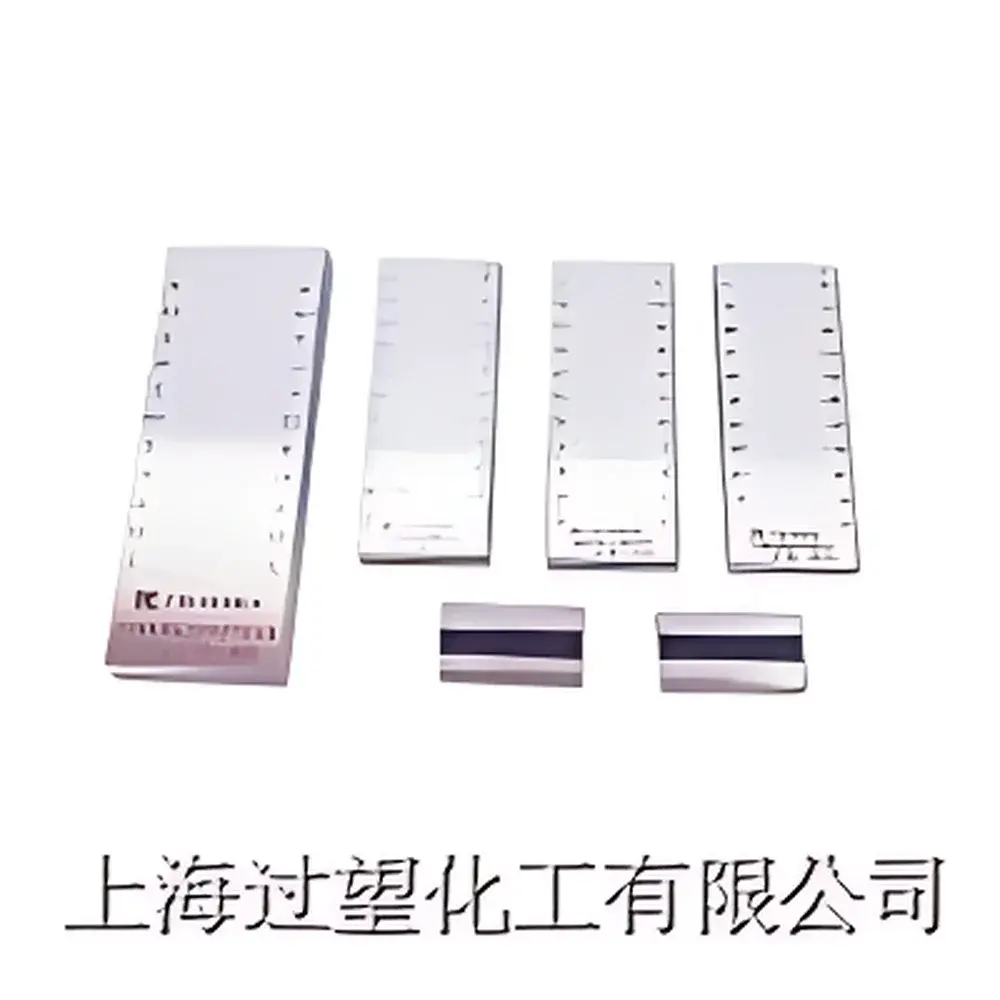
QXD Series ASTM D1210 Compliant Paint and Ink Hegman Grind Gauge
| Origin | Shanghai, China |
|---|---|
| Manufacturer Type | Authorized Distributor |
| Origin Category | Domestic (China) |
| Model | QXD-0 / QXD-1 / QXD-2 / QXD-3 / QXD-25 (Dual-Groove) |
| Measuring Range | 0–25 µm, 0–50 µm, 0–100 µm, 0–150 µm, or dual 0–25 µm |
| Graduation Interval | 2.5 µm, 5 µm, 10 µm, or 10 µm |
| Dimensions (Single Groove) | 170 × 50 × 12 mm (L × W × H) |
| Dimensions (Dual Groove QXD-25) | 175 × 65 × 13 mm (L × W × H) |
Overview
The QXD Series Hegman Grind Gauge is a precision-machined, hand-operated instrument engineered for rapid, repeatable assessment of particle dispersion fineness in liquid coatings, inks, pigmented pastes, and related suspensions. Based on the fundamental principle of controlled wedge-shaped gap measurement—where a sample is drawn across a calibrated, linearly decreasing groove—the device provides a direct visual readout of the largest particle or agglomerate present in the material. This method conforms to ASTM D1210 (“Standard Test Method for Fineness of Dispersion of Pigment–Vehicle Mixtures by Hegman-Type Gauge”), as well as ISO 1524 (“Paints and Varnishes — Determination of Fineness of Grind”) and GB/T 6753.1–2007 (Chinese national standard equivalent to ISO 1524). Unlike optical or laser-based particle analyzers, the Hegman gauge delivers an operational, real-time measure of *functional dispersion quality*—critical for predicting gloss, haze, stability, and film uniformity in final coating applications.
Key Features
- Precision-ground stainless steel or hardened tool steel body with laser-etched, permanent scale markings resistant to solvent exposure and mechanical wear
- Multiple standardized groove configurations: QXD-0 (0–25 µm, 2.5 µm increments), QXD-1 (0–50 µm, 5 µm), QXD-2 (0–100 µm, 10 µm), QXD-3 (0–150 µm, 10 µm), and QXD-25 dual-groove variant (two parallel 0–25 µm scales for comparative testing or redundancy)
- Consistent groove geometry validated per ASTM D1210 Annex A—ensuring reproducible draw-down angle (26° ± 0.5°), groove depth profile, and surface finish (Ra ≤ 0.4 µm)
- Ergonomic low-profile design facilitates stable, perpendicular draw-down using standard applicator bars or spatulas; no external power or calibration electronics required
- Compliant with GLP documentation requirements: each unit carries a unique identification mark and is supplied with a traceable Certificate of Conformance referencing ISO/IEC 17025-accredited verification procedures
Sample Compatibility & Compliance
The QXD gauge is routinely employed for QC/QA screening of architectural paints, automotive basecoats, industrial primers, flexographic and gravure inks, pigment concentrates, and epoxy resin slurries. It accommodates Newtonian and mildly pseudoplastic systems with viscosity up to ~500 mPa·s (measured at 25 °C, 10 s⁻¹ shear rate); highly thixotropic or gel-like materials may require pre-shearing prior to testing. All models meet the dimensional and metrological specifications defined in ASTM D1210, ISO 1524, and JJG 903–2018 (Chinese metrological verification regulation for grind gauges). Units are supplied with a NIST-traceable reference standard block (certified groove depths ±0.5 µm) for daily user verification.
Software & Data Management
As a purely mechanical, analog measurement device, the QXD Series requires no firmware, drivers, or software integration. However, its results are fully compatible with LIMS and ELN platforms via manual entry or barcode-assisted logging. For laboratories operating under FDA 21 CFR Part 11 or EU Annex 11 requirements, documented test records—including operator ID, environmental conditions (temperature/humidity), sample lot number, replicate readings, and pass/fail determination against internal specifications—must be retained for audit. Optional digital documentation kits include calibrated smartphone adapters with overlay grid templates for image-based archiving and cross-lab comparison.
Applications
- Final quality release testing of production batches prior to packaging or shipment
- In-process monitoring during milling, dispersing, or let-down stages in pigment manufacturing
- Supplier qualification and incoming raw material inspection (e.g., titanium dioxide, carbon black, or organic pigments)
- Troubleshooting haze, grittiness, or spray tip clogging in application trials
- Correlation studies with dynamic light scattering (DLS) or laser diffraction data to establish empirical thresholds for “grind acceptability”
- Training tool for new technicians to develop visual recognition of particle size distribution endpoints
FAQ
How often should the QXD gauge be verified?
Daily verification using the supplied certified reference block is recommended before first use and after any impact or cleaning event. Full recalibration by an ISO/IEC 17025-accredited lab is advised annually or per internal QA schedule.
Can the QXD gauge be used for water-based systems?
Yes—provided the substrate surface energy permits uniform wetting and the draw-down does not induce premature dewetting or edge bead formation. Use of a consistent draw speed (typically 1–2 seconds per stroke) is essential for inter-laboratory reproducibility.
What is the difference between QXD-2 and QXD-3?
QXD-2 covers 0–100 µm with 10 µm graduations and is suited for general-purpose industrial coatings; QXD-3 extends to 0–150 µm (also 10 µm increments) and is preferred for heavy-duty mastics, caulks, or filler pastes where coarser particles are acceptable.
Is cleaning solvent compatibility specified?
Stainless steel variants tolerate acetone, xylene, MEK, ethanol, and aqueous detergent solutions. Avoid prolonged exposure to strong acids, caustics, or chlorinated solvents that may degrade surface passivation.
Does the dual-groove QXD-25 support statistical analysis?
Yes—the two independent grooves enable immediate duplicate measurements without re-loading, supporting basic repeatability assessment (e.g., %RSD calculation) per ASTM E29 guidelines for significant figures and rounding in test data.



