
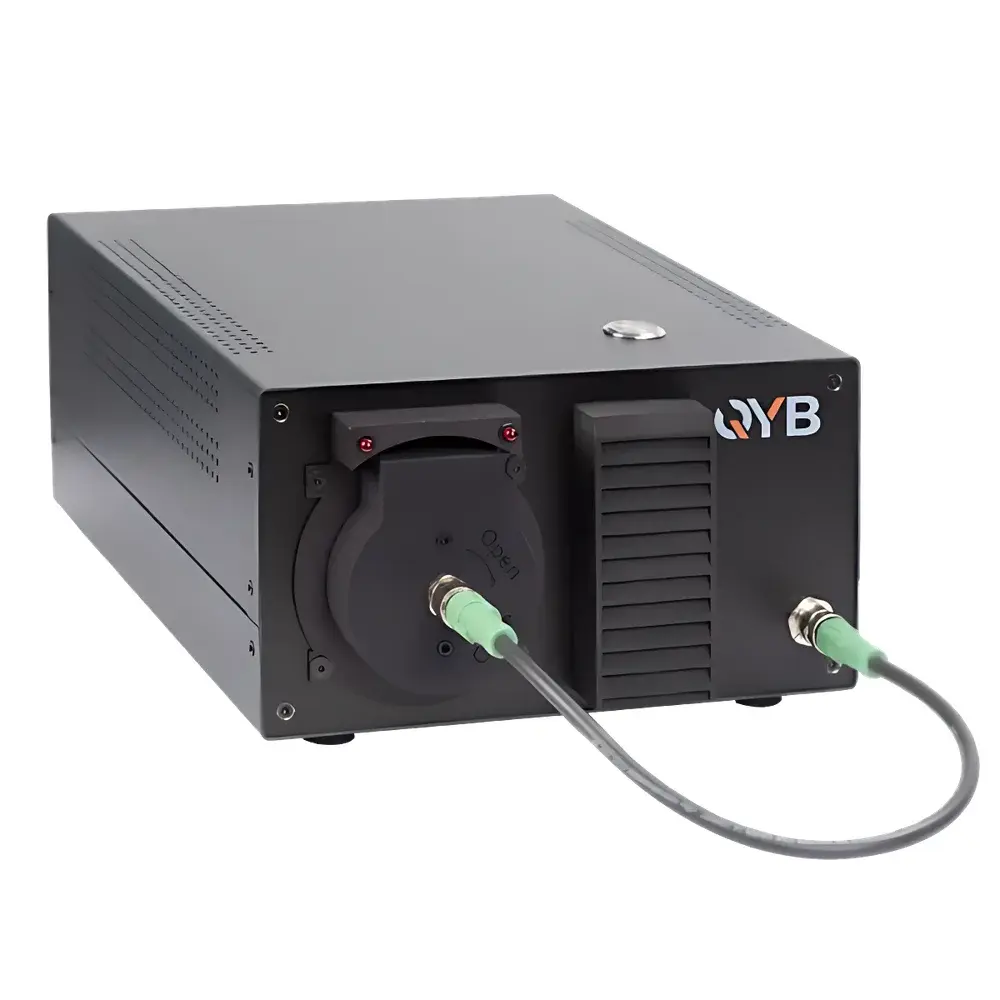
QYB LuQY Pro+ Quasi-Fermi Level Splitting (QFLS) Measurement System
| Brand | QYB / Quantum Yield Berlin |
|---|---|
| Origin | Germany |
| Manufacturer Type | Authorized Distributor |
| Origin Category | Imported |
| Model | LuQY Pro+ |
| Price Range | USD 200,000 – 500,000 |
| Measurement Mode | DC |
| Excitation Wavelength | 532 nm |
| Maximum Laser Power | 140 mW |
| Tunable Photon Flux (Equivalent Current) | 4 µA – 40 mA |
| Excitation Spot Size Options | 0.1 cm² / 1 cm² |
| Spectral Range | 550 – 1050 nm |
| Minimum Detectable EL/PL Quantum Yield | 1×10⁻⁶ |
| Integration Time | 1 ms – 35 min |
| Spectral Sampling Interval | 1 nm |
| Signal-to-Noise Ratio | 600:1 |
| Voltage Source & Measurement Range | ±10 V, ±150 mA |
| Voltage Source Accuracy | 10 mV |
| Voltage Sensing Accuracy | 50 µV |
| Current Sensing Accuracy | 100 nA / 1 µA / 10 µA |
| Sample Holder | Customizable (Max Subcell Dimensions: 30 mm × 30 mm × 10 mm) |
| Max Simultaneous Subcells | 6 |
| Dimensions | 220 mm × 390 mm × 120 mm |
| Weight | 6.1 kg |
Overview
The QYB LuQY Pro+ Quasi-Fermi Level Splitting (QFLS) Measurement System is a turnkey, glovebox-compatible instrumentation platform engineered for quantitative photophysical characterization of optoelectronic semiconductor devices—particularly perovskite, silicon, organic, and tandem solar cells, as well as LEDs and luminescent materials. It operates on the fundamental principle of measuring absolute electroluminescence (EL) and photoluminescence (PL) spectra under precisely controlled electrical bias or optical excitation, enabling direct calculation of thermodynamic voltage limits via quasi-Fermi level splitting. The system implements two physically grounded computational pathways—direct and refined QFLS estimation—each calibrated against certified reference standards traceable to NIST and Fraunhofer ISE CalLab PV Cells. Its design originates from the HZB Berlin spin-off QYB GmbH, whose core team co-authored the landmark 29.15% perovskite/silicon tandem cell record published in Science (DOI: 10.1126/science.abd4016), establishing foundational metrology for high-efficiency photovoltaic R&D.
Key Features
- Integrated dual-mode operation: simultaneous DC-biased EL and laser-driven PL spectroscopy with absolute photon flux calibration
- Two-tier QFLS computation framework—automatically selecting optimal method based on emission linewidth, Stokes shift, and user-provided absorption data
- Glovebox-compatible compact footprint (220 × 390 × 120 mm) with modular sample stage supporting up to six subcells (max 30 × 30 × 10 mm)
- High-sensitivity spectral detection (SNR 600:1) across 550–1050 nm with 1 nm sampling resolution and integration times from 1 ms to 35 minutes
- Traceable absolute quantum yield measurement: ELQY and PLQY down to 1×10⁻⁶, calibrated using NIST-traceable broadband lamps and ISE-certified reference cells
- Programmable excitation control: continuous laser intensity tuning from 0.001 to 10 “suns” (equivalent to 4 µA–40 mA photocurrent), with selectable spot sizes (0.1 cm² or 1 cm²)
- Built-in SMU with ±10 V / ±150 mA sourcing and sub-µV/100 nA sensing resolution for precise J–V acquisition and pseudo-JV reconstruction
Sample Compatibility & Compliance
The LuQY Pro+ accommodates standard device architectures including n-i-p, p-i-n, and inverted perovskite solar cells, thin-film photodetectors, OLED test structures, and epitaxial III–V LED chips. Its non-destructive, contact-based measurement protocol complies with ASTM E1036 (electrical performance of photovoltaic devices) and ISO 18570 (quantum efficiency measurements). All spectral calibrations are performed against primary standards accredited by national metrology institutes; software audit trails meet GLP/GMP requirements for traceability. While not FDA 21 CFR Part 11–certified out-of-the-box, the system supports electronic signature configuration and full data integrity logging for regulated environments upon customer-defined validation protocols.
Software & Data Management
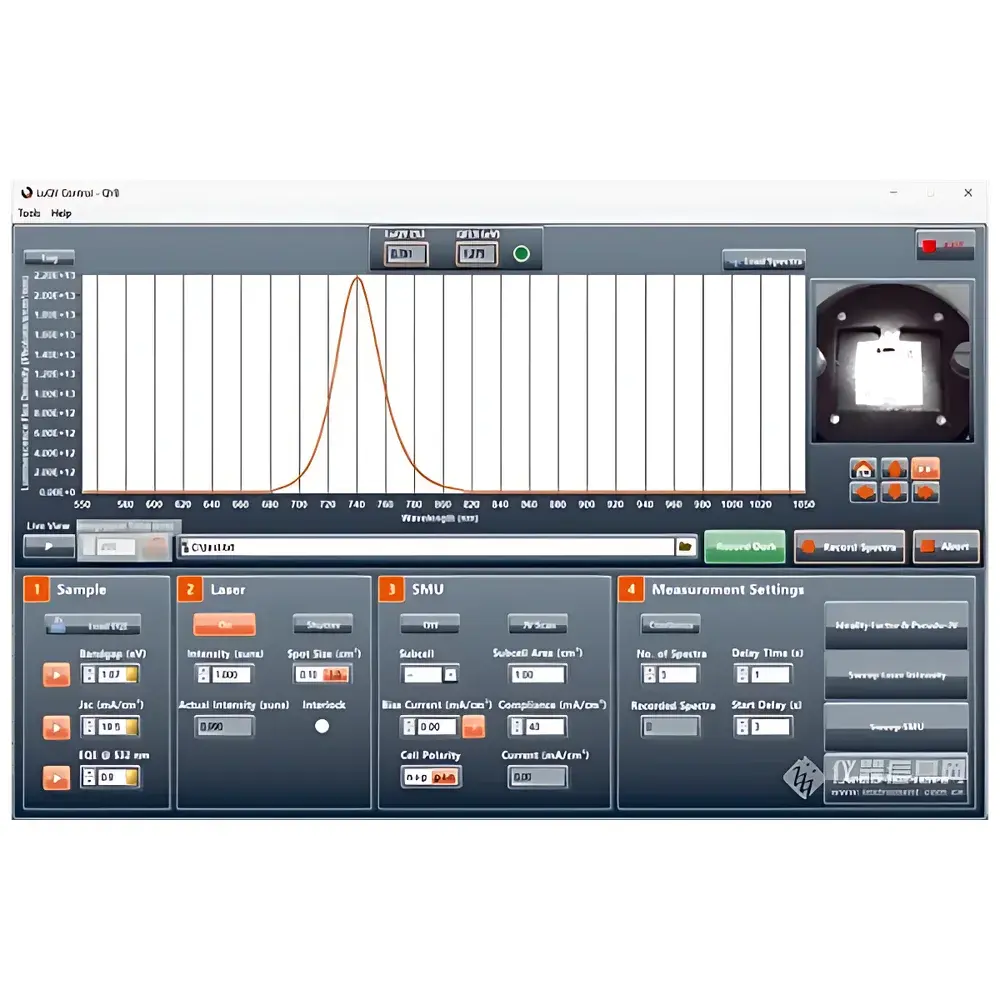
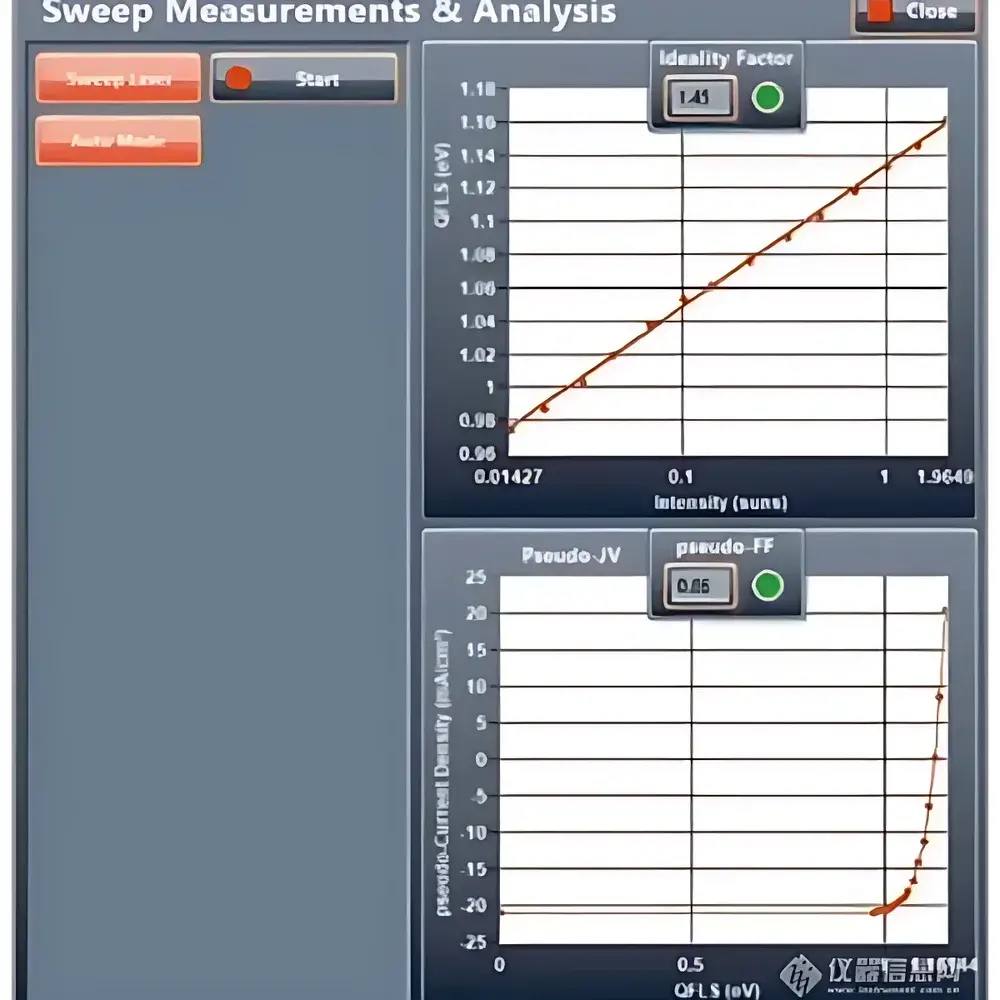
The LuQY Control Suite provides a unified graphical interface for real-time spectral visualization, parameter sweep automation (bias voltage, laser intensity, integration time), and multi-dimensional data export (CSV, HDF5, .mat). The upper display pane renders live EL/PL spectra alongside dynamically updated LuQY (ELQY/PLQY) and QFLS values; the lower pane manages sample metadata, excitation configuration, and calibration status. Crucially, the software embeds two distinct QFLS algorithms: (1) a direct method requiring no prior absorption input—suitable for rapid screening but limited to narrow-gap emitters with minimal Stokes shift; and (2) a refined method that ingests user-supplied EQE or absorption spectra to compute optical bandgap, Jsc at STC, and wavelength-resolved photon collection efficiency—enabling physically consistent excitation scaling (e.g., exact 1-sun equivalent) and uncertainty-reduced QFLS prediction. All raw spectra and derived metrics are timestamped and stored with full instrument configuration metadata.
Applications
This system serves as a critical metrology tool in academic and industrial photovoltaic laboratories pursuing Shockley–Queisser limit analysis, non-radiative voltage loss quantification (ΔVOC,nr), and radiative efficiency benchmarking. It enables direct correlation between ELQY and open-circuit voltage deficit in emerging perovskite tandems, validates interfacial passivation strategies via QFLS response to defect density, and supports LED efficiency optimization through absolute PLQY mapping under variable injection conditions. Published studies using LuQY Pro+ span high-impact journals including Nature, Science, Joule, and Energy & Environmental Science, covering topics such as bromine-substituted self-assembled monolayers (DOI: 10.1039/d4ee04029e), antimony-doped tin oxide charge transport layers (DOI: 10.1038/s41560-023-01442-1), and fully laminated perovskite/CIGS tandems (DOI: 10.1002/adma.202505571).
FAQ
What physical quantity does QFLS directly represent?
QFLS (Quasi-Fermi Level Splitting) quantifies the energy difference between electron and hole quasi-Fermi levels under non-equilibrium conditions—it is the fundamental thermodynamic upper bound for open-circuit voltage (VOC) in a given device.
How does LuQY Pro+ distinguish between radiative and non-radiative recombination losses?
By combining absolute ELQY with measured VOC, the system computes the radiative voltage limit (q·QFLS) and thus isolates ΔVOC,nr = q·QFLS − q·VOC.
Is absorption data mandatory for accurate QFLS calculation?
No—direct QFLS estimation is possible without absorption input, but refined calculation using EQE or absorption spectra improves accuracy by >15 mV in low-bandgap systems with significant Urbach tails.
Can the system operate inside nitrogen-filled gloveboxes?
Yes—the entire unit is sealed, fanless, and designed for inert-atmosphere integration with standard glovebox feedthroughs for electrical and optical interfaces.
What calibration standards are used for spectral responsivity?
NIST-traceable tungsten-halogen lamps for absolute photon flux calibration; Fraunhofer ISE CalLab PV Cells for laser power equivalence to AM1.5G irradiance.





