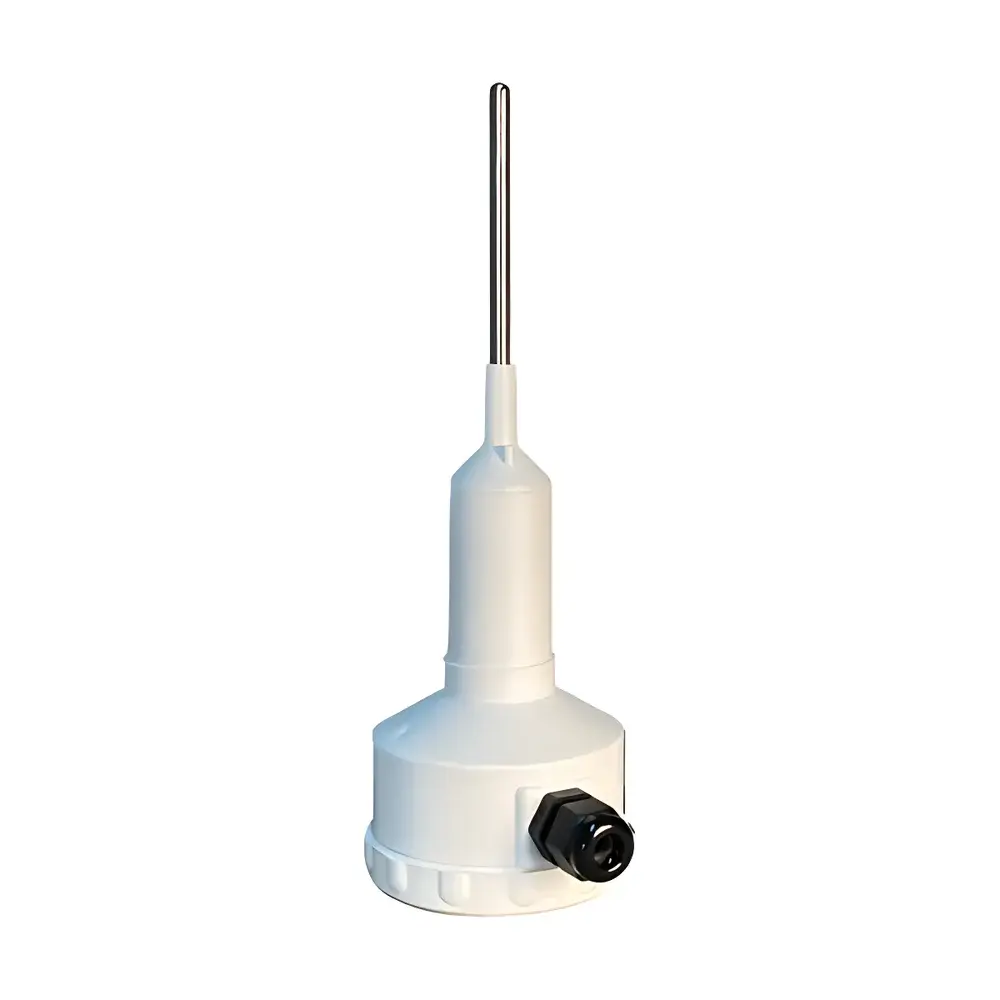
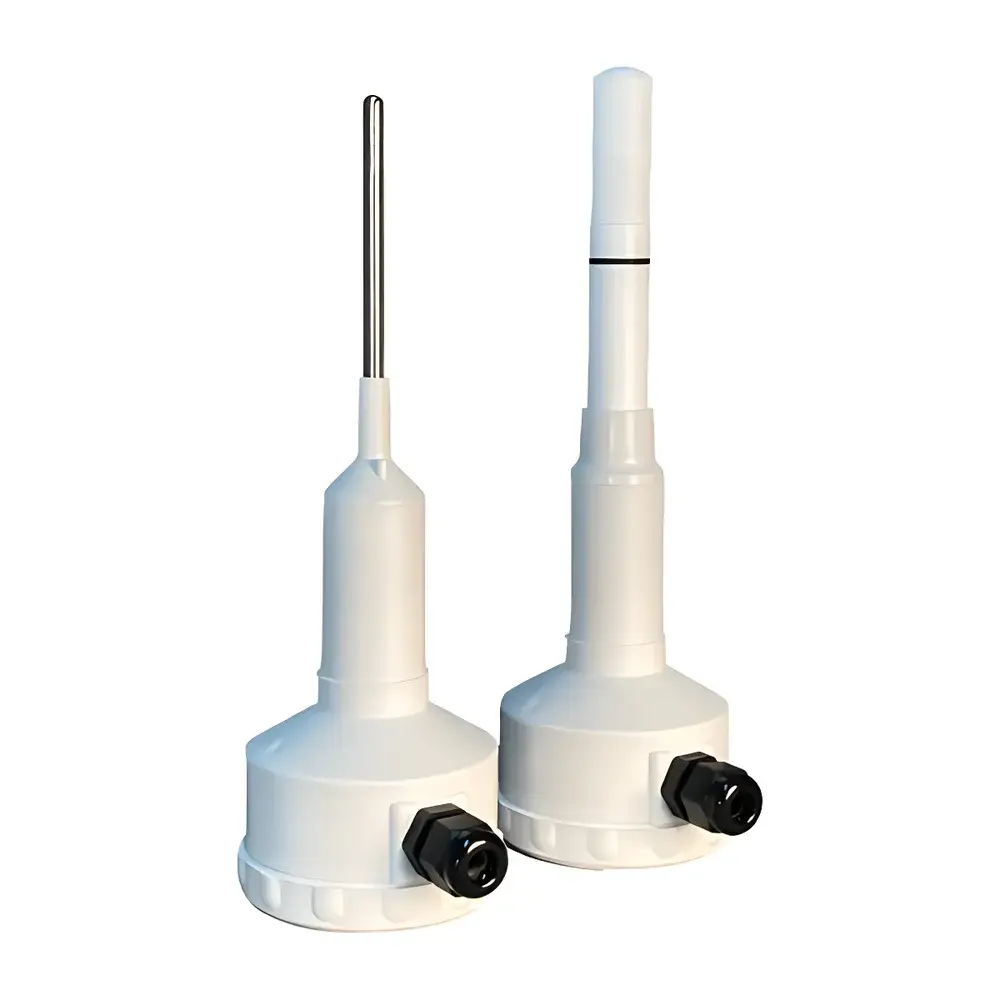
R.M. Young 41342LC Platinum RTD Temperature Sensor with 4–20 mA Current Output
| Brand | R.M. Young |
|---|---|
| Origin | USA |
| Model | 41342LC |
| Output Signal | 4–20 mA |
| Measurement Range | −50 to +50 °C |
| Accuracy (at 0 °C) | ±0.3 °C (±0.1 °C optional) |
| Time Constant | 42 s (with Model 43408 radiation shield) |
| Sensor Type | 1000 Ω Pt RTD (IEC 60751 Class B, standard |
| Enclosure | Weatherproof junction box |
| Calibration | Configurable for °C or °F output scaling |
| Recommended Radiation Shield | Model 43502 (aspirated) or Model 41003P (multi-plate passive) |
| Cable Recommendation | 2-pair shielded, 22 AWG (e.g., Part #18641) |
Overview
The R.M. Young 41342LC is a high-stability, industrial-grade platinum resistance temperature detector (RTD) sensor engineered for long-term environmental monitoring in meteorological, hydrological, and outdoor research applications. Built around a precision 1000 Ω Pt1000 element conforming to IEC 60751 standards (Class B as standard, Class A available on request), the 41342LC delivers traceable, linear temperature measurement across a robust operating range of −50 to +50 °C. Unlike thermistor- or thermocouple-based alternatives, this sensor leverages the inherent stability and repeatability of platinum RTD technology—offering superior long-term drift performance (<0.05 °C/year typical) and minimal hysteresis. Its integrated 4–20 mA current loop output provides inherent noise immunity and simplified integration into SCADA systems, PLCs, data loggers, and telemetry platforms compliant with industrial 2-wire or 4-wire analog input architectures. The sensor is factory-calibrated and shipped with NIST-traceable calibration documentation, ensuring metrological integrity from installation through routine maintenance cycles.
Key Features
- True 4-wire RTD sensing architecture—eliminates lead-wire resistance errors and ensures measurement fidelity independent of cable length (up to 1,000 m with appropriate shielding)
- 4–20 mA active current output with HART® compatibility support (optional firmware configuration), enabling remote diagnostics, range verification, and live zero/span adjustment
- Weatherproof ABS/polycarbonate junction box rated IP66, designed for permanent outdoor mounting without additional enclosures
- Optimized thermal mass and aerodynamic probe geometry—validated time constant of 42 seconds when deployed with the R.M. Young Model 43408 ventilated radiation shield, meeting WMO Guide to Instruments and Methods of Observation (CIMO) requirements for ambient air temperature
- Factory-configurable output scaling: user-selectable linear mapping to either °C or °F, with programmable offset and span via external calibrator or HART communicator
- Low-power design (≤12 mA at 20 mA output) compatible with solar-powered or battery-operated remote stations
Sample Compatibility & Compliance
The 41342LC is intended exclusively for ambient air temperature measurement in open-air environments. It is not suitable for immersion, surface contact, or process-line applications. For optimal performance, it must be installed within a certified radiation shield—preferably the aspirated Model 43502 (meeting WMO Class I specifications) or the multi-plate passive Model 41003P (WMO Class II). Mounting directly to YOUNG’s natural-ventilation multi-plate shields (e.g., Model 41302 series) is mechanically compatible but may reduce radiative error correction efficacy. The sensor complies with ASTM E745-21 (Standard Practice for Selecting Apparatus for Measuring Solar and Atmospheric Radiant Energy), ISO 9060:2018 (Classification of pyranometers), and supports GLP/GMP-aligned validation protocols when paired with documented calibration procedures. Its analog output meets IEC 61000-6-2 (immunity) and IEC 61000-6-4 (emissions) for industrial environments.
Software & Data Management
While the 41342LC operates as a standalone analog transducer, its 4–20 mA output integrates natively with industry-standard data acquisition ecosystems—including Campbell Scientific CR-series loggers, Onset HOBO UX120, Delta-T DL2e, and Siemens Desigo CC platforms. When used with HART-enabled controllers, full device configuration, diagnostics (e.g., sensor health, loop integrity, temperature saturation status), and firmware updates can be performed remotely without physical access. Raw output requires linearization per the ITS-90 polynomial coefficients embedded in the sensor’s calibration certificate. R.M. Young provides Excel-based conversion tools and Python-compatible coefficient tables upon request. All calibration records—including as-shipped reference points at −30 °C, 0 °C, and +40 °C—are archived and available for FDA 21 CFR Part 11-compliant audit trails when managed via validated LIMS or ELN systems.
Applications
- Climate monitoring networks (NOAA, EC, DWD, JMA-affiliated stations)
- Agricultural microclimate stations (irrigation scheduling, frost warning, phenology modeling)
- Environmental impact assessments (baseline air temperature logging for EIA reporting)
- Renewable energy site characterization (solar farm ambient derating, wind turbine nacelle intake profiling)
- Long-term ecological research (LTER sites requiring >10-year sensor stability)
- Calibration transfer standards for field-deployed reference sensors under ISO/IEC 17025-accredited labs
FAQ
What is the recommended minimum cable length between the 41342LC and data logger?
No minimum length is specified; however, signal integrity is maintained with ≥1 m of twisted, shielded 22 AWG cable. Shorter runs may increase susceptibility to common-mode noise in electrically noisy environments.
Can the 41342LC be recalibrated in-field?
No—recalibration requires controlled bath immersion and NIST-traceable reference standards. Field verification using a portable dry-block calibrator is permissible for functional checks, but full recalibration must be performed by an accredited lab or R.M. Young Service Center.
Is the 41342LC compatible with Modbus RTU or SDI-12 interfaces?
Not natively. It outputs only analog 4–20 mA. Integration with digital protocols requires an external analog-to-Modbus converter or SDI-12 transmitter module (e.g., Onset U30-NRC or Campbell Scientific AM16/32B).
Does the sensor include lightning protection?
The junction box does not incorporate transient voltage suppression. R.M. Young recommends installing a DIN-rail-mounted 4–20 mA signal isolator with surge protection (e.g., Phoenix Contact MINI MCR-SL-I-I-UP) upstream of the data logger in high-lightning-exposure regions.