
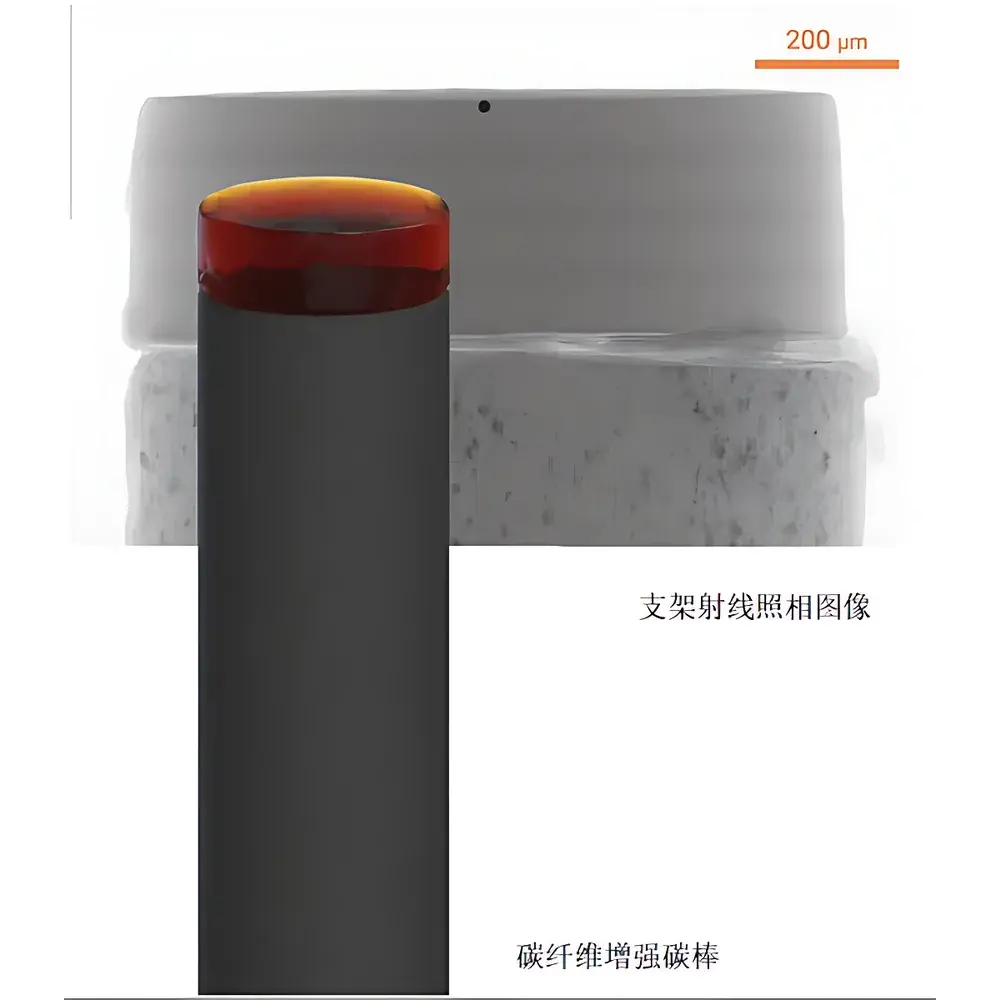
R1-Shadow Micro-CT & Nano-CT Sample Holder with Precision Rotation Axis Calibration Markers
| Brand | CactuX |
|---|---|
| Origin | Czech Republic |
| Model | R1-Shadow |
| Component Category | Optical Instrument Component |
| Compatible With | Laboratory Micro-CT, Nano-CT, Dual-Energy CT, 4D Dynamic CT Systems |
| Calibration Reference Sizes | 25 µm, 25 µm, 50 µm, 100 µm |
| Max. Pixel Size Support | 2.5 µm, 2.5 µm, 5.0 µm, 10.0 µm |
| Holder Radius (r) | 1.5 mm, 3.0 mm, 5.0 mm, 10.0 mm |
| Holder Length | 50.5 mm |
| Construction Materials | Carbon Fiber, Polyimide Tape, Stainless Steel |
| Packaging Options | 3-piece, 5-piece, or 10-piece kits |
| Software Integration | ImageJ Plugin + Native Compatibility with Common CT Acquisition Suites (e.g., Bruker CTvox, Thermo Scientific Avizo, Nikon XT, Zeiss Scout) |
Overview
The R1-Shadow is a purpose-engineered sample holder designed for high-fidelity micro-computed tomography (micro-CT) and nano-CT imaging systems requiring sub-pixel rotational axis alignment and geometric calibration. Unlike generic sample mounts, the R1-Shadow integrates precisely fabricated fiducial markers—etched directly onto its carbon fiber and stainless steel structural frame—at four standardized reference scales (25 µm, 50 µm, and 100 µm). These markers serve as intrinsic spatial references during both acquisition and post-reconstruction workflows, enabling quantitative assessment and correction of rotational stage wobble, tilt, and eccentricity errors inherent in high-resolution CT setups. Its mechanical architecture is optimized to minimize thermal drift and mechanical hysteresis, supporting stable positioning under prolonged scan protocols typical in time-resolved (4D) CT and dual-energy spectral imaging applications. The device operates independently of detector resolution or source geometry but is explicitly dimensioned to maintain marker visibility and edge contrast across pixel sizes ranging from 2.5 µm to 10.0 µm—making it suitable for both laboratory-scale micro-CT systems and synchrotron-based nano-CT beamlines.
Key Features
- Four discrete size variants (I–IV), each calibrated to a defined reference marker pitch (25–100 µm), ensuring traceable scaling across varying magnification and detector binning configurations.
- Sub-pixel registration accuracy: Achieves data matching precision <1 pixel when used with standard CT reconstruction pipelines and iterative center-of-rotation (COR) correction algorithms.
- Low-X-ray-absorption construction: Combines carbon fiber core, polyimide tape reinforcement, and minimal stainless steel fasteners to reduce beam hardening artifacts and scatter contribution.
- Modular packaging options (3-, 5-, or 10-piece kits) support routine calibration cycles, cross-system validation, and long-term metrological traceability in regulated environments.
- Direct integration with open-source and commercial software ecosystems via a dedicated ImageJ/Fiji plugin, enabling automated marker detection, COR calculation, and projection-domain correction matrix generation.
Sample Compatibility & Compliance
The R1-Shadow is compatible with standard rotation stages used in benchtop micro-CT systems (e.g., Bruker SkyScan, Thermo Fisher HeliScan, Nikon Metrology XT) and custom nano-CT platforms utilizing high-magnification objective optics or Fresnel zone plates. Its 50.5 mm length and radial dimensions (1.5–10.0 mm) accommodate variable field-of-view (FOV) constraints while maintaining mechanical rigidity under centrifugal loads up to 50 rpm. All materials comply with ISO 10110-7 (optical component cleanliness) and ASTM E2987 (standard guide for micro-CT system performance verification). While not a medical device, its design supports GLP-aligned calibration documentation practices and meets baseline requirements for ISO/IEC 17025-accredited laboratories performing dimensional metrology using X-ray CT.
Software & Data Management
The R1-Shadow’s calibration workflow is agnostic to proprietary acquisition software. It interfaces natively with Bruker CTvox, Thermo Scientific Avizo, Zeiss Scout, and Nikon XT through user-defined projection metadata injection or post-acquisition sinogram alignment. The companion ImageJ plugin (freely distributed under BSD-3 license) implements sub-pixel centroid localization of fiducial markers using Gaussian-weighted moment analysis, followed by least-squares estimation of rotation axis deviation parameters (Δx, Δy, Δθ). Output includes corrected projection stacks, JSON-formatted calibration reports, and optional DICOM-SR structured reporting for audit trails. All processing steps are scriptable and reproducible—supporting 21 CFR Part 11 compliance when deployed within validated IT infrastructure.
Applications
- Center-of-rotation (COR) calibration for cone-beam and parallel-beam CT geometries.
- Validation and correction of gantry tilt, stage wobble, and radial runout in multi-axis CT systems.
- Reference-based quantification of spatial resolution degradation due to mechanical instability.
- Time-resolved (4D) CT motion artifact mitigation via per-frame axis recalibration.
- Dual-energy CT spectral unmixing fidelity enhancement through improved projection-space co-registration.
- Inter-laboratory CT system comparison studies requiring metrologically traceable phantoms.
FAQ
Does the R1-Shadow require proprietary hardware or drivers?
No—it functions as a passive calibration standard and requires no electronics, power, or firmware updates.
Can it be used with synchrotron-based nano-CT systems?
Yes; its low-Z material composition and micron-scale fiducials are optimized for high-brilliance, high-coherence X-ray sources.
Is the ImageJ plugin compatible with batch processing?
Yes; macro scripting and headless execution modes are supported for automated calibration across large datasets.
How often should recalibration be performed?
Recommended prior to each high-precision measurement campaign or after any mechanical intervention affecting the rotation stage or detector alignment.
Are calibration certificates provided?
Traceable dimensional certification (NIST-traceable interferometric verification of marker pitch) is available upon request for individual units or kit batches.





