
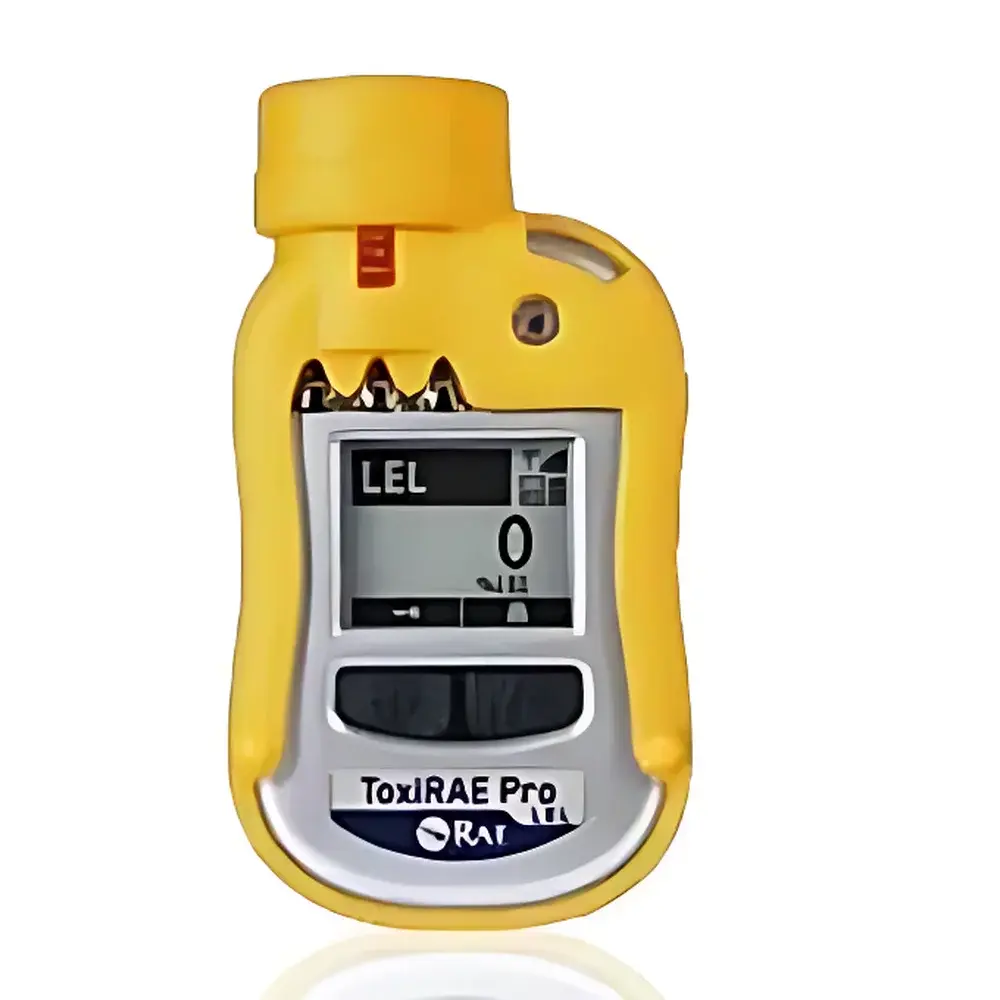
RAE Systems ToxiRAE Pro LEL Personal Combustible Gas Detector
| Brand | RAE Systems Inc. |
|---|---|
| Origin | USA |
| Manufacturer Type | Authorized Distributor |
| Origin Category | Imported |
| Model | PGM-1820 |
| Pricing | Upon Request |
Overview
The RAE Systems ToxiRAE Pro LEL is a compact, intrinsically safe personal combustible gas detector engineered for continuous real-time monitoring of lower explosive limit (LEL) concentrations of hydrocarbon and other flammable gases in industrial environments. Utilizing a catalytic bead (pellistor) sensor principle, the device measures gas concentration via thermal conductivity changes induced by catalytic oxidation on a heated filament—providing stable, field-proven response to methane, propane, hydrogen, gasoline vapors, and common refinery/chemical process gases. Designed for frontline personnel operating in confined spaces, offshore platforms, refineries, LNG terminals, and utility infrastructure, the PGM-1820 delivers reliable single-gas LEL detection with intrinsic safety compliance for Class I, Division 1 hazardous locations.
Key Features
- Intrinsically safe design certified to ATEX II 1G Ex ia IIC T4 Ga, UL 913 Class I, Division 1, Groups A–D, CSA C/US Class I, Division 1, Groups A–D, and IECEx Ex ia IIC T4 Ga — ensuring operational integrity in explosive atmospheres.
- Large backlit graphical LCD with intuitive icon-driven interface and multilingual menu support (including English and Chinese), enabling rapid status recognition and simplified operation under PPE constraints.
- Integrated wireless telemetry via built-in 900 MHz or 2.4 GHz RF module (depending on regional configuration), supporting real-time data streaming to central safety management systems such as AreaRAE Pro or Radius BZ1 base stations — enabling remote alarm verification, location tracking, and duty-cycle oversight.
- Rechargeable lithium-ion battery providing up to 12 hours of continuous operation under typical sampling conditions; hot-swappable battery option available for extended shift coverage without instrument downtime.
- Onboard memory stores up to 3 months of time-stamped LEL readings (sample interval configurable from 1 to 60 seconds), supporting post-incident review, exposure trending, and regulatory recordkeeping.
- Modular architecture allows field replacement of sensor cartridges and batteries without calibration recalibration — reducing lifecycle maintenance time and total cost of ownership.
- Rugged stainless-steel enclosure rated IP67 for dust-tight and immersion-resistant performance (1 m for 30 min); tested to MIL-STD-810G for shock, vibration, and thermal cycling resilience.
- Advanced auto-compensation algorithms dynamically correct for ambient temperature drift and zero-point baseline shifts, maintaining measurement stability across -20 °C to +50 °C operating range.
Sample Compatibility & Compliance
The ToxiRAE Pro LEL is optimized for detection of combustible gases with LEL thresholds between 1.0% (e.g., hydrogen) and 5.0% (e.g., methane) by volume in air. It exhibits cross-sensitivity profiles consistent with ISO 28011:2010 and EN 60079-29-1:2016 standards for catalytic bead sensors. Device firmware and calibration protocols comply with OSHA 1910.120, NFPA 70E, and HSE INDG389 guidance for portable gas detection. All units ship with NIST-traceable calibration certificate and are compatible with standard 4–20 mA or 0–5 V analog output interfaces for integration into DCS or SCADA systems where required.
Software & Data Management
Data retrieval and configuration are managed through RAE Systems’ proprietary ProRAE Studio II software (Windows-based), which supports batch download, spectral trend analysis, alarm log export (CSV/PDF), and automated report generation per GLP/GMP documentation requirements. Audit trails include user login timestamps, calibration events, bump test records, and firmware update history — fully compliant with FDA 21 CFR Part 11 electronic record and signature provisions when deployed in regulated pharmaceutical or biotech facilities. Firmware updates are delivered via secure HTTPS channel with SHA-256 signature verification.
Applications
- Petrochemical and refining: perimeter monitoring during turnaround activities, flare stack entry, and tank farm patrols.
- Natural gas distribution: pipeline integrity verification, metering station surveys, and odorant injection point checks.
- Chemical manufacturing: solvent handling areas, reactor vent monitoring, and loading rack operations.
- Municipal utilities: sewer entry, water treatment plant digester zones, and underground vault inspections.
- Fire service and emergency response: initial hazard assessment in structure fires, vehicle accident scenes, and hazmat incidents.
FAQ
What calibration gases are recommended for routine bump testing?
A certified 50% LEL methane or propane standard in air (e.g., 2.5% CH₄ or 1.0% C₃H₈) is recommended per manufacturer guidelines and OSHA 1910.120 Appendix B.
Does the PGM-1820 support multi-gas configurations?
No — the ToxiRAE Pro LEL is a dedicated single-channel LEL detector; for multi-gas capability, consider the MultiRAE Lite or QRAE 3 platforms.
Can historical data be exported in CSV format for third-party analytics tools?
Yes — ProRAE Studio II enables direct export of time-series LEL readings, alarm logs, and calibration history in industry-standard CSV and XML formats.
Is the device suitable for use in oxygen-deficient environments?
The PGM-1820 does not measure oxygen; it must be used in conjunction with a separate O₂ sensor (e.g., ToxiRAE Pro O₂) when assessing confined space entry compliance per OSHA 1910.146.
What is the recommended calibration interval under normal industrial use?
Daily bump testing is required prior to each shift; full calibration is recommended every 30 days or after exposure to sensor poisons (e.g., silicones, sulfides, lead compounds).
Related Products







