
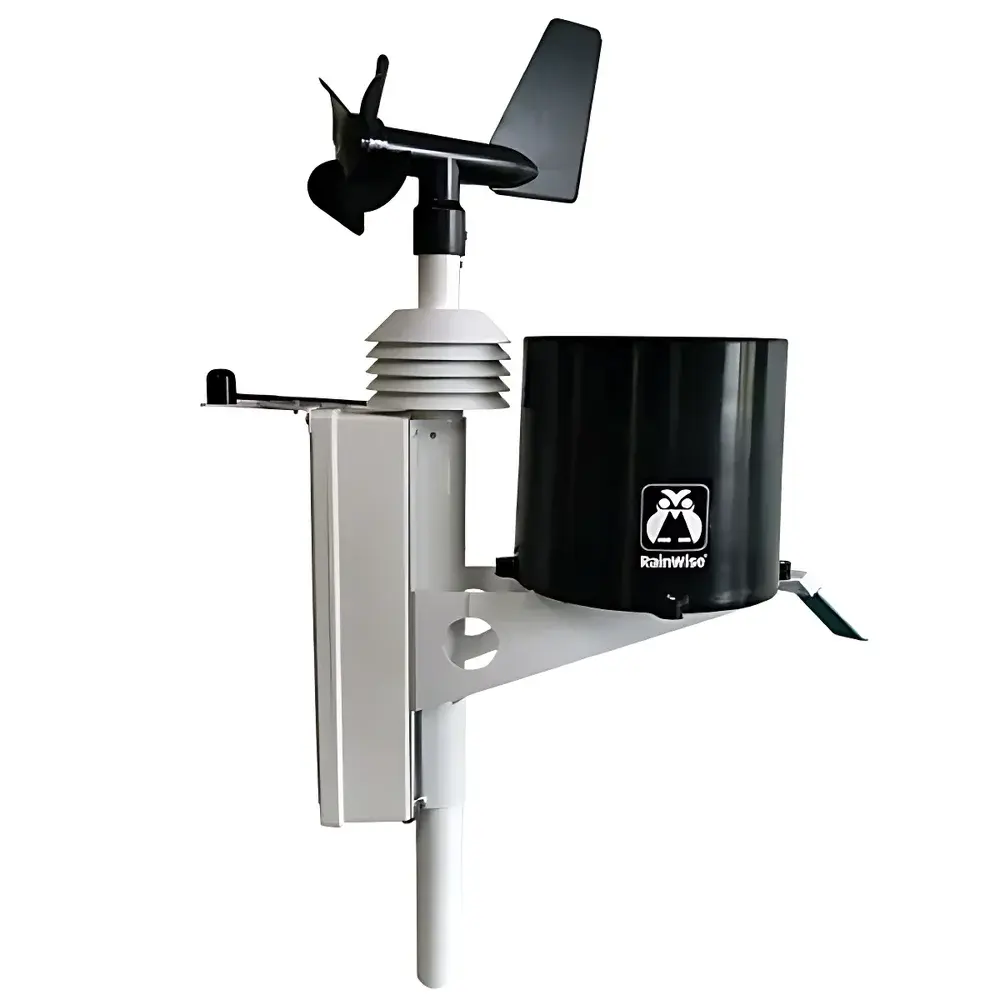
RainWise MK-III-RTI-US-MB Portable Weather Station
| Brand | RainWise |
|---|---|
| Origin | USA |
| Model | MK-III-RTI-US-MB |
| Instrument Type | Portable Weather Station |
| Communication Interface | RS-422/RS-485 Modbus RTU (2-wire half-duplex) |
| Wind Speed Range | 0.25–45 m/s |
| Wind Speed Accuracy | ±0.13 m/s |
| Wind Direction Range | 0–359° |
| Wind Direction Accuracy | ±1° |
| Air Temperature Range | −55 to +85 °C |
| Temp Accuracy | ±0.2 °C @ 25 °C |
| Relative Humidity Range | 0–100 % RH |
| RH Accuracy | ±2 % (10–90 % RH, 25 °C), ±4 % (<10 or >90 % RH, 25 °C) |
| Barometric Pressure Range | 300–1100 hPa |
| Pressure Accuracy | ±0.5 hPa @ 25 °C |
| Rainfall Measurement Range | 0–762 mm/hr |
| Rain Accuracy | ±2 % @ 25.4 mm/hr |
| Operating Temperature | −40 to +70 °C (electronics), −55 to +85 °C (sensors) |
| Power Supply | 6 V, 5 Ah AGM sealed lead-acid battery with 0.6 W solar panel |
| Enclosure Materials | PVC, ABS, anodized aluminum, stainless steel, polycarbonate (LEXAN®, Makrolon® 2658) |
| Compliance | RoHS-compliant, lead-free electronics |
Overview
The RainWise MK-III-RTI-US-MB is a fully integrated, compact, and rugged portable weather station engineered for continuous, high-reliability environmental monitoring in demanding industrial, infrastructural, and agricultural settings. Unlike traditional anemometer-based systems, it employs ultrasonic wind sensing technology—eliminating mechanical wear, reducing maintenance intervals, and delivering stable wind speed and direction measurements across its full operational range (0.25–45 m/s; 0–359°). All core meteorological parameters—including air temperature, relative humidity, barometric pressure, and tipping-bucket rainfall—are measured using NIST-traceable sensor elements (optional certification available), ensuring metrological integrity for regulatory reporting and long-term climate trend analysis. Designed for seamless integration into existing supervisory control architectures, the station implements the industry-standard Modbus RTU protocol over RS-422/RS-485 physical layer, enabling deterministic, low-latency data exchange without reliance on IP networks or cloud intermediaries.
Key Features
- Ultrasonic wind sensor with no moving parts—immune to icing, corrosion, and bearing degradation
- Modbus RTU interface (9600/19200 baud, 2-wire half-duplex) compatible with PLCs, RTUs, SCADA, DCS, and BMS platforms
- Pre-assembled, field-ready enclosure constructed from UV-stabilized polycarbonate (LEXAN®, Makrolon® 2658), anodized aluminum, and stainless steel
- Wide operating temperature envelope: −55 °C to +85 °C (sensor level); −40 °C to +70 °C (electronics)
- Low-power architecture: powered by 6 V, 5 Ah AGM battery with integrated 0.6 W solar charging—supports multi-year deployment in remote locations
- RoHS-compliant, lead-free electronics meeting EU Directive 2011/65/EU requirements
- Configurable analog/digital I/O expansion options for optional sensors (solar radiation, UV index, heated rain gauge)
Sample Compatibility & Compliance
The MK-III-RTI-US-MB is validated for outdoor deployment in unsheltered environments per IEC 60529 (IP65-rated enclosure) and meets UL 61010-1 safety requirements for measurement/control equipment. Sensor calibration protocols align with ISO/IEC 17025 principles when NIST-traceable certificates are selected. Data acquisition workflows support audit-ready documentation under GLP and GMP frameworks—particularly relevant for environmental impact assessments, HVAC commissioning reports, and agricultural input optimization records. The Modbus implementation conforms to Modbus Organization specifications v1.1b, ensuring interoperability with third-party HMIs and historian systems compliant with ISA-88 and ISA-95 standards.
Software & Data Management
No proprietary software is required: the station operates as a passive Modbus slave device, transmitting time-synchronized parameter sets at user-defined polling intervals (default: 10-second cycles). Raw register maps are published in RainWise’s publicly available Modbus register documentation (v3.2), facilitating direct integration into custom Python, Node-RED, Ignition SCADA, or Siemens Desigo CC environments. For traceability-critical applications, timestamped Modbus transaction logs can be archived with full CRC validation—supporting FDA 21 CFR Part 11 compliance when deployed with electronic signature-capable host systems. Optional RainWise CloudLink gateway (sold separately) enables encrypted MQTT forwarding to AWS IoT Core or Azure IoT Hub with TLS 1.2 encryption and certificate-based authentication.
Applications
- Building Automation: Real-time HVAC setpoint optimization, demand-controlled ventilation, and energy performance benchmarking per ASHRAE Guideline 36
- Transportation Infrastructure: Road surface condition modeling (via dew point and wet-bulb calculations), airport crosswind alerts, bridge sway mitigation, and flood-stage forecasting at river gauging stations
- Agricultural Operations: Evapotranspiration (ET₀) modeling for irrigation scheduling, frost warning triggers, pesticide drift risk assessment, and greenhouse climate control logic
- Renewable Energy: Turbine cut-in/cut-out validation, solar panel soiling rate estimation, and micro-siting analysis for distributed wind generation
- Environmental Compliance: Continuous emission monitoring system (CEMS) auxiliary meteorological inputs, ambient air quality network augmentation, and EPA Method 205 verification support
FAQ
Does the MK-III-RTI-US-MB require a dedicated data logger?
No—it functions natively as a Modbus RTU slave device and requires only a Modbus master (e.g., PLC, RTU, or SCADA front-end) for data acquisition.
Can the rain gauge be heated for winter operation?
Yes—an industrial-grade anodized aluminum rain collector with optional 120 VAC or 240 VAC resistive heating is available as a factory-installed upgrade.
Is NIST calibration included by default?
NIST-traceable calibration certificates are optional and must be specified at time of order; base units ship with factory calibration verified against internal reference standards.
What is the expected battery life in off-grid deployments?
With the integrated 0.6 W solar panel and typical insolation (≥3 kWh/m²/day), the 6 V / 5 Ah AGM battery supports continuous operation for ≥18 months without replacement.
How is sensor-level time synchronization handled?
The station does not include GPS or RTC; time stamping is performed exclusively by the Modbus master device—ensuring consistency with enterprise time infrastructure (e.g., NTP-synchronized control servers).
Related Products







