
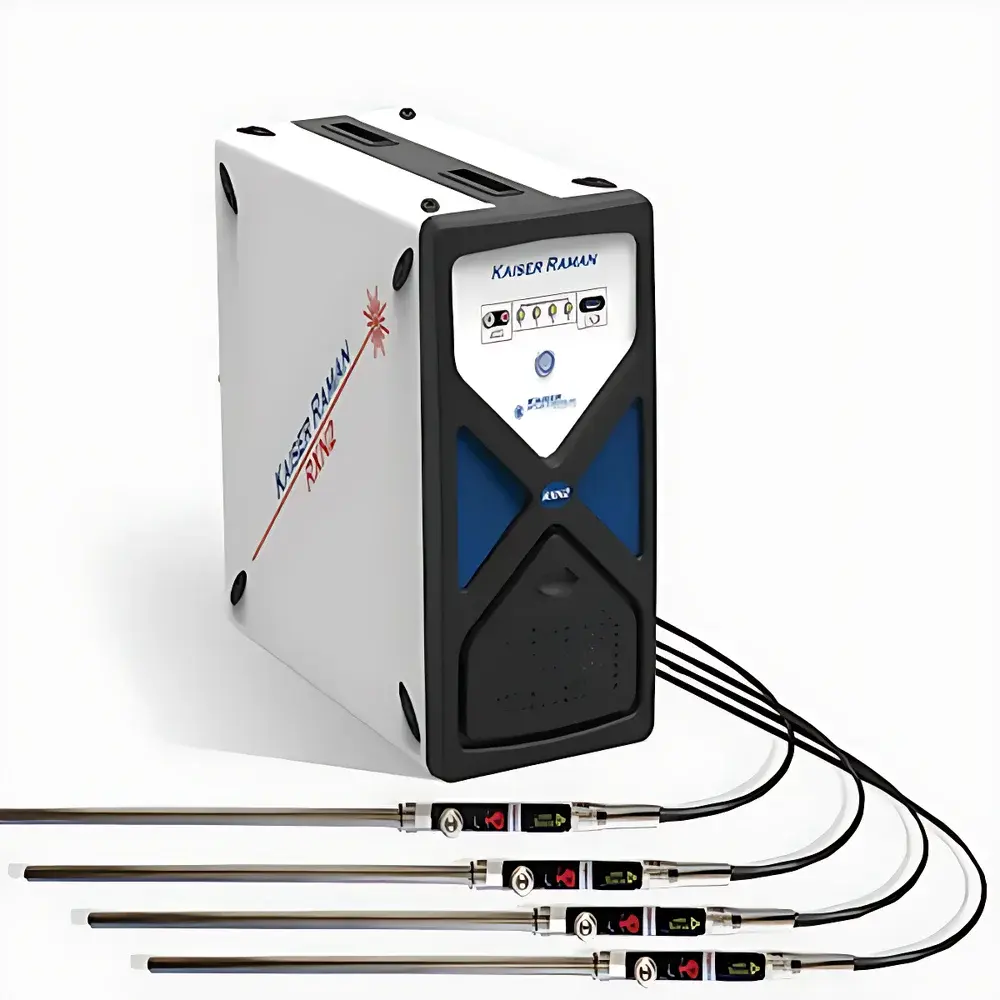
Raman Rxn2 Spectrometer by Endress+Hauser
| Brand | Endress+Hauser |
|---|---|
| Origin | USA |
| Manufacturer Type | Authorized Distributor |
| Origin Category | Imported |
| Model | RAMANRXN2 |
| Instrument Type | Grating-Based Raman Spectrometer |
| Excitation Wavelength Options | 532 nm, 785 nm, or 1000 nm |
| Channel Configuration | Single-Channel (Standard), Optional 4-Channel Multiplexing |
| Probe Compatibility | Rxn-10 (with accessory optics), Rxn-30, Rxn-40, Rxn-41, Rxn-45, Rxn-46 |
| Hazardous Area Certifications | ATEX, IECEx, North American Class I Div 1/2, Class II Div 1/2 |
| Installation Form Factor | Benchtop or Mobile Cart-Mounted |
| Regulatory Compliance | Designed for cGMP/GLP environments, supports FDA 21 CFR Part 11–compliant audit trails when integrated with validated software platforms |
| Software Interface | Embedded touchscreen control with optional remote web-based access via Ethernet/Wi-Fi |
Overview
The Raman Rxn2 Spectrometer by Endress+Hauser is a purpose-engineered, process-grade grating-based Raman spectrometer designed to bridge the methodological and operational gap between laboratory-scale analytical development and continuous industrial process monitoring. Operating on the principle of inelastic light scattering—where monochromatic laser excitation induces vibrational mode shifts in molecular bonds—the Rxn2 delivers chemically specific, non-invasive spectral fingerprints directly within reactors, pipelines, bioreactors, and crystallizers. Unlike benchtop research instruments optimized for maximum resolution under controlled conditions, the Rxn2 is engineered for robustness, long-term stability, and seamless integration into automated process control architectures. Its core architecture supports real-time, in situ, and at-line measurement without sample extraction, enabling quantitative tracking of key analytes, reaction progress, polymorphic transitions, and critical quality attributes (CQAs) aligned with Process Analytical Technology (PAT) frameworks.
Key Features
- Triple-wavelength excitation flexibility: Selectable 532 nm (high sensitivity for non-fluorescent samples), 785 nm (optimal balance of signal-to-noise and fluorescence suppression), or 1000 nm (deep-penetration capability for highly scattering or colored matrices).
- Modular multi-probe support: Standard single-channel configuration scalable to four independent optical channels via time-multiplexed acquisition—enabling sequential analysis across multiple process points without hardware duplication.
- Self-monitoring and self-calibration architecture: Integrated reference standards and real-time spectral drift correction ensure measurement integrity over extended unattended operation; automatic diagnostics log system health metrics including laser power stability, grating alignment status, and detector thermal drift.
- Hazardous area readiness: Certified for use in Zone 0/1 (ATEX/IECEx) and Class I Div 1 (North America) environments; explosion-proof enclosures and intrinsically safe optical interfaces eliminate need for purge systems or remote sensor placement.
- Flexible deployment: Available in fixed benchtop configuration for lab-scale process development or mobile cart-mounted variant with integrated UPS, Ethernet switch, and probe management rack—ideal for pilot plant mobility and cross-unit validation studies.
Sample Compatibility & Compliance
The Rxn2 accommodates diverse sampling geometries through its broad probe portfolio: immersion probes (Rxn-30, Rxn-40), flow-cell adapters (Rxn-41), high-pressure reactor variants (Rxn-45), and fiber-coupled backscattering configurations (Rxn-10, Rxn-46). It supports aqueous, organic, viscous, particulate-laden, and gas-phase systems—including opaque slurries and turbid fermentation broths—without dilution or filtration. From a regulatory standpoint, the instrument’s hardware design and firmware architecture are structured to support qualification under ICH Q5, Q7, and Q9; its data acquisition engine meets foundational requirements for 21 CFR Part 11 compliance when deployed with validated third-party software platforms supporting electronic signatures, role-based access control, and immutable audit trails. Documentation packages include IQ/OQ templates aligned with ASTM E2500 and ISO 13485 principles.
Software & Data Management
The embedded Linux-based control interface provides intuitive touchscreen operation with configurable dashboards, real-time spectral overlays, and alarm-triggered snapshot capture. All spectral data are stored in vendor-agnostic HDF5 format with embedded metadata (timestamp, probe ID, excitation wavelength, integration time, temperature, pressure). The Rxn2 exposes a RESTful API and OPC UA server for bidirectional integration with DCS, MES, and LIMS systems. Multivariate model deployment—using PLS, PCA, or SVM algorithms developed in MATLAB, Python (scikit-learn), or commercial chemometrics suites—is supported via standardized .pmml or .onnx model import. Raw spectra and prediction outputs can be streamed directly to cloud analytics platforms or local historian databases with configurable buffering and compression policies.
Applications
- Chemical Manufacturing: Real-time monitoring of hydrogenation, nitration, esterification, and polymerization reactions; quantification of residual monomers, catalyst concentration, and crosslink density in extrusion lines.
- Pharmaceutical Production: Crystallization endpoint detection, polymorph identification during antisolvent addition, blend uniformity assessment in high-shear mixers, and moisture content tracking during fluid-bed drying.
- Biopharmaceutical Processes: In situ glucose/lactate/ammonia monitoring in CHO and microbial fermentations; viability estimation via cytochrome band ratios; harvest timing optimization based on metabolic shift signatures.
- Food & Beverage: Fat crystallization profiling in chocolate tempering, ethanol and glycerol kinetics in wine fermentation, and adulterant screening in edible oils using spectral fingerprint matching.
FAQ
What excitation wavelengths are available, and how do they affect measurement performance?
The Rxn2 offers 532 nm, 785 nm, and 1000 nm laser sources. Shorter wavelengths yield higher Raman scattering intensity but increase fluorescence interference in aromatic or biological matrices. 785 nm remains the industry standard for general-purpose process applications. 1000 nm minimizes both fluorescence and water absorption—ideal for high-moisture or deeply pigmented samples.
Can the Rxn2 operate in fully automated,无人值守 mode for extended periods?
Yes. Its self-diagnostic routines, temperature-stabilized optics, and watchdog-timer firmware enable continuous operation exceeding 30 days without manual intervention—validated under IEC 61511 SIL2-aligned reliability testing.
Is probe calibration traceable to NIST or other national standards?
While Raman shift calibration is inherently referenced to internal atomic emission lines (e.g., Neon lamp), Endress+Hauser provides factory calibration certificates with uncertainty budgets traceable to NIST SRM 2241 (polystyrene) for intensity and wavenumber accuracy verification.
How does the Rxn2 handle spectral interference from ambient light or process vibrations?
All probes feature narrow-band laser line filters (OD6. Mechanical isolation mounts and adaptive integration time adjustment mitigate vibration-induced signal noise; spectral averaging algorithms suppress transient photonic artifacts without compromising temporal resolution.




