
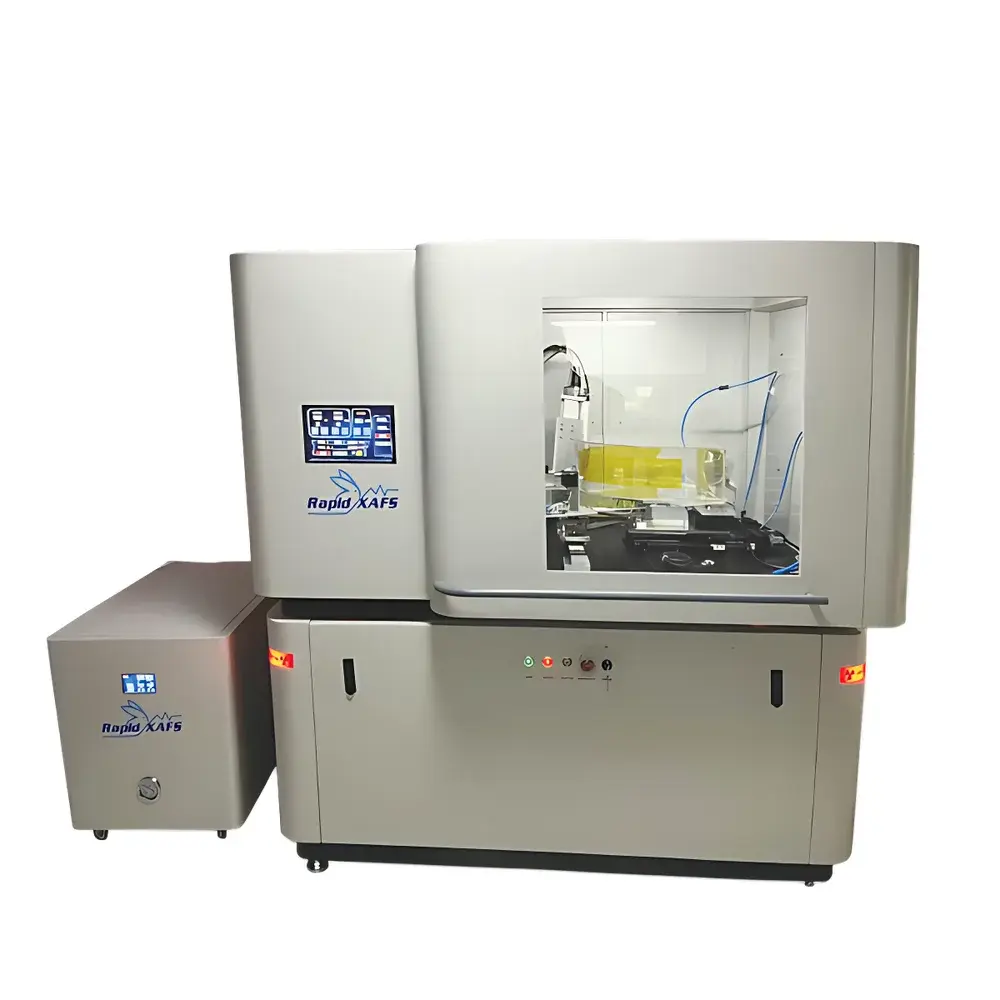
RapidXAFS 1M Desktop X-ray Absorption Fine Structure (XAFS) Spectrometer
| Brand | RapidXAFS |
|---|---|
| Origin | Anhui, China |
| Manufacturer Type | Authorized Distributor |
| Model | RapidXAFS 1M |
| Price Range | USD 420,000 – 700,000 |
| X-ray Source Power | 1.6 kW & 3.0 kW |
| Monochromatic X-ray Photon Flux | 1,000,000 photons/s/eV |
| Minimum Detectable Elemental Concentration | 1 wt% |
| Tunable X-ray Absorption Energy Range | 4.5 keV – 15 keV (extendable) |
Overview
The RapidXAFS 1M is a high-performance, laboratory-scale X-ray Absorption Fine Structure (XAFS) spectrometer engineered for routine, non-synchrotron-based EXAFS and XANES measurements. Unlike conventional benchtop X-ray fluorescence or diffraction systems, the RapidXAFS 1M implements a robust, optimized fixed-exit double-crystal monochromator coupled with a high-brightness rotating-anode X-ray source to deliver synchrotron-comparable photon flux and spectral resolution. Its core measurement principle relies on scanning monochromatic X-ray energy across an element-specific absorption edge while monitoring transmission or fluorescence yield—enabling quantitative local structural analysis (bond distances, coordination numbers, disorder parameters) and oxidation state determination in heterogeneous, amorphous, or crystalline materials. Designed for operation in standard analytical laboratories without beamline infrastructure, it bridges the gap between academic synchrotron access constraints and industrial QC/QA requirements for catalyst characterization, battery electrode analysis, environmental speciation, and metallurgical process control.
Key Features
- High-flux X-ray optics: Delivers >1 × 10⁶ photons/s/eV at the sample position—among the highest reported for compact laboratory XAFS systems—enabling sub-minute EXAFS acquisition times and high signal-to-noise ratios even for dilute samples.
- Dual-power X-ray source: Switchable 1.6 kW and 3.0 kW rotating-anode configuration allows optimization between thermal load management and maximum flux output depending on experimental duty cycle and sample sensitivity.
- Energy stability & reproducibility: Monochromator and source thermal control ensure <0.1% relative intensity drift over 8-hour runs and energy reproducibility better than ±50 meV—critical for multi-scan averaging and long-term time-resolved studies.
- Extended tunability: Standard coverage from 4.5 keV (e.g., Ti K-edge) to 15 keV (e.g., Sn K-edge), with optional crystal upgrades (e.g., Si(311), Ge(422)) enabling L₃-edge measurements for 4d/5d transition metals (e.g., Pd, Pt) and actinides.
- Modular detection: Supports both transmission (ionization chamber) and fluorescence (multi-element SDD array) modes, with automatic mode switching and dead-time correction embedded in acquisition firmware.
Sample Compatibility & Compliance
The RapidXAFS 1M accommodates solid powders, pressed pellets, thin films, frozen solutions, and sealed capillary cells—compatible with air-sensitive or radioactive samples via optional glovebox-integrated sample chambers. All hardware and firmware comply with IEC 61000-6-3 (EMC), IEC 61000-6-4 (industrial emission), and GB/T 18268.1–2010 (electromagnetic compatibility for laboratory equipment). Data acquisition and processing workflows support audit-trail generation aligned with GLP and GMP principles; raw spectra metadata (energy calibration, beam current, dwell time, detector gain) are embedded in NeXus/HDF5 format files per IAEA XAFS Data Standards v2.1. While not certified under FDA 21 CFR Part 11, the system’s software architecture supports user-defined electronic signatures and role-based access control when deployed in regulated environments.
Software & Data Management
Control and analysis are unified within the RapidXAFS Studio platform—a Qt-based, cross-platform application supporting real-time spectrum visualization, automated energy calibration (using reference foils), and batch normalization. Raw data export adheres to Demeter-compatible ASCII and NeXus/HDF5 standards. Built-in Athena-equivalent modules enable background subtraction, k³-weighting, Fourier transformation, and shell-fitting using FEFF-generated theoretical standards. All processing steps are scriptable via Python API (PyRapidXAFS), enabling integration into Jupyter-based lab notebooks and CI/CD pipelines for method validation. Audit logs record operator ID, timestamp, instrument configuration, and processing parameters—retained for ≥10 years unless purged per institutional data retention policy.
Applications
- Catalysis research: In situ/operando Co, Ni, Cu, and Fe K-edge EXAFS to track coordination environment evolution during CO₂ hydrogenation or NH₃ synthesis.
- Battery materials: Quantifying Mn/Ni/Co local structure changes in layered oxide cathodes upon cycling, including cation mixing and oxygen redox participation.
- Environmental geochemistry: Speciation of As, Se, Cr, and U in soils and sediments via L₃-edge XANES, distinguishing adsorbed vs. precipitated forms.
- Pharmaceutical metallodrugs: Determination of Pt–S bond lengths and coordination geometry in cisplatin analogues using K-edge EXAFS.
- Metallurgy: Oxidation state mapping of V, Mo, and W in high-entropy alloy precursors prior to sintering.
FAQ
What elements can be measured with the RapidXAFS 1M in standard configuration?
K-edge absorption edges from Ti (4.97 keV) through Sn (29.2 keV) are accessible; however, the default 4.5–15 keV range covers K-edges up to Cd (26.7 keV) with reduced flux, and L-edges of heavier elements (e.g., Pd L₃ at 3.17 keV, Pt L₃ at 11.56 keV) require optional low-energy optics.
Is helium purge required for low-Z element measurements?
Yes—measurements below ~5 keV (e.g., V, Cr, Mn K-edges) require He-purged or vacuum beam paths to minimize air absorption; the system supports integrated He-flow sample chambers and differential pumping options.
Can the system perform time-resolved XAFS?
Yes—via step-scan or quick-XAFS (QXAFS) modes with minimum dwell time of 100 ms per point; full EXAFS scans (k = 3–14 Å⁻¹) can be completed in <90 seconds using the 3.0 kW source and fluorescence detection.
Does the software support third-party fitting packages like Artemis or LARCH?
Yes—exported χ(k) and FT(r) data conform to Demeter format; Python API enables direct memory transfer to LARCH; Artemis project files (.prj) can be imported after manual path adjustment.
What maintenance intervals are recommended for the X-ray tube and monochromator?
Rotating anode tubes require annual bearing inspection and filament replacement every 1,500–2,000 hours; monochromator crystals and Si collimators are maintenance-free but should be verified for alignment quarterly using Cu Kα reference scans.





