
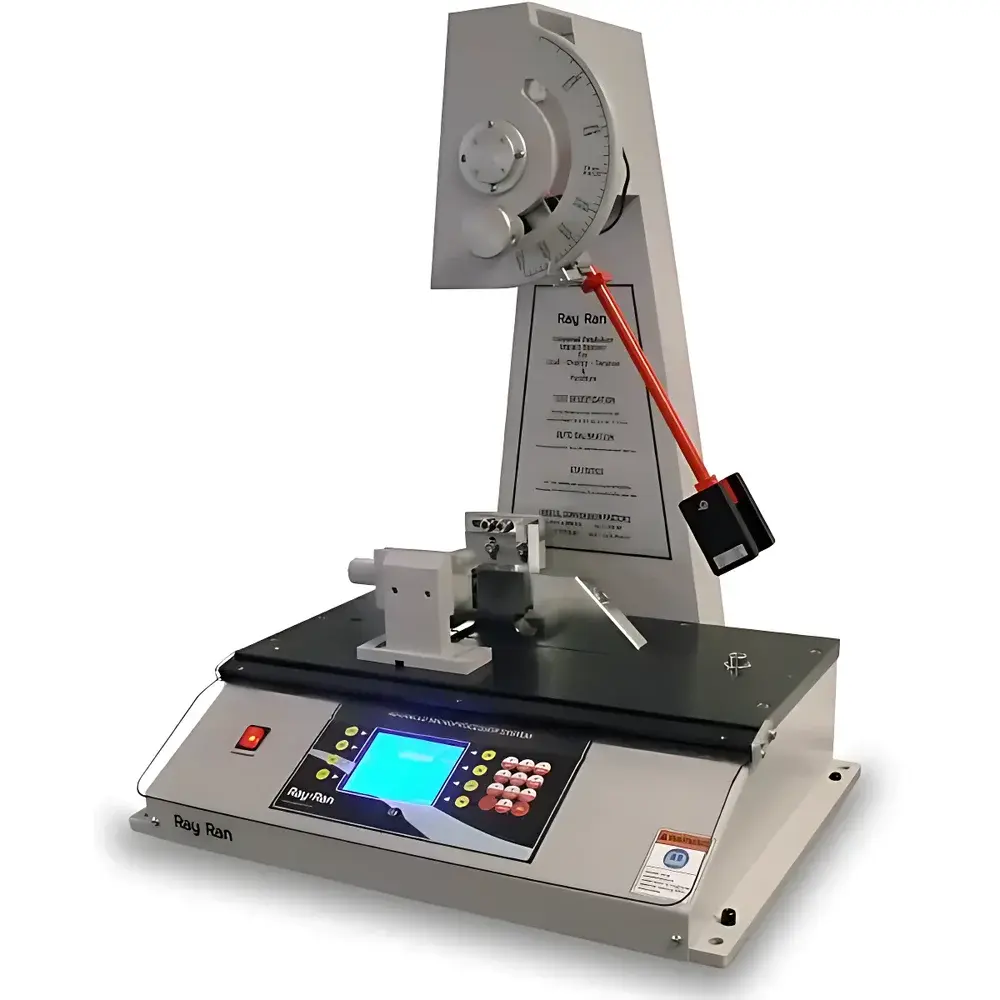
Ray-Ran IMT Pendulum Impact Tester
| Brand | Ray-Ran |
|---|---|
| Origin | United Kingdom |
| Model | IMT |
| Net Weight | 110 kg |
| Dimensions (W×D×H) | 630 × 500 × 760 mm |
| Power Supply | 110–240 VAC, 50–60 Hz |
| Display | 160 × 128 dot matrix graphic LCD with alphanumeric keypad |
| Pendulum Velocity Range | up to 3.8 m/s |
| Maximum Hammer Energy | 50 J |
| Impact Energy Units | kJ/m and kJ/m² |
| Compliance | CE-marked |
| Calibration | Traceable certificate provided |
| Interface Options | RS232, Ethernet (LAN) |
| Position Sensing | High-resolution optical encoder |
| Self-calibration | Automatic compensation for air resistance and bearing friction |
| Test Configurations | Charpy (notched/unnotched), Izod (notched/unnotched), tensile impact, component & pipe testing |
| Safety | Electromagnetic hammer release, integrated safety guard, audible pre-impact warning |
| Software | Techni-Test PC software for data acquisition, statistical analysis (mean, SD, CV), trend charts and export (CSV, PDF) |
| Leveling | Motorized electronic auto-leveling system |
Overview
The Ray-Ran IMT Pendulum Impact Tester is a precision-engineered mechanical impact testing system designed for standardized determination of material toughness under sudden dynamic loading. Operating on the fundamental principle of conservation of energy, the IMT measures the energy absorbed by a specimen during fracture using a calibrated pendulum hammer. The system complies with major international test standards—including ISO 179-1 (Charpy), ISO 180 (Izod), ASTM D256 (Izod/Charpy), ASTM D7136 (tensile impact), and EN ISO 8256—enabling reproducible quantification of impact strength in both unnotched and notched configurations. Its robust cast-iron base, vibration-damped frame, and electromagnetic hammer release mechanism ensure high positional repeatability and operator safety across repetitive testing cycles.
Key Features
- High-resolution optical encoder for precise angular position tracking and energy calculation with sub-millijoule resolution
- Automated self-calibration routine compensating for aerodynamic drag and bearing friction—eliminating manual correction factors required in legacy systems
- Motorized electronic auto-leveling system ensuring consistent pendulum arc geometry and minimizing measurement uncertainty due to misalignment
- Dual interface architecture: RS232 for legacy instrument integration and Ethernet (LAN) for networked lab environments supporting remote monitoring and centralized data logging
- Intuitive graphical user interface with alphanumeric membrane keypad and 160 × 128 pixel LCD display—supporting multilingual menu navigation and real-time parameter feedback
- Electromagnetic hammer release with programmable pre-impact audible warning and interlocked safety guard—meeting EN ISO 13857 and IEC 61508 functional safety requirements
- Modular anvil and clamp configuration enabling rapid reconfiguration between Charpy, Izod, tensile impact, and custom component or pipe testing geometries
Sample Compatibility & Compliance
The IMT accommodates standard and non-standard specimens per ISO and ASTM dimensional tolerances—including rectangular bars (e.g., 80 × 10 × 4 mm for Charpy), notched specimens with standardized root radii (e.g., 0.25 mm for ISO 179), and tubular or molded components with optional fixtures. All test modes are validated against traceable reference standards, and the delivered unit includes a UKAS-accredited calibration certificate traceable to NPL (National Physical Laboratory). The system conforms to CE marking requirements under the Machinery Directive 2006/42/EC and Electromagnetic Compatibility Directive 2014/30/EU. For regulated laboratories, Techni-Test software supports 21 CFR Part 11-compliant audit trails, electronic signatures, and data integrity controls when deployed in GMP/GLP environments.
Software & Data Management
Techni-Test PC software provides full control of test execution, real-time visualization of pendulum trajectory, and automated calculation of impact energy (kJ/m and kJ/m²), normalized to specimen cross-section or ligament area. Statistical modules compute mean, standard deviation, coefficient of variation, confidence intervals (95%), and generate histogram distributions and time-series trend plots. Raw data—including encoder timestamps, angular displacement, and calculated energy—is exportable in CSV, Excel-compatible XML, and print-ready PDF formats. The software architecture supports multi-user role-based access control and integrates with LIMS via ODBC or RESTful API endpoints.
Applications
The IMT is routinely deployed in polymer formulation labs evaluating notch sensitivity of polypropylene copolymers, automotive Tier-1 suppliers validating thermoplastic composite crashworthiness, medical device manufacturers assessing brittle-ductile transitions in PEEK orthopedic implants, and construction materials testing facilities characterizing impact resistance of PVC-U window profiles per EN 1452-2. It also serves academic research in fracture mechanics, where variable-energy testing enables construction of impact transition curves (ITT) for temperature-dependent ductile-to-brittle behavior.
FAQ
What standards does the IMT support out-of-the-box?
ISO 179-1 (Charpy), ISO 180 (Izod), ASTM D256, ASTM D7136, EN ISO 8256, and BS EN ISO 13802—all with preloaded test method templates in Techni-Test software.
Is the system suitable for accredited testing laboratories?
Yes. Delivered with a UKAS-traceable calibration certificate, CE documentation, and 21 CFR Part 11-ready software options for audit-compliant operation.
Can the IMT test non-standard geometries such as pipes or overmolded assemblies?
Yes. Optional fixtures—including split anvils, clamping jaws for cylindrical specimens, and custom fixture mounting plates—enable secure positioning of irregular components without compromising energy transfer fidelity.
How is energy loss from friction compensated during testing?
Via an automated self-calibration sequence that measures baseline pendulum decay without specimen, then applies real-time correction to all subsequent impact calculations.
What maintenance is required to sustain measurement accuracy?
Annual recalibration recommended; optical encoder and electromagnetic release mechanism require no routine lubrication or adjustment—designed for >100,000 impact cycles with documented metrological stability.



