
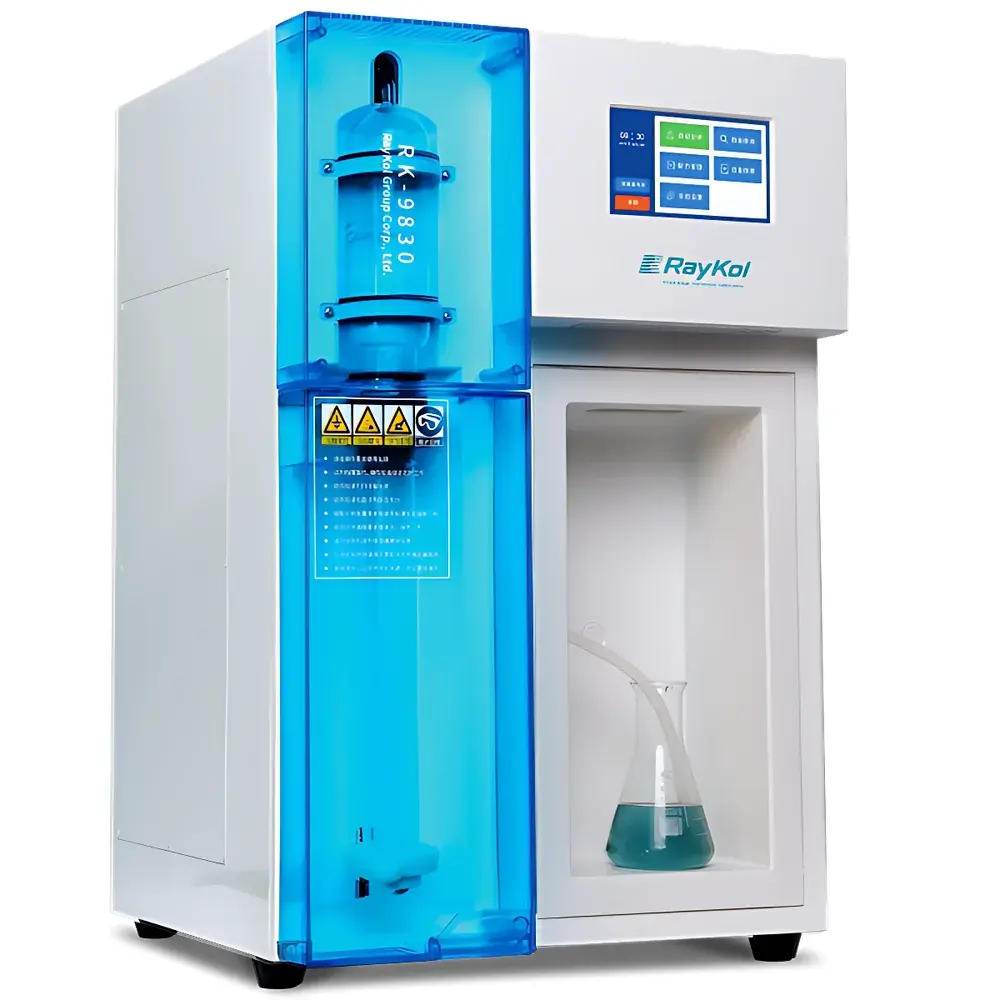
Raykol RK-9830 Automated Kjeldahl Nitrogen Determinator
| Brand | Raykol |
|---|---|
| Origin | Fujian, China |
| Manufacturer Type | Direct Manufacturer |
| Instrument Type | Kjeldahl Nitrogen Determinator |
| Automation Level | Fully Automated |
| Nitrogen Determination Range | 0.1–240 mg N |
| Steam Distillation Time Setting Range | 10–9990 s |
| Repeatability | ≤0.5% RSD (at ≥10 mg N) |
| Sample Weight Capacity | Solids ≤5.00 g, Liquids ≤20 mL |
| Nitrogen Recovery Rate | 99–101% |
| Power Rating | 2000 W |
| Dimensions (L×W×H) | 500 mm × 460 mm × 710 mm |
Overview
The Raykol RK-9830 Automated Kjeldahl Nitrogen Determinator is a fully integrated, benchtop analytical system engineered for precise and reproducible total nitrogen quantification in accordance with ISO 8968-1, AOAC 984.27, ASTM D1122, and USP <467> methodologies. It implements the classical Kjeldahl digestion–distillation–titration workflow in a single, closed-loop platform, eliminating manual transfer steps and minimizing operator intervention. The instrument performs acid digestion (not included), alkaline steam distillation under controlled pressure and temperature, automatic colorimetric or potentiometric titration, and real-time stoichiometric calculation of nitrogen content—based on the measured titrant volume and pre-configured protein conversion factors. Designed for high-throughput laboratories in food safety, agricultural research, feed quality control, environmental testing, and pharmaceutical excipient analysis, the RK-9830 delivers regulatory-compliant data integrity without requiring external titrators or third-party software integration.
Key Features
- 7-inch full-color capacitive touchscreen interface with seamless English/Chinese language switching and intuitive icon-driven navigation
- Three-tier electronic user permission management (Administrator, Supervisor, Operator) supporting ALCOA+ principles for audit-ready access control
- Automated idle shutdown after 60 minutes of inactivity to reduce energy consumption and enhance operational safety
- Integrated titration module with auto-zero calibration, dynamic endpoint detection, and direct volumetric input-to-result conversion using IUPAC-standardized stoichiometry
- Built-in protein conversion factor database (e.g., 6.25 for cereals, 5.70 for wheat gluten, 6.38 for dairy) editable per sample group or method template
- Stainless steel 304 construction for both steam generator and condenser assemblies—ensuring corrosion resistance, thermal stability, and long-term dimensional integrity
- Comprehensive hardware-level safety architecture: door interlock with audible/visual alarm, digest tube position sensor, low-water cutoff, overtemperature cutout (≥220 °C), and ground-fault circuit interrupter (GFCI) protection
- Onboard non-volatile memory storing up to 1,000,000 test records with timestamp, operator ID, method ID, raw titration volume, calculated N%, and recovery check flags
Sample Compatibility & Compliance
The RK-9830 accommodates a broad spectrum of organic matrices—including powdered grains, meat homogenates, milk powder, soil extracts, wastewater digests, and pharmaceutical intermediates—within defined mass/volume limits (≤5.00 g solids or ≤20 mL liquids per run). All wet chemistry steps comply with GLP and GMP documentation requirements: electronic signatures are supported, all critical parameters (distillation time, steam temperature, titrant consumption) are logged with microsecond timestamps, and change history is immutably retained. Data export adheres to 21 CFR Part 11 Annex 11 expectations via encrypted CSV or PDF report generation, with optional LIMS connectivity through RS232/USB virtual COM port.
Software & Data Management
Firmware v3.2 embeds a deterministic real-time operating system (RTOS) ensuring deterministic response latency for safety-critical events (e.g., door open → immediate steam cutoff). Method templates store complete procedural parameters—including digestion protocol references (though digestion is performed externally), distillation duration, titrant concentration, blank subtraction logic, and rounding rules per ISO 5725-2. Audit trails capture every parameter modification, login/logout event, and calibration action—including who made the change, when, and from which IP (if network-enabled). Data backups are performed automatically to internal eMMC storage and optionally mirrored to USB drives formatted as FAT32.
Applications
- Protein content verification in infant formula, plant-based beverages, and sports nutrition products per Codex Alimentarius STAN 206
- Crude protein estimation in animal feed formulations complying with AAFCO guidelines
- Nitrogen balance studies in agronomic soil health assessments (ISO 11261)
- Residual ammonium salt quantification in active pharmaceutical ingredient (API) synthesis batches
- Validation of enzymatic hydrolysis efficiency in biopolymer degradation research
- Quality control of fertilizer nitrogen release kinetics using sequential Kjeldahl extraction
FAQ
Does the RK-9830 include a digestion unit?
No—the RK-9830 is a dedicated distillation–titration system. Sample digestion must be performed separately using a compatible block digester or microwave digestion system prior to loading into the RK-9830.
Can the instrument interface with laboratory information management systems (LIMS)?
Yes—via ASCII-based serial communication (RS232) or virtual COM port over USB, supporting ASTM E1384 and HL7-compatible data packet structures for automated result ingestion.
What titration methods does the built-in titrator support?
The system uses a standardized potentiometric titration mode with pH electrode endpoint detection, optimized for boric acid–HCl back-titration. Colorimetric titration is not supported natively but may be integrated externally via analog voltage output.
Is method validation documentation provided?
Raykol supplies IQ/OQ documentation templates aligned with ISO/IEC 17025 and GAMP5, including performance qualification protocols for recovery, repeatability, linearity (0.1–240 mg N), and robustness across ambient temperature fluctuations (15–30 °C).




