
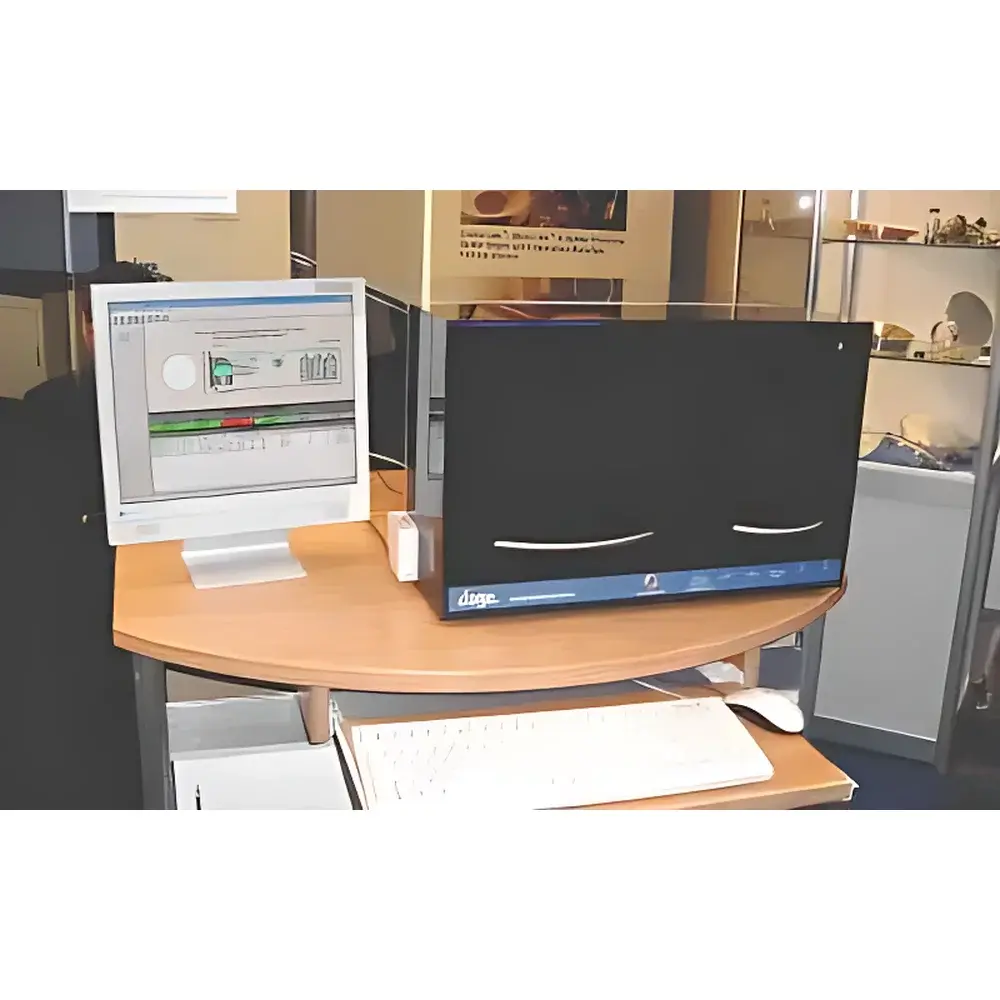
Rayscience CVP21 Automated Electrochemical Capacitance–Voltage Profiler
| Brand | Rayscience |
|---|---|
| Origin | Germany |
| Model | CVP21 |
| Instrument Type | Electrochemical Capacitance–Voltage Profiling System |
| Application Domain | Semiconductor Doping Profile Characterization |
| Carrier Concentration Range | 1×10¹¹ to 1×10²¹ cm⁻³ |
| Depth Resolution | Down to ≤1 nm |
| Sample Compatibility | Wafer-scale (up to 300 mm), micro-samples, epitaxial layers, bulk crystals |
| Compliance | Designed for GLP/GMP-aligned lab environments |
Overview
The Rayscience CVP21 is a fully automated electrochemical capacitance–voltage (C–V) profiling system engineered for quantitative, non-destructive depth-resolved characterization of dopant concentration distributions in semiconductor materials. Operating on the principle of electrochemical etching combined with high-precision capacitance measurement under controlled voltage sweep, the CVP21 enables direct correlation between junction capacitance (C) and depletion width (W), yielding carrier concentration (NA/ND) as a function of depth via the standard relationship: N = (2/εq)(d(1/C²)/dV)⁻¹. Unlike conventional secondary ion mass spectrometry (SIMS) or spreading resistance profiling (SRP), the CVP21 delivers rapid, cost-effective, and lab-based profiling without requiring ultra-high vacuum infrastructure or radioactive standards. Its design targets R&D and process control applications in photovoltaics, power electronics, and compound semiconductor device fabrication—particularly where real-time feedback on epitaxial growth uniformity, diffusion kinetics, or ion implant activation is critical.
Key Features
- Modular, cleanroom-compatible architecture with optically isolated electronics, electrochemical cell compartment, and precision motion stage—ensuring long-term stability and minimizing electromagnetic interference.
- High-fidelity analog front-end with sub-femtofarad capacitance resolution and programmable AC bias (1 kHz–1 MHz) for optimal signal-to-noise ratio across wide doping ranges.
- Automated electrolyte delivery and dynamic etch rate compensation algorithm, enabling reproducible removal of material layers while maintaining constant surface potential during profiling.
- Integrated real-time monitoring of both capacitance transients and etch current, allowing immediate detection of interface states, heterojunction discontinuities, or unintentional dopant segregation.
- Software-controlled sample handling for wafers up to 300 mm diameter, including edge exclusion mapping and multi-point radial profiling with positional repeatability < ±2 µm.
Sample Compatibility & Compliance
The CVP21 supports a broad spectrum of elemental and compound semiconductors, including Si, Ge, SiC, GaAs, InP, AlGaAs, GaInP, AlGaN, InGaN, ZnO, CdTe, and HgCdTe. It accommodates both planar and mesa-structured samples, with configurable electrolyte formulations (e.g., HF-based for Si, KOH for GaN, bromine-methanol for III–V nitrides) optimized for selective, stoichiometric etching. All measurement protocols adhere to ASTM F1188 (Standard Practice for Determining Electrical Characteristics of Semiconductor Devices Using Capacitance Techniques) and ISO/IEC 17025 traceability guidelines when operated with calibrated reference standards. System firmware and data acquisition modules are configurable for 21 CFR Part 11 compliance, including electronic signatures, audit trails, and role-based access control—essential for GMP-regulated PV cell manufacturing and qualification labs.
Software & Data Management
The proprietary CVP-Suite v4.x provides a unified interface for instrument control, real-time visualization, and post-processing. Key capabilities include: automatic baseline correction for series resistance effects; multi-layer deconvolution using iterative Tikhonov regularization; export of carrier profiles in industry-standard formats (CSV, HDF5, VTK); batch processing of wafer maps with statistical overlay (e.g., uniformity σ/mean, edge roll-off analysis); and integration with MATLAB and Python APIs for custom modeling (e.g., Poisson–Boltzmann fitting, drift-diffusion simulation validation). Raw data files retain full metadata—including timestamp, environmental conditions (T, RH), electrolyte lot ID, and operator credentials—to satisfy GLP documentation requirements.
Applications
- Quantitative evaluation of dopant activation efficiency following rapid thermal annealing (RTA) or laser annealing in Si and SiC power devices.
- Depth-resolved profiling of graded AlGaN buffer layers in GaN-on-Si HEMTs to assess strain relaxation and unintentional carbon incorporation.
- In-line monitoring of phosphorus diffusion in n-type silicon solar wafers during POCl₃ diffusion furnace runs.
- Characterization of ion-implanted junctions in GaAs MMICs, including tail region analysis and channeling artifact identification.
- Validation of MBE and MOCVD growth parameters for ternary and quaternary III–V alloys used in multi-junction concentrator cells.
FAQ
What semiconductor materials require custom electrolyte formulation?
Materials such as GaN, AlN, and ZnO necessitate non-aqueous or weakly acidic electrolytes (e.g., bromine in methanol or dilute HF–NH₄F mixtures) to achieve controlled, stoichiometric etching without surface passivation or pitting.
Can the CVP21 measure ultra-shallow junctions (<10 nm) in advanced CMOS nodes?
Yes—when paired with low-frequency AC excitation (1–10 kHz) and optimized electrolyte flow dynamics, the system achieves effective depth resolution down to ≤1 nm, validated against SIMS cross-checks on implanted Si wafers.
Is remote operation and data review supported?
The CVP-Suite includes secure TLS-encrypted web interface (HTTPS) for off-site instrument monitoring, live data streaming, and collaborative annotation—fully compatible with corporate SSO and LDAP authentication frameworks.
How is calibration traceability maintained?
Each system ships with NIST-traceable capacitance and voltage reference modules; annual recalibration services include full electrical verification per IEC 61000-4-30 and certificate of conformance aligned with ISO/IEC 17025.
Does the system support automated wafer cassette loading?
Optional robotic loader integration (SEMI E47-compliant) is available for high-throughput production environments, supporting SMIF and FOUP configurations with integrated barcode tracking.
Related Products





