
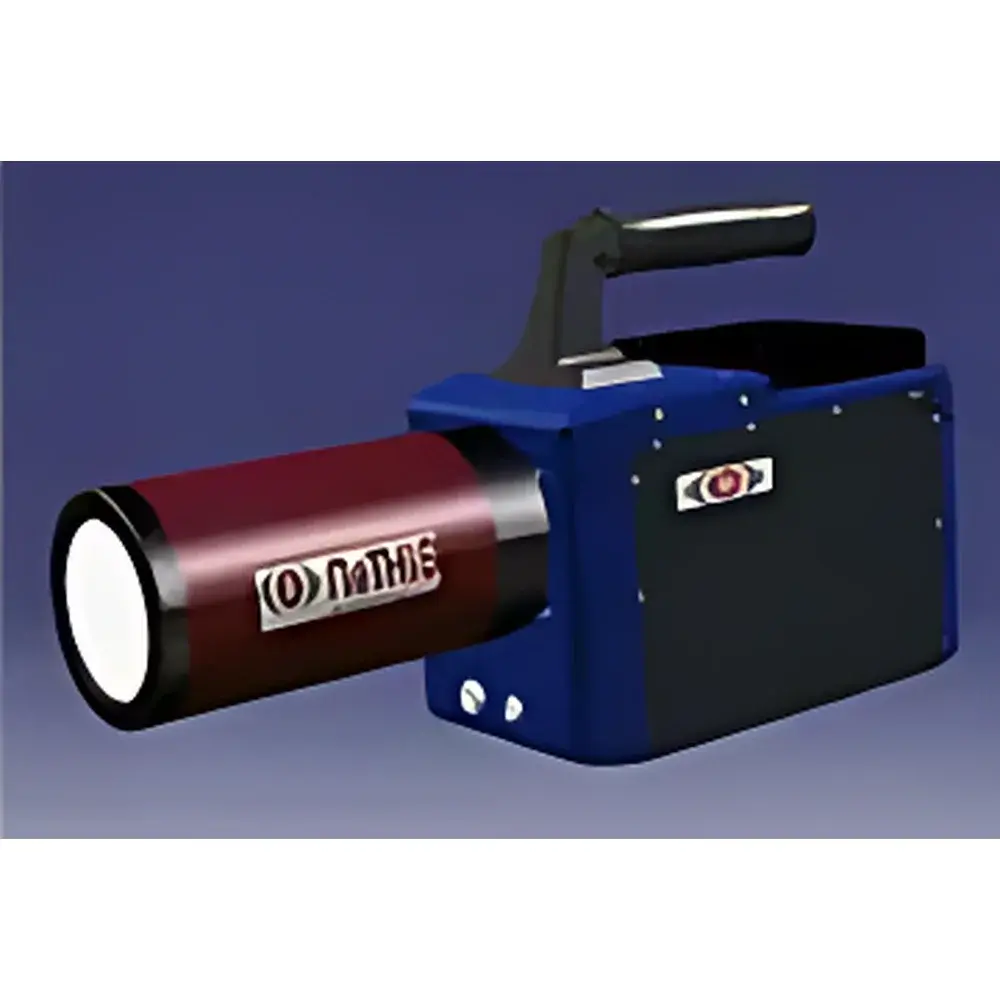
Rayscience TeraCAM Terahertz Imaging Camera
| Brand | Rayscience |
|---|---|
| Origin | USA |
| Model | TeraCAM |
| Imaging Spectrum | 0.1–3000 µm |
| Pixel Pitch | 100 µm |
| Array Size | 700 × 700 pixels |
| Active Area | 700 × 700 mm² |
| Frame Rate | 1–50 Hz |
| Minimum Detectable Irradiance | <50 µW/cm² per pixel |
| Operating Temperature | Ambient (uncooled operation) |
| Interface | IEEE 1394 and Ethernet |
| Spatial Resolution | Millimeter-scale (diffraction-limited) |
| Compliance | Designed for ISO/IEC 17025-aligned laboratory environments, compatible with GLP/GMP data integrity workflows |
Overview
The Rayscience TeraCAM Terahertz Imaging Camera is a high-sensitivity, uncooled focal plane array (FPA) instrument engineered for two-dimensional and three-dimensional spatial characterization of broadband electromagnetic radiation across the terahertz (THz), sub-terahertz, far-infrared (FIR), mid-infrared (MIR), near-infrared (NIR), visible, and ultraviolet spectral domains (0.1–3000 µm). Unlike conventional cooled bolometric or pyroelectric cameras, the TeraCAM employs a large-area, room-temperature microbolometer array with optimized thermal responsivity and low-noise readout architecture—enabling quantitative beam profiling, spatial intensity mapping, and dynamic source characterization without cryogenic infrastructure. Its design follows fundamental principles of thermal radiation detection: incident THz and IR photons induce minute temperature gradients across the absorber layer, transduced into measurable resistance changes via integrated CMOS readout circuitry. This enables direct, real-time visualization of CW and pulsed THz beams—including those generated by quantum cascade lasers (QCLs), backward-wave oscillators (BWOs), Gunn diodes, IMPATT/TUNNETT devices, free-electron lasers (FELs), and molecular gas lasers—without optical down-conversion or scanning mechanisms.
Key Features
- Large-format uncooled microbolometer array (700 × 700 pixels, 100 µm pitch) with 700 × 700 mm² active detection area
- Broadband spectral response spanning 0.1 µm (UV) to 3000 µm (sub-THz), supporting multi-regime laser diagnostics
- Real-time frame acquisition at up to 50 Hz, optimized for both continuous-wave (CW) and nanosecond-to-microsecond pulsed THz sources
- Millimeter-scale spatial resolution governed by diffraction limits of long-wavelength radiation; no moving parts or mechanical scanning required
- Dual-interface architecture: IEEE 1394 (FireWire) and Gigabit Ethernet for deterministic timing synchronization and high-throughput data streaming
- Robust mechanical housing (200 × 200 × 300 mm³) with passive thermal stabilization, suitable for integration into vacuum chambers, optical tables, and industrial THz inspection stations
Sample Compatibility & Compliance
The TeraCAM is validated for use with diverse THz and IR emitters, including solid-state lasers, fiber lasers, QCLs, optically pumped molecular lasers, electronic semiconductor sources (Gunn, IMPATT, TUNNETT), BWOs, and FELs. It supports non-contact, non-destructive evaluation of opaque, non-conductive materials—such as polymers, ceramics, composites, and biological tissues—for subsurface defect detection (e.g., delamination, voids, moisture ingress), weld integrity assessment, and thermal property mapping. The system complies with foundational metrological requirements outlined in ISO/IEC 17025 for calibration laboratories and supports audit-ready data handling under GLP and GMP frameworks. While not inherently FDA 21 CFR Part 11-certified, its software architecture permits implementation of electronic signatures, audit trails, and user access controls when deployed with validated third-party data management platforms.
Software & Data Management
The TeraCAM operates with Rayscience’s proprietary acquisition and analysis suite, offering real-time beam centroid tracking, 2D/3D intensity reconstruction, M² calculation, beam propagation modeling (via Fresnel diffraction algorithms), and time-resolved pulse energy distribution analysis. Raw frame data are exported in standardized formats (HDF5, TIFF, CSV) with embedded metadata—including timestamp, exposure settings, ambient temperature, and detector gain state—to ensure traceability. The software supports scripting interfaces (Python API) for automated measurement sequences and integration into LabVIEW- or MATLAB-based test benches. All acquired datasets retain full bit-depth fidelity (16-bit dynamic range), enabling post-acquisition reprocessing without loss of quantitative accuracy.
Applications
- Quantitative THz beam profiling for QCL and photomixing source optimization
- Non-destructive testing (NDT) of aerospace composites and additive-manufactured parts using millimeter-wave transmission imaging
- Material science studies: dielectric constant extraction, loss tangent mapping, hydration level quantification in hygroscopic media
- THz time-domain spectroscopy (THz-TDS) spatial gating and collimation validation
- Free-space optical alignment verification in high-power THz systems where traditional silicon-based sensors saturate or degrade
- Education and research labs requiring turnkey, maintenance-free THz imaging capability without liquid nitrogen or Stirling coolers
FAQ
Is the TeraCAM compatible with ultrafast THz pulses from photoconductive antennas?
Yes—the 1–50 Hz frame rate supports single-shot and multi-shot averaging modes; when synchronized with external trigger signals (TTL-compatible), it captures temporally gated THz pulses with sub-millisecond latency.
Does the camera require optical coupling optics or attenuators for high-energy THz sources?
For sources exceeding 10 mW average power, optional calibrated neutral-density filters and ZnTe or HDPE beam splitters are recommended to prevent localized pixel saturation while preserving linearity.
Can the TeraCAM be used in vacuum environments?
The standard enclosure is rated for ambient pressure operation; however, a custom vacuum-compatible variant with feedthrough connectors and outgassing-certified materials is available upon request.
How is spatial calibration performed?
Calibration is conducted using NIST-traceable reticles and reference THz sources; users receive a certificate of geometric distortion correction and pixel responsivity uniformity map.
Is firmware update support provided post-purchase?
Yes—Rayscience delivers quarterly firmware updates addressing noise reduction algorithms, interface stability, and new export protocol support, accessible via secure customer portal.





