
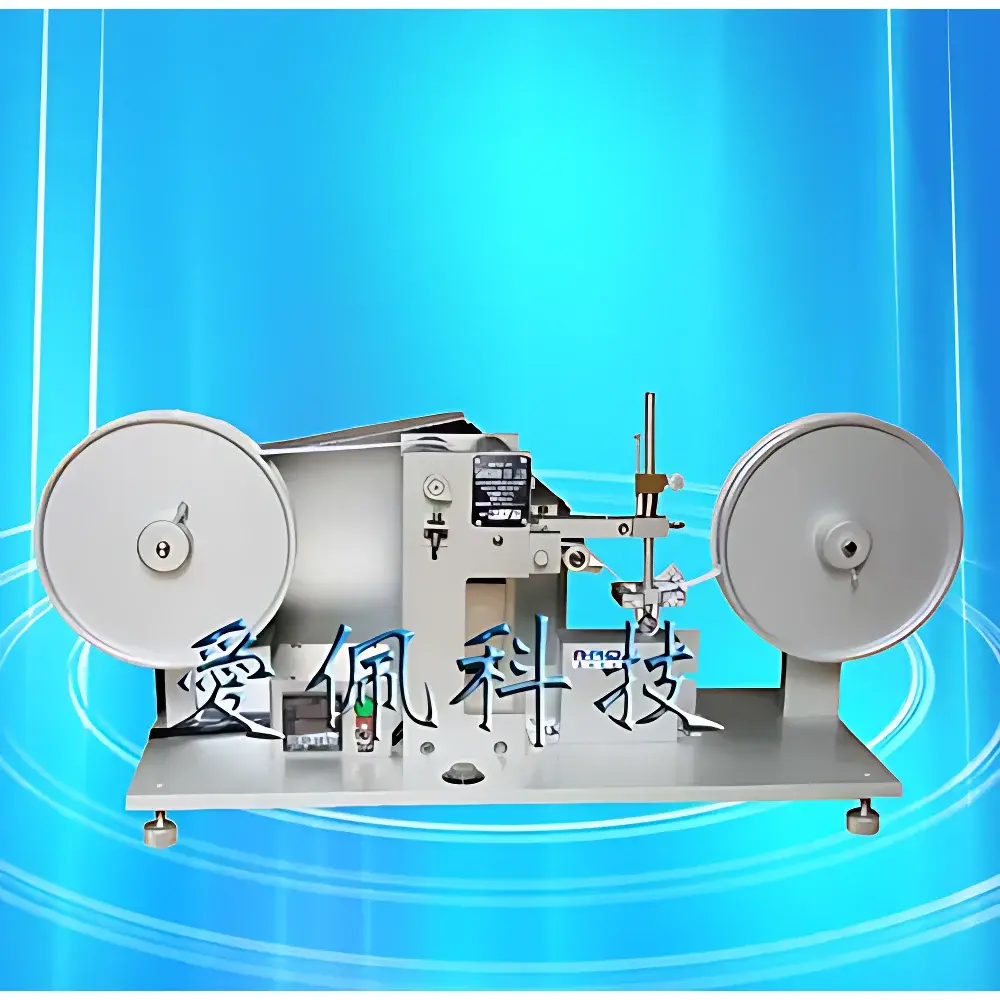
RCA Paper Tape Abrasion Tester by Aipei Technology (APKJ)
| Brand | Aipei Technology (APKJ) |
|---|---|
| Origin | Guangdong, China |
| Manufacturer Type | Direct Manufacturer |
| Country of Origin | China |
| Model | AP-RCA |
| Pricing | Upon Request |
| Load Options | 55 g, 175 g, 275 g |
| Dimensions (W×D×H) | 830 × 490 × 340 mm |
| Weight | ~15 kg |
| Power Supply | AC 220 V, 50/60 Hz |
| Rated Power | 500 W |
| Counter Range | 0–999,999 cycles (LCD digital preset counter) |
| Included Accessories | Elevating platform (1), LED-lit magnifier (1), 55 g weight (1), 175 g weight (1), hex key set (1), O-rings (5), dovetail clamps (2), circular level (1), Norman PCA abrasive paper rolls (2) |
Overview
The RCA Paper Tape Abrasion Tester (Model AP-RCA) by Aipei Technology is an electromechanical test instrument engineered for standardized surface abrasion resistance evaluation of coated and laminated substrates. It operates on the principle of controlled rotary friction between a standardized abrasive medium—unlubricated Norman PCA paper tape—and a stationary or dynamically secured specimen under defined normal load conditions. This method aligns with widely adopted industry practices for assessing wear durability in consumer electronics, including mobile phones, PDAs, MP3 players, CD players, and laptop casings, where surface coatings (e.g., UV-cured acrylics, hard-coat polycarbonates, PVD finishes) must withstand repeated mechanical contact during daily use. The tester delivers reproducible linear motion via a precision synchronous belt drive system coupled with a low-noise micro-motor, ensuring consistent rotational velocity and minimal vibration-induced measurement variance.
Key Features
- Triple-load configuration: Interchangeable standard weights (55 g, 175 g, 275 g) enable compliance with multiple internal and customer-specific abrasion protocols—each selected based on substrate hardness and coating thickness.
- High-resolution digital control: LCD-based preset counter supports full-range cycle programming from 0 to 999,999, with automatic stop functionality upon reaching the target count; non-volatile memory retains settings after power interruption.
- Dual sample mounting options: Dovetail clamps and an elevating platform accommodate flat, curved, or irregularly shaped specimens up to 150 mm × 150 mm, supporting both rigid PCB housings and flexible polymer films.
- Integrated visual inspection aid: LED-illuminated magnifier (10× optical magnification) facilitates real-time observation of surface degradation—including gloss loss, micro-scratching, coating delamination, or substrate exposure—without specimen removal.
- Robust mechanical architecture: Cast aluminum frame, precision-ground shafts, and sealed bearing assemblies ensure long-term dimensional stability and repeatability across extended testing campaigns (>50,000 cycles per unit).
Sample Compatibility & Compliance
The AP-RCA is compatible with a broad range of planar and low-curvature substrates, including but not limited to polycarbonate, ABS, aluminum alloy housings, tempered glass overlays, PET films, and painted MDF panels. Its operational methodology conforms to common reference frameworks used in electronics OEM quality assurance, such as ASTM F2357 (Standard Practice for Evaluating Wear Resistance of Coatings Using Rotary Abrasion), IPC-TM-650 2.6.17.1 (Abrasion Resistance of Printed Wiring Board Surface Finishes), and internal specifications issued by major smartphone and wearable device manufacturers. While not certified to ISO/IEC 17025, the system supports GLP-aligned documentation workflows when integrated with laboratory information management systems (LIMS) via manual data logging.
Software & Data Management
The AP-RCA operates as a standalone hardware platform without embedded firmware or network connectivity. All test parameters—including load selection, cycle count, and start/stop timestamps—are manually entered and recorded. Users are advised to maintain traceable test logs compliant with internal QA procedures or FDA 21 CFR Part 11 requirements (when applicable) using external electronic notebooks or validated spreadsheet templates. The LCD interface provides immediate feedback on elapsed cycles and remaining count, minimizing operator interpretation error. Optional calibration verification can be performed using certified torque meters and optical tachometers to validate motor speed consistency (±1 rpm tolerance at nominal 60 rpm).
Applications
- Qualification of anti-fingerprint and oleophobic coatings on touchscreen devices.
- Comparative wear ranking of inkjet-printed decorative layers on plastic enclosures.
- Process validation for plasma-enhanced chemical vapor deposition (PECVD) hard coatings.
- Pre-release durability screening of electroplated metal trims on audio equipment.
- Root cause analysis of premature coating failure observed in field return units.
- Supplier audit support for Tier-2 component vendors supplying coated injection-molded parts.
FAQ
What abrasive media is required for this tester?
Norman brand PCA (Paper Conductive Abrasive) rolls—specifically the uncoated, non-lubricated variant—are the recommended and validated medium. Two rolls are supplied with each unit.
Can the tester accommodate curved surfaces like smartphone frames?
Yes—via the adjustable elevating platform and dovetail clamps, specimens with radii down to 15 mm may be secured while maintaining uniform contact pressure.
Is calibration certification included?
No factory calibration certificate is provided; however, dimensional and mechanical verification points (e.g., weight mass tolerance ±0.5 g, counter accuracy ±1 count) are documented in the user manual for in-house verification.
Does the unit meet CE or UL safety standards?
The AP-RCA complies with IEC 61000-6-3 (EMC emission limits) and IEC 61000-6-2 (immunity), and incorporates double-insulated motor windings and thermal cutoff protection, though formal CE/UL marking is not applied for export outside regulated markets.
How often should maintenance be performed?
O-ring replacement and synchronous belt tension verification are recommended every 6 months or after 10,000 test cycles; lubrication is not required for sealed bearings.



