
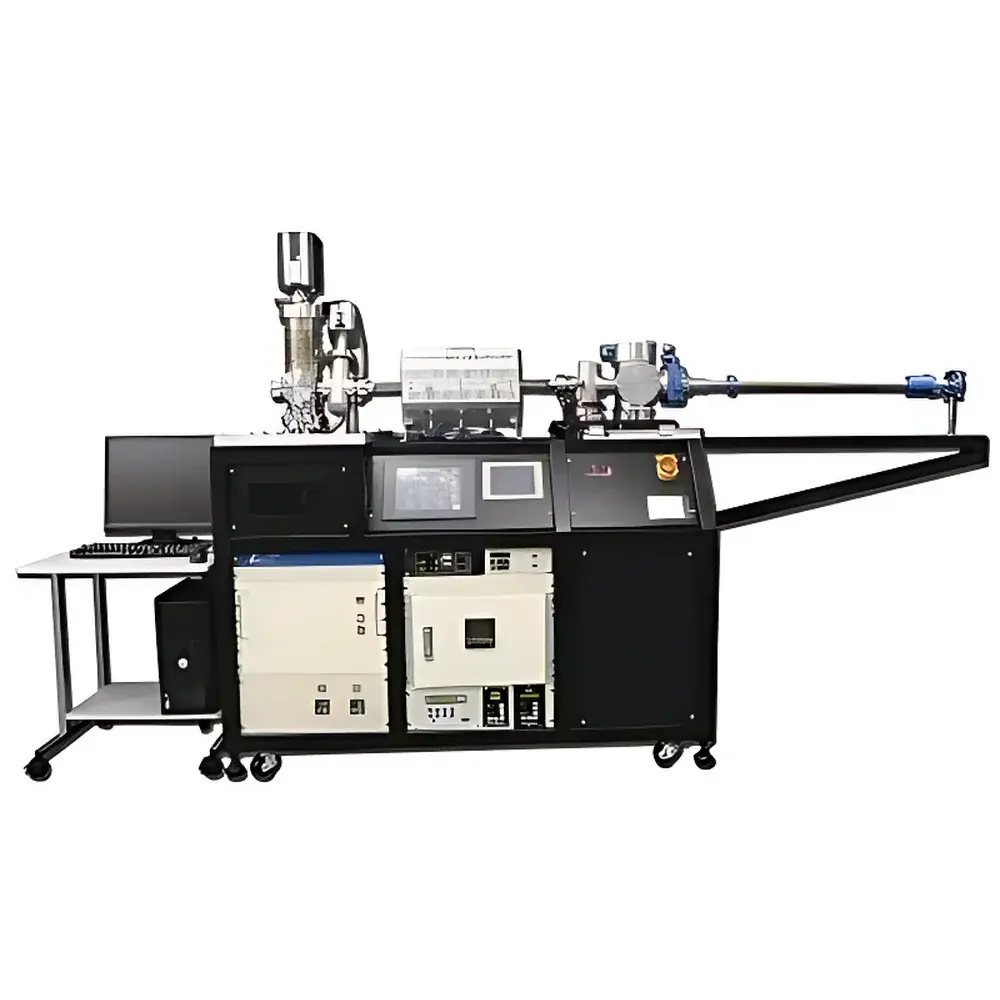
RDEC-NIMS HTDS-002 High-Sensitivity Thermal Desorption Hydrogen Analyzer for Large-Scale Steel Samples
| Origin | Japan |
|---|---|
| Manufacturer Type | Authorized Distributor |
| Origin Category | Imported |
| Model | HTDS-002 |
| Price | USD 620,000 (FOB Yokohama) |
Overview
The RDEC-NIMS HTDS-002 is a high-precision, ultra-high vacuum (UHV) thermal desorption hydrogen analyzer engineered specifically for quantitative determination of hydrogen content in large-volume ferrous metallurgical specimens—particularly structural steels, high-strength low-alloy (HSLA) steels, and advanced ultra-high-strength steels (UHSS). It operates on the principle of controlled thermal desorption coupled with quadrupole mass spectrometry (QMS), enabling trace-level detection and quantification of hydrogen liberated from solid metal matrices upon programmed heating. Hydrogen atoms diffusing from lattice interstices and trapping sites are thermally mobilized, evolved as H₂ gas, and directly introduced into a UHV analysis chamber where they are ionized, separated by mass-to-charge ratio (m/z = 2), and detected with sub-ppm(wt) sensitivity. The system’s design prioritizes metrological integrity: background hydrogen suppression (<5.0×10⁻⁹ Pa), calibrated standard gas introduction, and full traceability to NIST-traceable reference gases. Developed over a decade through joint R&D between RDEC Co., Ltd. and Japan’s National Institute for Materials Science (NIMS), the HTDS-002 meets stringent requirements for hydrogen embrittlement research, failure analysis, and quality assurance in aerospace, energy, and heavy industrial manufacturing.
Key Features
- Ultra-low hydrogen background vacuum architecture: dual-stage turbomolecular pumping (magnetic levitation + pivot-bearing) achieving ≤1×10⁻⁷ Pa base pressure and ≤5.0×10⁻⁹ Pa residual H₂ partial pressure.
- Quantitative detection limit of 0.01 ppm (wt) hydrogen in steel, validated via three-point calibration using certified H₂ standard gas flows (3.9–4.9×10⁻⁵ atm·cc/s).
- Integrated UHV sample handling: magnetically coupled sample transfer enables contamination-free loading/unloading under continuous vacuum isolation between load lock and analysis zones.
- Programmable resistive furnace with 3-zone heating control (max. 1000 °C), ±10 °C ramp accuracy (50–600 °C/hr), and real-time thermocouple feedback synchronized to QMS data acquisition.
- Touchscreen-based operational interface with hardware-enforced interlocks preventing unauthorized parameter changes or unsafe vacuum sequences.
- Electropolished SUS-316 analysis chamber baked at 200 °C; SUS-304 load lock baked at 150 °C; all flanges conform to ISO-KF/UHV standards.
Sample Compatibility & Compliance
The HTDS-002 accepts cylindrical steel specimens up to Ø20 mm × 120 mm. Surface coatings with volatilization temperatures below 1000 °C (e.g., Zn, Cd, Sn) must be fully removed prior to analysis to prevent interference and chamber contamination. The system complies with ISO 3690 (Welding — Determination of hydrogen content in ferritic steels), ASTM E1447 (Standard Test Method for Determination of Hydrogen in Titanium and Titanium Alloys), and supports GLP/GMP audit readiness through full electronic record retention, user-access logging, and 21 CFR Part 11–compliant software modules (via optional validation package). All vacuum components meet UHV outgassing specifications (<1×10⁻⁹ Torr·L/s), and furnace materials (Kanthal A1 heating wire, quartz tube liner) are selected for minimal hydrogen contribution during thermal cycling.
Software & Data Management
Data acquisition and processing are managed by Process Eye Professional QMS control software running on a dedicated Windows XP platform (upgradable to Windows 10 LTSB with driver certification). The software provides synchronized time-resolved monitoring of H₂ signal intensity (m/z = 2) versus furnace temperature, with configurable sampling intervals (0.6–3.5 s). Built-in EasyView modules support multi-channel ion current logging (12 m/z channels), leak-check diagnostics, and real-time background subtraction. Quantitative analysis employs proprietary algorithms that integrate net H₂ peak area over user-defined temperature windows, correct for instrumental background (measured pre- and post-run), and normalize against calibrated standard gas injections. All raw spectra, temperature logs, vacuum status timestamps, and calculation parameters are saved in ASCII-compatible .csv and proprietary binary formats for long-term archival and third-party statistical analysis.
Applications
- Hydrogen embrittlement susceptibility assessment of pipeline steels, offshore structural alloys, and automotive UHSS grades.
- Process validation of vacuum degassing, electroplating, pickling, and welding procedures affecting hydrogen ingress.
- Fundamental research on hydrogen trapping kinetics, diffusion coefficients, and trap binding energies in microstructurally complex steels.
- Failure analysis of catastrophic fractures where hydrogen-assisted cracking (HAC) is suspected.
- Qualification of hydrogen-resistant materials for nuclear reactor pressure vessels and hydrogen storage infrastructure.
FAQ
What is the maximum sample mass the HTDS-002 can accommodate?
The system accepts specimens up to Ø20 mm × 120 mm in dimension; typical mass ranges from 15 g to 120 g depending on density. Larger geometries require custom furnace liner adaptation.
Does the system support automated temperature ramping protocols?
Yes—predefined heating profiles (linear, step, hold-and-ramp) can be stored and recalled via touchscreen interface, with real-time synchronization to mass spectral acquisition.
How is hydrogen quantification traceability ensured?
Traceability is established through certified H₂ standard gas injections (three-point calibration), documented vacuum performance metrics, and software audit trails meeting ISO/IEC 17025 documentation requirements.
Can the system analyze non-ferrous metals such as titanium or aluminum alloys?
While optimized for steel, the HTDS-002 is technically capable of analyzing other hydrogen-containing metals; however, method validation per ASTM E1447 or ISO 10848 is required for regulatory reporting.
Is remote diagnostics and software update support available?
Yes—RDEC provides secure remote access for firmware updates, calibration verification, and troubleshooting under signed service agreement terms.




