
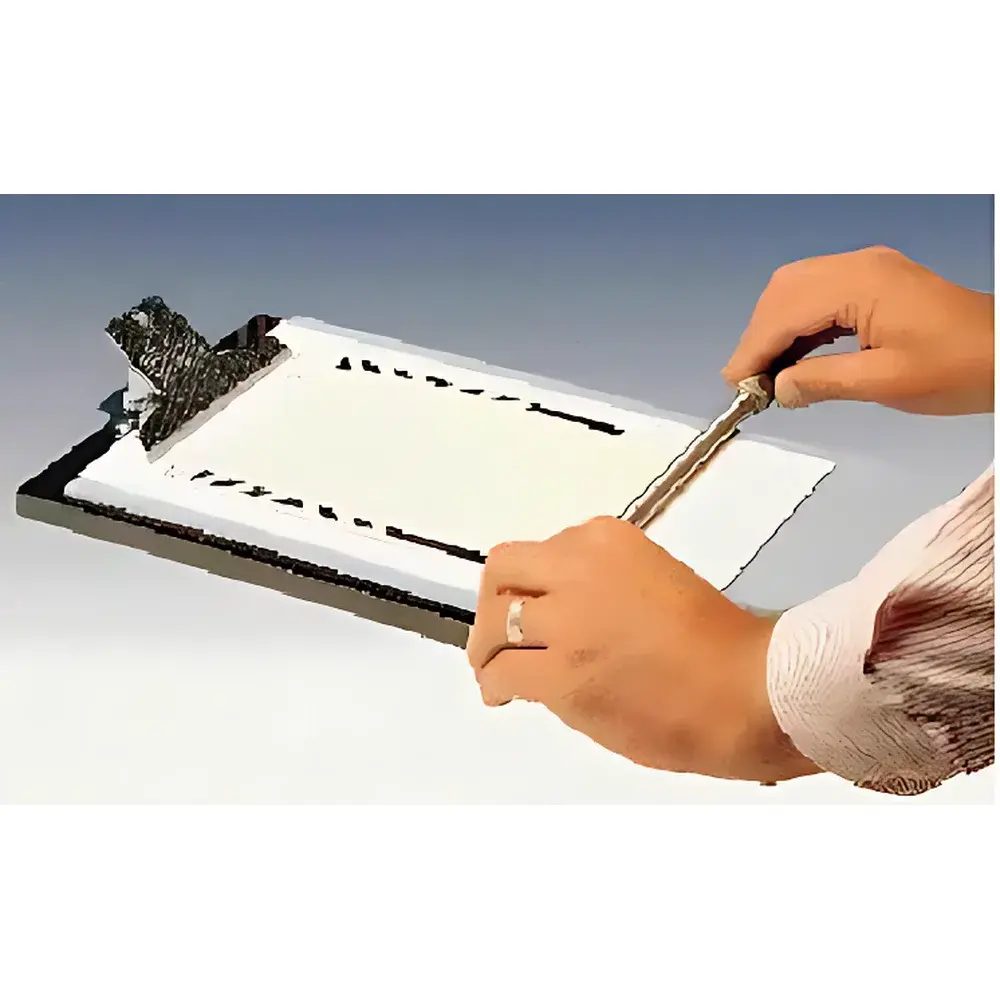
RDS Stainless Steel Wire Wound Drawdown Rods (USA-Made)
| Origin | USA |
|---|---|
| Manufacturer Type | Authorized Distributor |
| Origin Category | Imported |
| Model Range | No. 3 to No. 75 |
| Pricing | Available Upon Request |
| Diameter | 3/8″ (9.6 mm) |
| Overall Length | 16″ (406 mm) |
| Coated Length | 12″ (305 mm) |
| Handle Dimensions | 2″ × 2″ (51 mm × 51 mm) |
| Coating Thickness Range | 7.0–171.0 µm (corresponding to rod numbers 3–75) |
Overview
RDS Stainless Steel Wire Wound Drawdown Rods are precision-engineered laboratory tools designed for consistent, repeatable wet film thickness application in coating, ink, adhesive, and polymer formulation development and quality control. Manufactured in the United States to stringent dimensional tolerances, each rod consists of a rigid 3/8″ (9.6 mm) diameter stainless steel mandrel precisely wound with calibrated stainless steel wire—forming a uniform helical groove geometry that governs the final wet film thickness upon drawdown. The principle of operation is based on controlled volumetric displacement: as the rod is drawn across a substrate at a consistent speed and angle, the gap between adjacent wire turns defines the thickness of the deposited liquid layer. This method provides traceable, non-contact, and operator-independent film formation—critical for ASTM D823, ISO 2808, and ISO 1514 compliant testing protocols.
Key Features
- US-sourced 304 or 316 stainless steel construction ensures long-term corrosion resistance, mechanical stability, and compatibility with solvents, acids, and caustic formulations.
- Precision-wound wire geometry guarantees high reproducibility across batches; each rod number corresponds to a certified nominal wet film thickness (e.g., No. 3 = 7.0 µm, No. 75 = 171.0 µm), validated per RDS’s internal calibration protocol aligned with NIST-traceable reference standards.
- 16″ (406 mm) overall length with a 12″ (305 mm) active winding zone enables full-width drawdown on standard test panels (e.g., Leneta charts, ISO 1514 panels) without edge interference.
- Robust 2″ × 2″ (51 mm × 51 mm) square handle section provides ergonomic grip, minimizes torque-induced wobble during manual drawdown, and supports integration with motorized drawdown apparatuses (e.g., BYK Automatic Film Applicator).
- Surface finish meets Ra ≤ 0.4 µm specification to prevent unintended shear thinning or particle entrapment during application—essential for nanoparticle dispersions and high-solids coatings.
Sample Compatibility & Compliance
These rods are compatible with Newtonian and mildly shear-thinning fluids having viscosities up to 5000 mPa·s (at 25°C). They are routinely employed in QC labs validating conformal coatings (IPC-CC-830), automotive OEM paint systems (SAE J2334), and pharmaceutical film-coated tablets (USP ). All rods comply with ISO 2808 Annex A (wire-wound applicator method) and support GLP-compliant documentation when used with calibrated substrates and environmental controls (23 ± 2°C, 50 ± 5% RH). Traceability documentation—including lot-specific calibration certificates referencing ASTM D1212 and ISO 2360—is available upon request for audit readiness.
Software & Data Management
While the rods themselves are passive mechanical instruments, they integrate seamlessly into digital lab workflows. When paired with automated drawdown systems (e.g., Elcometer 456 or Erichsen 301), raw film thickness data can be logged via RS-232 or USB interfaces into LIMS or ELN platforms supporting 21 CFR Part 11 compliance. RDS provides downloadable Excel-based lookup tables mapping rod number to nominal thickness (µm), including temperature-corrected values for solvents with known thermal expansion coefficients. Audit trails for calibration history and usage logs may be maintained manually or synchronized with instrument management modules in LabWare or Veeva Vault QMS.
Applications
- Formulation screening of architectural paints, industrial primers, and UV-curable inks under controlled wet film conditions.
- Accelerated weathering sample preparation where precise film thickness directly impacts degradation kinetics (ASTM G154, ISO 4892-3).
- Adhesion testing per ASTM D3359—uniform film thickness ensures consistent cross-hatch evaluation across substrate types (metal, plastic, wood).
- Optical property characterization (gloss, haze, transparency) requiring sub-micron thickness repeatability on glass or PET substrates.
- Validation of rheological models by correlating rod-derived wet film thickness with predicted flow profiles from computational fluid dynamics (CFD) simulations.
FAQ
How is wet film thickness verified for each rod number?
Each production batch undergoes optical profilometry (Wyko NT1100) and stylus profilometry (Dektak XT) at three axial positions along the coated length; mean deviation from nominal is reported in the certificate of conformance.
Can these rods be cleaned with acetone or chlorinated solvents?
Yes—stainless steel construction permits immersion in common organic solvents; however, prolonged exposure to hydrochloric acid or bleach requires post-rinse with deionized water and immediate drying to prevent pitting.
Is there a recommended drawdown speed for optimal repeatability?
For manual operation, 1–2 cm/s is typical; automated systems use 5–10 cm/s with dwell time ≥ 0.5 s before lift-off—speed must be documented per ISO 2360 Annex B for report validity.
Do rod numbers correspond to dry film thickness?
No—rod numbers define nominal wet film thickness only; final dry thickness depends on solids content, solvent volatility, and substrate porosity, and must be measured separately (e.g., eddy current or micrometer).
Are custom rod numbers or diameters available?
RDS offers OEM manufacturing for specialized geometries (e.g., 1/4″ mandrels, non-standard wire pitch); lead time is 8–10 weeks with minimum order quantity of 25 units.



