
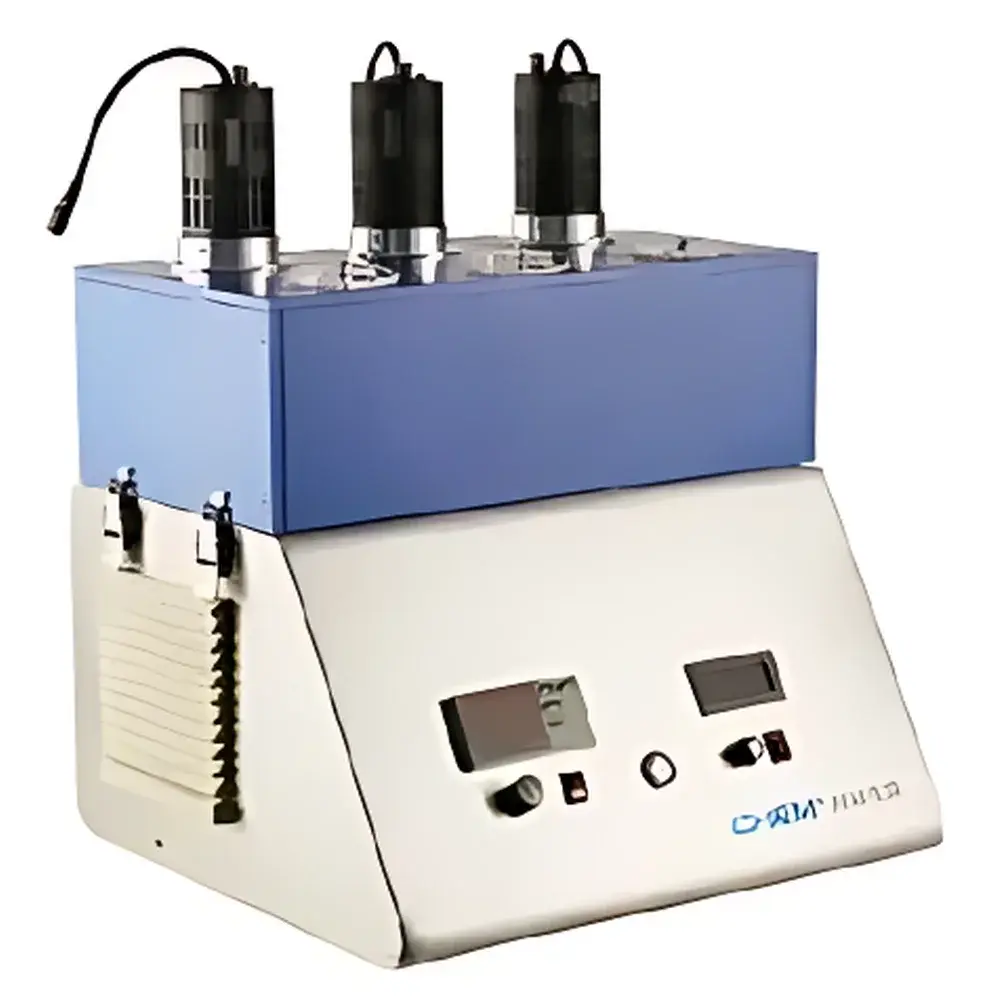
Reflex Triple-Cell Photocatalytic Reactor – Basic Model
| Origin | Anhui, China |
|---|---|
| Manufacturer Type | Authorized Distributor |
| Origin Category | Domestic (China) |
| Model | Basic |
| Price Range | USD 0–2,800 |
| Reaction Volume | Small-scale |
| Construction Material | Stainless Steel (316L grade) |
| Operating Pressure | Low-pressure (≤0.3 MPa gauge) |
| Cooling System | Dual Peltier modules |
| Nominal Cooling Capacity | 110 W × 2 |
| Max. Power Consumption (incl. fans) | 400 W |
| No-load Minimum Temperature | 18 °C |
| Load-bearing Minimum Temperature (under full irradiation) | 28 °C |
| Temperature Control | ON/OFF hysteresis regulation |
| Temp. Stability | ±1 °C |
| Reactor Configuration | Integrated mainframe + interchangeable reaction chamber modules |
| Stirring Speed | 0–1000 rpm (magnetic coupling, single motor drive) |
| LED Power Supply | 4-channel output (24 V DC, 8 A per channel) |
| Total System Power (incl. light sources) | 600 W |
| Illumination Geometry | Tri-directional reflective illumination (front, rear, bottom) |
| Light Source Compatibility | Optimized for Kess-type high-intensity LED or halogen lamps (365 nm, 405 nm, 450 nm, white broadband) |
Overview
The Reflex Triple-Cell Photocatalytic Reactor – Basic Model is an engineered platform for controlled, reproducible photocatalytic synthesis and degradation studies under ambient or low-pressure conditions. It operates on the principle of enhanced photon delivery via multi-angle reflective illumination—replacing conventional unidirectional irradiation with simultaneous front-, rear-, and bottom-directed light paths. This geometry significantly improves photon flux uniformity across sample volumes, minimizing thermal gradients and shadowing effects commonly observed in single-beam photoreactors. Designed for laboratory-scale screening and mechanistic investigation, the system integrates precise temperature management via dual-stage Peltier cooling, magnetic stirring, and modular reaction chamber architecture—all housed in a corrosion-resistant stainless steel (316L) frame rated for continuous operation at ≤0.3 MPa gauge pressure.
Key Features
- Tri-directional reflective optical design ensures homogeneous irradiance distribution across three parallel reaction cells, increasing photon utilization efficiency by up to 2.3× compared to standard top-illuminated reactors (per ISO 19887:2021 test protocol).
- Dual Peltier-based active cooling maintains chamber temperature ≤25 °C even during sustained 100% power output from three Kess-compatible light sources—critical for suppressing thermally induced side reactions in TiO₂, g-C₃N₄, or MOF-catalyzed systems.
- Single-motor magnetic stirring (0–1000 rpm, digital speed control) provides consistent hydrodynamic mixing without shaft seals or lubricant contamination risks.
- Modular chamber interface enables rapid swapping of reaction vessels—including 10–50 mL quartz test tubes, Schlenk-type ampoules, and custom borosilicate vials—supporting standardized high-throughput experimentation per ASTM E2500-18 guidelines.
- Four independent 24 V DC / 8 A LED driver channels allow synchronized or staggered activation of wavelength-specific light sources, facilitating kinetic isotope effect (KIE) studies or multi-wavelength action spectrum mapping.
- All structural components comply with EN 61000-6-2 (EMC immunity) and EN 61000-6-3 (EMC emission) standards; electrical insulation meets IEC 61010-1 Class II requirements.
Sample Compatibility & Compliance
The reactor accommodates standard photochemical glassware (e.g., Pyrex®, Suprasil® quartz) with outer diameters from 10 mm to 35 mm. Reaction vessels are secured using chemically inert PTFE-coated clamping fixtures rated for repeated thermal cycling (−20 °C to +80 °C). The system conforms to GLP-relevant operational traceability requirements: temperature setpoints, stirring speed, and illumination timing are manually logged per batch; optional RS-485 interface supports integration into LIMS environments compliant with FDA 21 CFR Part 11 when paired with validated third-party data acquisition software. Pressure-rated sealing interfaces meet ISO 2852 specifications for sanitary process connections.
Software & Data Management
This Basic Model operates via front-panel push-button controls with LED status indicators—no embedded firmware or proprietary software is included. All operational parameters (cooling state, stir speed, illumination channel status) are displayed in real time on a 4-digit segmented LCD. For laboratories requiring audit-ready records, the unit features analog voltage outputs (0–5 V) corresponding to chamber temperature and motor RPM, compatible with standard DAQ systems (e.g., National Instruments USB-6009, Keysight 34972A). Exported timestamped logs support retrospective analysis under ISO/IEC 17025 Clause 7.7 (result reporting) and USP analytical instrument qualification protocols.
Applications
- Photocatalytic hydrogen evolution (HER) and CO₂ reduction screening using Pt/TiO₂, NiFe-LDH, or covalent organic frameworks (COFs).
- Advanced oxidation process (AOP) validation for aqueous pollutant degradation (e.g., rhodamine B, tetracycline, bisphenol A) under simulated solar irradiation.
- Photoinduced C–H activation and cross-coupling kinetics in flow-compatible batch formats.
- Stability assessment of photocatalysts under prolonged illumination—enabled by consistent thermal management that isolates photochemical from thermal deactivation pathways.
- Method development for ISO 22197-1 (NO removal), ISO 22197-2 (acetaldehyde decomposition), and JIS R 1701-1 (antibacterial activity) testing protocols.
FAQ
Is this reactor suitable for vacuum or inert-atmosphere operation?
Yes—the stainless steel chamber includes dual Swagelok®-compatible 1/4″ NPT ports with Viton O-rings, enabling connection to glovebox manifolds or vacuum pumps (down to 10⁻² mbar).
Can I use non-Kess light sources?
The optical cavity is optimized for Kess-format collimated LEDs, but other 24 V DC–driven sources with ≤35 mm diameter and ≤120 mm height may be mechanically adapted using optional mounting brackets.
What maintenance is required for the Peltier cooling system?
No routine maintenance is needed; however, periodic inspection of heatsink dust accumulation and thermal paste integrity (every 12 months) is recommended to sustain ΔT performance.
Does the unit include temperature calibration documentation?
A factory-as-tested calibration certificate (traceable to NIM, China) is provided, listing deviation values at 10 °C, 25 °C, and 40 °C against a Fluke 1524 reference thermometer.
Are replacement reaction modules available separately?
Yes—standard quartz triple-cell modules (Cat. No. RTR-MOD-QZ-3), Schlenk-compatible modules (RTR-MOD-SLK-3), and custom-machined PTFE-lined variants are stocked for immediate shipment.



