
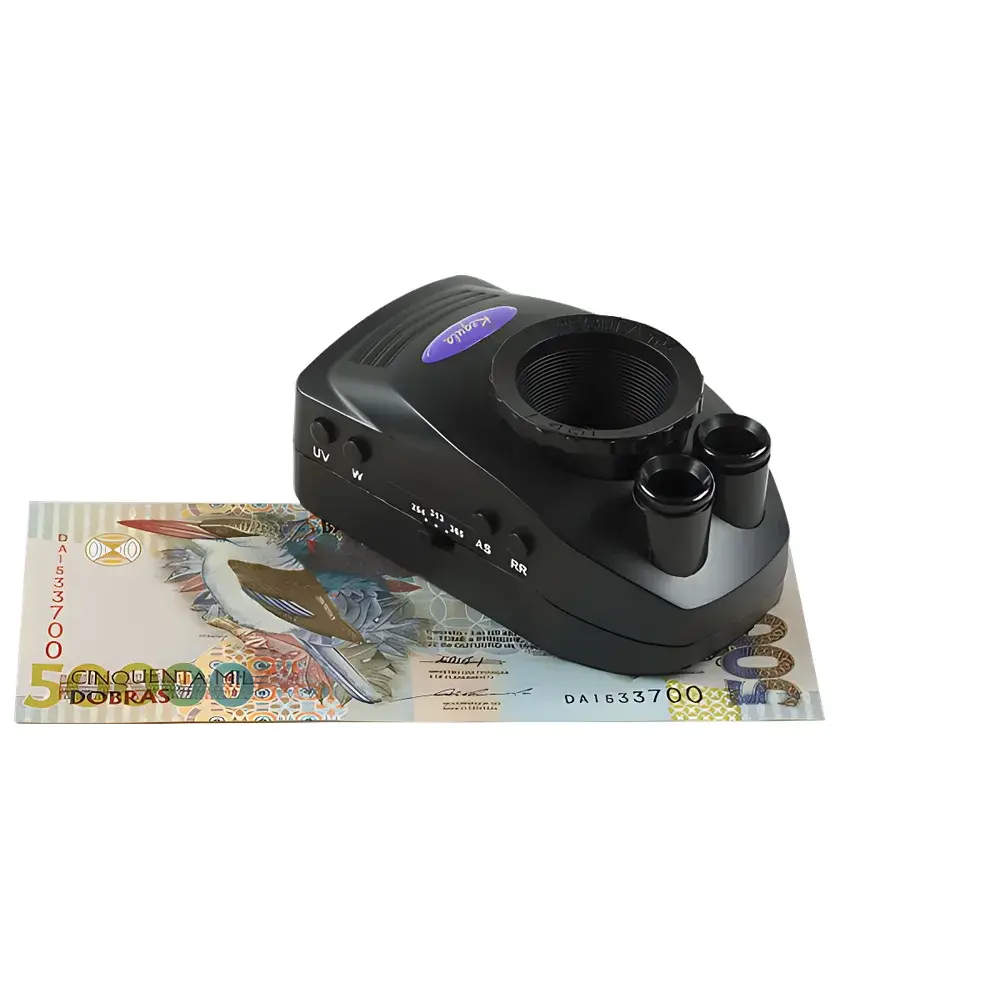
Regula 1019 Document Examination Mouse – Portable Multi-Spectrum Stereo Magnifier
| Brand | Regula |
|---|---|
| Origin | Belarus |
| Model | 1019 |
| Dimensions (L×W×H) | 96 × 45 × 58 mm |
| Weight (without batteries) | 0.15 kg |
| Power Supply | 2 × AAA batteries |
| Magnification | 10× or 15× (switchable) |
| Focusing | Manual, continuous variable focus |
| Illumination Modes | White light, dual-side lighting, ring light (for OVD/hologram inspection), white/UV flash combination, four UV bands (254 nm, 313 nm, 365 nm, 400 nm), coaxial illumination, wide-field anti-Stokes illumination, narrow-field anti-Stokes illumination |
| Reticle | Integrated calibrated scale graticule for dimensional measurement |
| Compliance | Designed for forensic document examination workflows in accordance with ISO/IEC 17025–aligned laboratory practices |
Overview
The Regula 1019 Document Examination Mouse is a handheld, ergonomically engineered stereo magnifier specifically designed for non-destructive, on-the-spot forensic verification of security documents. Operating on the principle of multi-spectral optical contrast enhancement, it enables simultaneous visual analysis under precisely controlled illumination conditions—including transmitted light, reflected light, and fluorescence excitation—across ultraviolet, visible, and near-infrared spectral domains. Its compact, mouse-shaped form factor integrates high-resolution optics with a modular illumination system to support rapid comparative assessment of physical document features without requiring sample preparation or external power sources. The device is routinely deployed in border control checkpoints, national ID issuance offices, central bank cash handling units, notary services, and forensic laboratories where field-deployable, GLP-compliant visual inspection tools are mandated.
Key Features
- Ergonomic, shock-resistant polymer housing optimized for extended handheld operation and drop resilience in mobile environments.
- Switchable magnification (10× / 15×) with continuously adjustable focus mechanism ensuring optimal depth-of-field for layered security elements (e.g., laminates, holographic foils, microprinting).
- Comprehensive multi-spectral illumination suite: four discrete UV wavelengths (254 nm, 313 nm, 365 nm, 400 nm) for detecting anti-Stokes inks, security threads, and phosphorescent tags; coaxial lighting for specular reflection analysis of embossed seals and intaglio printing; ring illumination for uniform OVD (Optically Variable Device) and hologram evaluation.
- Integrated precision reticle with calibrated metric scale enabling direct linear measurement of security features (e.g., line width, microtext height, perforation pitch) within ±0.1 mm accuracy under optimal focus conditions.
- Dual-side lighting configuration facilitates shadow-based topographic assessment of raised ink, latent images, and mechanical alterations such as erasures or chemical bleaching.
- Flash-mode white/UV combination illumination supports instantaneous comparison between normal and excited-state appearance—critical for verifying dynamic security features like thermochromic or photochromic inks.
Sample Compatibility & Compliance
The Regula 1019 is validated for use across a broad spectrum of security media, including but not limited to machine-readable travel documents (ICAO-compliant e-passports), national identity cards (ISO/IEC 7810 ID-1 format), driver’s licenses, vehicle registration certificates, banknotes (ISO 22320:2020 referenced), fiscal stamps, bearer bonds, and notarized legal instruments. Its illumination geometry and spectral output align with international forensic imaging standards, including EN 16108:2019 (security document verification procedures) and ICAO Doc 9303 Part 10 (machine-readable passport inspection guidelines). While not a certified measuring instrument per ISO/IEC 17025 calibration requirements, its optical path stability and repeatable illumination positioning support traceable qualitative assessment workflows in accredited laboratories operating under ISO/IEC 17025 quality management systems.
Software & Data Management
The Regula 1019 operates as a standalone optical inspection tool with no embedded firmware or digital connectivity. It does not generate electronic records, store images, or interface with external software platforms. This architecture ensures full compliance with air-gapped operational protocols required in high-security government facilities and eliminates potential data leakage vectors associated with networked devices. All observations are documented manually or via synchronized external imaging systems (e.g., Regula’s companion document scanners or third-party forensic cameras), maintaining audit-trail integrity in accordance with ISO/IEC 17025 clause 7.5.2 (recording of observations) and supporting evidentiary chain-of-custody documentation.
Applications
- Verification of UV-fluorescent security threads, planchettes, and optically variable inks in banknotes and passports.
- Assessment of holographic overlay integrity, diffraction efficiency, and angular response using ring and coaxial illumination modes.
- Detection of chemical alterations (e.g., solvent-based tampering, bleach exposure) through differential absorption under 254 nm and 313 nm UV.
- Measurement of typographic consistency in machine-printed text, including font height, inter-character spacing, and line thickness deviation from reference specimens.
- Transmitted-light inspection of watermark clarity, paper fiber distribution, and embedded security fibers in document substrates.
- Comparative analysis of signature morphology, pen pressure variation, and ink flow characteristics under side-lighting and anti-Stokes excitation.
FAQ
Is the Regula 1019 suitable for ISO/IEC 17025-accredited laboratories?
Yes—it supports qualitative forensic examination workflows aligned with ISO/IEC 17025 clause 7.2.2 (selection of examination methods) when used in conjunction with documented standard operating procedures and trained personnel.
Does the device require calibration or periodic verification?
No formal calibration is specified by the manufacturer; however, users are advised to perform routine functional checks of illumination uniformity, focus repeatability, and reticle alignment against traceable reference standards.
Can the 1019 be used for detecting counterfeit pharmaceutical packaging?
Yes—its multi-spectral illumination and 15× magnification enable verification of security labels, batch codes, holograms, and UV-reactive tamper-evident seals commonly applied to pharmaceutical blister packs and cartons.
What battery life can be expected during continuous operation?
With two fresh AAA alkaline cells, typical operational duration exceeds 8 hours under mixed illumination mode usage; LED drivers maintain stable spectral output throughout discharge cycle.
Is the reticle scale metric or imperial?
The integrated graticule is metric-calibrated with 0.5 mm major divisions and 0.1 mm minor subdivisions, traceable to NIST-traceable reference slides used in validation protocols.





