
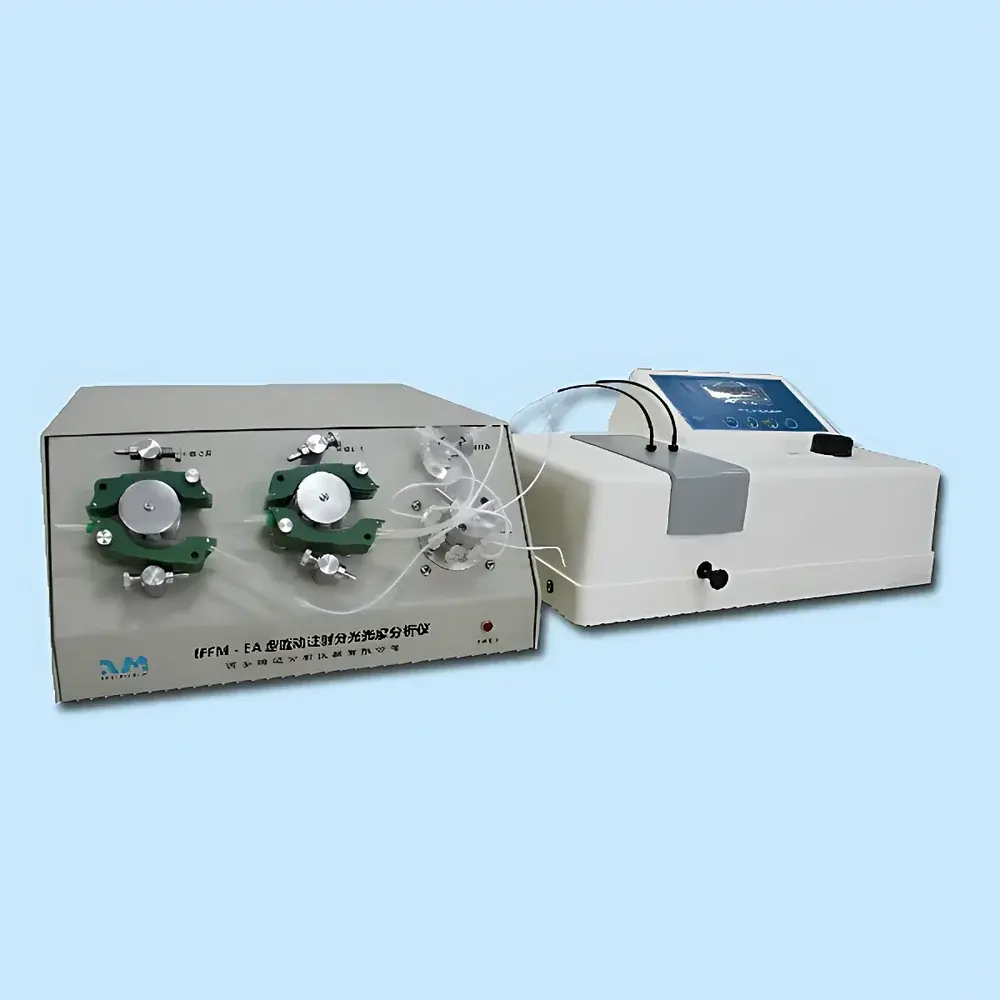
REMEX IFFM-EA Flow Injection Spectrophotometer
| Brand | REMEX |
|---|---|
| Origin | Shaanxi, China |
| Model | IFFM-EA |
| Product Type | Flow Injection Analyzer |
| Wavelength Range | 325–1000 nm |
| Cuvette Path Length | 10 mm (standard, fixed) |
| Wavelength Accuracy | ≤ ±2 nm |
| Wavelength Repeatability | 1 nm |
| Spectral Bandwidth | 5 nm |
| Stray Light | < 0.1% T (at NaNO₂) |
| Dark Current Drift | 0.2% T / 3 min |
| Light Current Drift | 0.5% T / 3 min |
| Data Acquisition Rate | 1–100 samples/s |
| Gain Settings | 1×, 2×, 4×, 8×, 16× |
| Filter Cutoff Frequency | 10–100 Hz |
| Pump Speed Control | 0–99 digital steps |
| Number of Pump Channels | 10 (5 per pump) |
| Valve Configuration | 16-position auto/manual selector valve |
Overview
The REMEX IFFM-EA Flow Injection Spectrophotometer is a fully automated, benchtop analytical platform engineered for high-reproducibility spectrophotometric quantification in flow injection analysis (FIA) mode. It operates on the fundamental principle of controlled dispersion and reaction kinetics within a continuous carrier stream, where discrete sample zones are introduced into a reagent-carrying stream, allowed to undergo defined mixing and reaction times in coiled tubing, and then detected via UV-Vis absorbance at a fixed or programmable wavelength. Unlike segmented-flow or continuous-flow systems, this instrument leverages FIA’s inherent precision in zone definition, temporal resolution, and reagent economy—enabling rapid, low-volume (<100 µL/sample), and contamination-minimized assays. Its architecture integrates a dual high-precision peristaltic pumping system, a modular optical detection unit based on the 722N visible spectrophotometer, and a dedicated PC-based control and data acquisition environment. Designed for method development and routine QC/QA workflows, the IFFM-EA supports both static (cuvette-based) and dynamic (flow-through) measurement paradigms without hardware modification.
Key Features
- Dual independent peristaltic pumps with 0–99-step digital speed control, supporting up to 10 simultaneous fluidic channels (5 per pump) for multi-analyte or multi-reagent protocols.
- 16-position programmable selector valve enabling automated reagent switching, standard addition, calibration series delivery, and multi-step derivatization sequences.
- Integrated 722N single-beam visible spectrophotometer featuring low-stray-light optics (≤0.1% T at NaNO₂), 5 nm spectral bandwidth, and calibrated wavelength accuracy (±2 nm) across 325–1000 nm.
- Real-time analog signal conditioning: adjustable gain (1×–16×), configurable low-pass filtering (10–100 Hz cutoff), and user-defined sampling rates (1–100 Hz) to resolve fast kinetic transients.
- Hardware synchronization interface: external analog input (0–5 V) allows triggering or gated acquisition from auxiliary instruments (e.g., pH meters, conductivity detectors, or electrochemical cells).
- Full zero/100%T auto-calibration capability with LED-displayed transmittance (%T), absorbance (A), and concentration values—traceable to NIST-traceable standards.
Sample Compatibility & Compliance
The IFFM-EA accommodates aqueous and mildly organic solvent-based samples (up to 20% v/v methanol or acetonitrile) compatible with standard Tygon® or PharMed® tubing. Sample volumes range from 20 µL to 500 µL per injection, with typical linear dynamic ranges spanning 2–4 orders of magnitude depending on analyte extinction coefficient and path length. The system meets core functional requirements of ISO 8466-1 (calibration of analytical methods), ASTM D3370 (sampling and analysis of water), and USP (spectrophotometric analysis). While not pre-certified for 21 CFR Part 11, its software architecture supports audit trail logging, user access levels, and electronic signature-ready data export (CSV, TXT, XML), facilitating GLP/GMP-aligned validation when deployed in regulated environments.
Software & Data Management
The REMEX Full-Chinese Data Analysis System (English-localized version available upon request) provides unified control of fluidics, detection, and kinetics processing. It enables real-time plotting of absorbance vs. time (FIA peaks), automatic peak integration (area, height, width), baseline correction, and multi-curve overlay for method optimization. Users may define custom reaction zones, apply point-wise outlier removal, compute derivative spectra, and export time-resolved datasets with timestamped metadata. All raw signals and processed results are stored in structured binary archives with embedded instrument configuration parameters, ensuring full traceability. Export formats include ASCII-delimited tables suitable for import into LIMS, MATLAB, or statistical packages (e.g., JMP, Minitab).
Applications
- Environmental monitoring: nitrate, phosphate, silicate, ammonia, and cyanide in surface/groundwater per EPA Methods 353.2, 365.1, and ISO 15681.
- Food & beverage quality control: sulfite, nitrite, total phenolics, and antioxidant capacity (FRAP, DPPH) using standardized kinetic protocols.
- Clinical chemistry research: enzymatic assays (e.g., glucose oxidase, alkaline phosphatase) requiring precise reaction timing and temperature-stable flow paths.
- Pharmaceutical intermediate analysis: dissolution testing support, content uniformity screening, and stability-indicating assays under ICH Q2(R2) guidelines.
- Method development laboratories: kinetic parameter extraction (kobs, t1/2), dispersion modeling, and residence time distribution (RTD) characterization.
FAQ
What is the optical path length of the flow cell used in the IFFM-EA system?
The standard flow-through detection cell employs a 10 mm path length quartz or high-transmission glass cuvette, optimized for sensitivity and minimal backpressure in laminar flow conditions.
Can the IFFM-EA be interfaced with third-party HPLC or GC systems?
Yes—via its 0–5 V analog input port, the system can accept external trigger pulses or analog detector outputs for synchronized data acquisition, though no native digital communication (e.g., RS-232, USB-TMC) is provided for bidirectional instrument control.
Is wavelength scanning supported during flow injection runs?
No—the 722N module operates at a fixed wavelength selected prior to analysis; spectral scanning requires manual cuvette-mode operation outside the FIA workflow.
What maintenance is required for long-term peristaltic pump reliability?
Pump tubing should be replaced every 500–1000 hours of cumulative operation; REMEX recommends PharMed BPT or Norprene LFT tubing for chemical resistance and dimensional stability across pH 2–12.
Does the software support automated calibration curve generation and concentration back-calculation?
Yes—linear, quadratic, and cubic regression models are available with residual analysis, limit-of-detection (LOD) estimation, and forced-zero-intercept options compliant with ISO/IEC 17025 reporting requirements.
Related Products




