
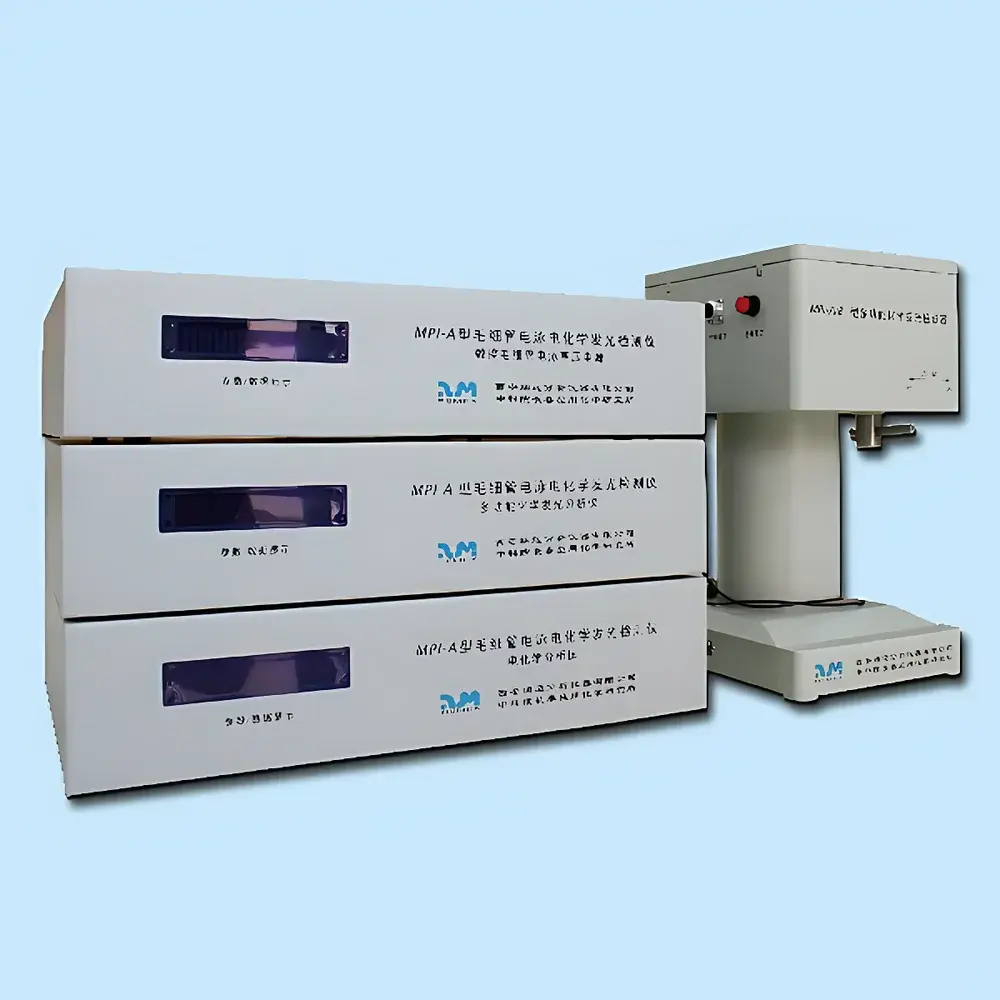
REMEX MPI-A Capillary Electrophoresis Electrochemiluminescence Detector
| Brand | REMEX |
|---|---|
| Origin | Shaanxi, China |
| Model | MPI-A |
| Current Range | ±250 mA |
| Potential Range | −10 V to +10 V |
| Reference Electrode Input Impedance | 10 MΩ |
| Sensitivity | 1 × 10⁻⁹ A to 1 × 10⁻² A (8 decades) |
| Input Bias Current | <50 pA |
| Potential Increment | 1 mV |
| Scan Rate | 0.001–65 V/s |
| CE High-Voltage Power Supply Output | 0–20 kV / 0–300 µA |
| Photodetector HV Input | −100 to −1000 V |
| Wavelength Response Range | 300–650 nm (peak @ 420 nm) |
| Dynamic Range | >5 decades |
| Amplifier Gain | 1×, 10×, 100×, 1000× |
| Filter Frequencies | 10 Hz, 20 Hz, 50 Hz, 100 Hz |
| Integration Time | 0.001–10 s |
| Sampling Rate | 1–200 Hz |
| Signal Noise | ≤0.5 mV (P-P, 1× gain) |
| Amplifier Drift | <0.05% |
Overview
The REMEX MPI-A Capillary Electrophoresis Electrochemiluminescence Detector is a fully integrated analytical platform engineered for high-sensitivity, multi-modal detection in capillary electrophoresis (CE) and electrochemical analysis workflows. It combines three core functional modules—potentiostat/galvanostat, programmable CE high-voltage power supply, and photon-counting electrochemiluminescence (ECL) detector—into a single synchronized instrument controlled via native Windows-based software. The system operates on the principle of electrochemiluminescence, where redox-active species (e.g., Ru(bpy)₃²⁺/tripropylamine) undergo electrode-driven electron transfer at precisely controlled potentials, generating transient light emission proportional to analyte concentration. This optical signal is captured by a high-quantum-efficiency photomultiplier tube (PMT) with spectral response optimized from 300 nm to 650 nm (peak sensitivity at 420 nm), enabling sub-picomolar detection limits in complex biological matrices. Unlike conventional UV-Vis or fluorescence CE detectors, ECL eliminates background excitation light and photobleaching, delivering superior signal-to-noise ratios and long-term measurement stability—critical for quantitative clinical assay development and regulatory-compliant bioanalysis.
Key Features
- Integrated potentiostat with ±250 mA current range and ultra-low input bias current (<50 pA), ensuring accurate low-current ECL signal acquisition without amplifier-induced drift
- Wide potential control window (−10 V to +10 V) with 1 mV resolution and programmable scan rates (0.001–65 V/s), supporting cyclic voltammetry, linear sweep, and amperometric ECL triggering protocols
- Dedicated CE high-voltage power supply (0–20 kV, 0–300 µA) with independent programmable control over injection voltage/duration and separation voltage/time—enabling reproducible electrokinetic sample introduction and optimized separation efficiency
- Multi-gain, low-drift photodetection system (1×–1000×) with selectable analog filtering (10–100 Hz) and user-defined integration times (1 ms–10 s), accommodating both transient flash-type and sustained glow-type ECL kinetics
- USB 2.0 interface compliant with USB CDC class standards, enabling deterministic data streaming, real-time synchronization between electrochemical waveform generation and photon counting, and full compatibility with third-party DAQ systems
- Modular architecture: the ECL detector functions as an electrically shielded enclosure during electrochemical measurements, minimizing electromagnetic interference (EMI) coupling into low-level current signals—a critical design feature for GLP-compliant trace analysis
Sample Compatibility & Compliance
The MPI-A supports direct analysis of aqueous and buffered samples containing small molecules (e.g., pharmaceuticals, amino acids), peptides, proteins, oligonucleotides, and antibody–drug conjugates. Its ECL detection mode is particularly suited for assays relying on Ru(bpy)₃²⁺-tagged probes or label-free coreactant systems (e.g., luminol/H₂O₂). The instrument’s hardware and firmware architecture adhere to fundamental principles outlined in ISO/IEC 17025:2017 for testing laboratories, including traceable calibration procedures for potential/current channels and photometric response validation using NIST-traceable LED standards. While not pre-certified for FDA 21 CFR Part 11, the software framework supports audit trail logging, electronic signatures, and user-access controls—enabling laboratories to configure the system for GxP environments under internal SOPs. All electrical safety complies with IEC 61010-1:2010 for laboratory equipment.
Software & Data Management
The MPI-A is operated through REMEX’s proprietary Windows-native application, built on .NET Framework 4.8 with native support for Windows 10/11 (64-bit). The software provides simultaneous dual-channel visualization: real-time electrochemical waveform (potential vs. time or current vs. potential) alongside time-resolved photon count rate (cps) with configurable averaging and baseline subtraction. Raw data are saved in HDF5 format—self-describing, hierarchical, and compatible with Python (h5py), MATLAB, and LabVIEW for downstream statistical modeling or machine learning pipelines. Export options include CSV (with metadata headers), ASCII, and PDF reports compliant with ISO/IEC 17025 documentation requirements. Calibration curves can be generated using internal standard addition or external calibration; all curve-fitting algorithms (linear, quadratic, weighted least-squares) are documented per ASTM E29-23 guidelines for significant figures and uncertainty propagation.
Applications
- Quantitative determination of therapeutic monoclonal antibodies and biosimilars in serum using Ru(bpy)₃²⁺-labeled secondary antibodies and CE-ECL immunoassays
- High-resolution separation and detection of phosphorylated vs. non-phosphorylated peptides in kinase activity profiling, leveraging differential ECL response under controlled potential windows
- Label-free detection of DNA hybridization events via intercalator-mediated ECL enhancement, applied to rapid viral nucleic acid screening (e.g., SARS-CoV-2 ORF1ab amplicons)
- Stability-indicating assays for oxidatively degraded drug substances, where ECL signal quenching correlates directly with peroxide formation kinetics
- Electrochemical binding affinity studies (e.g., protein–ligand KD determination) via titration-coupled ECL intensity decay modeling
FAQ
Can the MPI-A be used as a standalone potentiostat for conventional electrochemical experiments?
Yes—the instrument includes full electrochemical workstation functionality with standard techniques (CV, LSV, CA, DPV) and supports external cell configurations including rotating disk electrodes and flow cells.
Is the PMT detector cooled to reduce dark current noise?
No—the MPI-A employs a thermally stabilized, side-on dynode PMT with factory-optimized gain distribution; active cooling is omitted to maintain mechanical rigidity and minimize thermal drift during long-duration CE runs.
Does the software support method transfer between instruments?
Method files (.remexm) contain all hardware parameters, timing sequences, and data processing settings; they are portable across MPI-A units but require identical firmware revision levels for deterministic execution.
What maintenance is required for long-term ECL performance stability?
Annual verification of PMT quantum efficiency using calibrated 420 nm LED source and biannual recalibration of current/potential channels using NIST-traceable reference standards are recommended per ISO/IEC 17025 Clause 6.5.
Can the MPI-A interface with autosamplers or microfluidic CE chips?
The USB interface supports TTL-level trigger I/O (±5 V, opto-isolated); custom integration with third-party autosamplers or chip-based CE platforms requires OEM-level API documentation, available under NDA from REMEX Technical Support.






