
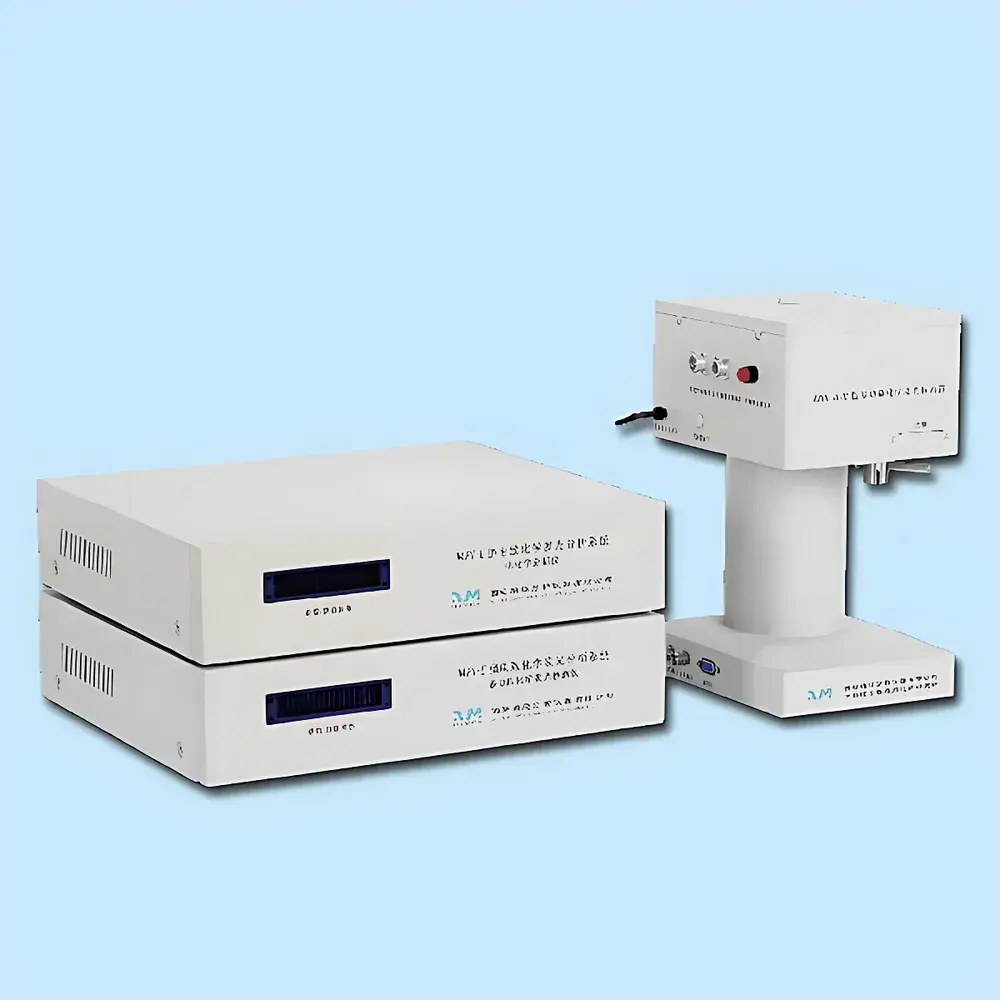
REMEX MPI-E Electrochemiluminescence Detector
| Brand | REMEX (Xi’an Remex Instrument Co., Ltd.) |
|---|---|
| Origin | Shaanxi, China |
| Model | MPI-E |
| Current Range | ±250 mA |
| Potential Range | −10 V to +10 V |
| Reference Electrode Input Impedance | 10 MΩ |
| Sensitivity | 1 × 10⁻⁹ A to 1 × 10⁻² A (8 auto-ranging decades) |
| Input Bias Current | <50 pA |
| Potential Increment | 1 mV |
| Scan Rate | 0.001–65 V/s |
| Luminescence Detection Dynamic Range | >5 decades |
| Photomultiplier Tube (PMT) High Voltage | −100 V to −1000 V |
| Emission Wavelength Range | 300–650 nm (Peak Sensitivity at 420 nm) |
| PMT Spectral Responsivity | >1000 A/lm |
Overview
The REMEX MPI-E Electrochemiluminescence Detector is a laboratory-grade, integrated analytical platform engineered for simultaneous electrochemical control and ultrasensitive luminescent signal acquisition. It operates on the principle of electrochemiluminescence (ECL), wherein electrochemical redox reactions generate excited-state species that emit photons upon relaxation—enabling label-free or label-based quantitative detection with exceptional signal-to-noise ratio and low background interference. Unlike conventional fluorescence or chemiluminescence systems, ECL eliminates the need for external excitation sources (e.g., lasers or lamps), thereby minimizing photobleaching, autofluorescence, and spectral overlap artifacts. The MPI-E is designed for rigorous research environments including academic laboratories, pharmaceutical QC/QA units, and contract research organizations conducting mechanistic studies of electron-transfer kinetics, interfacial reaction pathways, and biomolecular recognition events.
Key Features
- Integrated dual-module architecture: Synchronized electrochemical workstation (potentiostat/galvanostat) and high-gain photon-counting detection system co-located in a single chassis with shared timing control and data synchronization.
- Wide electrochemical operating envelope: ±10 V potential range and ±250 mA current compliance support demanding applications such as water oxidation, metal deposition, and high-current biosensor characterization.
- Ultra-low-noise current measurement: Input bias current <50 pA and programmable 8-decade sensitivity (1 nA–10 mA full scale) ensure reliable detection of sub-picomolar analyte concentrations in ECL immunoassays.
- High-voltage, spectrally optimized photomultiplier tube (PMT): Adjustable negative HV (−100 V to −1000 V), 300–650 nm spectral response (peak at 420 nm), and responsivity >1000 A/lm enable sensitive detection of common ECL emitters including Ru(bpy)₃²⁺, luminol derivatives, and quantum dot conjugates.
- Real-time dual-channel acquisition: Simultaneous digitization of electrochemical current/potential waveforms and time-resolved photon flux (up to 200 Hz sampling rate) with microsecond-level timestamp alignment for kinetic deconvolution.
- Hardware-level electromagnetic shielding: The integrated ECL detector housing functions as an active Faraday cage, suppressing ambient RF/EMI noise during low-signal measurements—critical for reproducible single-turnover ECL experiments.
Sample Compatibility & Compliance
The MPI-E supports aqueous and non-aqueous electrolyte systems, standard three-electrode configurations (working, counter, reference), and disposable or reusable electrode substrates—including screen-printed carbon electrodes, gold ultramicroelectrodes, and ITO-coated glass slides. Its design conforms to general laboratory safety standards (IEC 61010-1) and supports method validation under GLP-compliant workflows. While not pre-certified for clinical diagnostics (IVDR/CE-IVD), the instrument’s analog/digital signal chain meets linearity and repeatability requirements outlined in ASTM E2917 (Standard Practice for Validation of Analytical Methods) and ISO/IEC 17025:2017 (General Requirements for the Competence of Testing and Calibration Laboratories). Data integrity features include hardware timestamps, uneditable raw binary storage (.bin), and optional audit trail logging compatible with FDA 21 CFR Part 11–aligned software extensions.
Software & Data Management
The MPI-E is operated via REMEX ECL Studio v3.x—a Windows-based application offering modular experiment sequencing, real-time visualization of voltammograms and ECL intensity transients, and post-acquisition analysis tools including peak integration, baseline correction, Savitzky-Golay smoothing, and multi-exponential decay fitting. All datasets are saved in HDF5 format with embedded metadata (electrode geometry, scan parameters, PMT gain, integration time), ensuring traceability and interoperability with Python (h5py), MATLAB, or LabVIEW environments. Export options include CSV, ASCII, and image-ready PNG/PDF. The software architecture supports scripting via COM interface for automated assay protocols and integration into LIMS or ELN ecosystems.
Applications
- Quantitative immunoassays and nucleic acid hybridization assays using Ru(bpy)₃²⁺-tagged antibodies or oligonucleotides.
- Kinetic analysis of electron-transfer-initiated ECL mechanisms (e.g., coreactant pathways involving tripropylamine or persulfate).
- Surface-confined ECL for studying monolayer redox behavior, enzyme-electrode interactions, and aptamer folding dynamics.
- Development and validation of point-of-care ECL biosensors targeting cardiac troponins, PSA, AFP, or SARS-CoV-2 spike protein.
- Electrocatalytic ECL enhancement studies involving nanomaterial-modified electrodes (e.g., graphene oxide, Pt nanoparticles, MOFs).
FAQ
What electrochemical techniques are supported by the MPI-E?
Cyclic voltammetry, linear sweep voltammetry, chronoamperometry, chronopotentiometry, differential pulse voltammetry, square-wave voltammetry, and open-circuit potential monitoring—all fully synchronized with photon counting.
Can the MPI-E be used with flow cells or microfluidic devices?
Yes; the instrument supports custom cell interfaces via standard BNC and SMA connectors. Flow-cell compatibility requires external peristaltic or syringe pump integration and appropriate electrode sealing—application notes available upon request.
Is the PMT module replaceable or upgradeable?
The PMT is field-serviceable with calibrated HV supply and optical coupling alignment fixtures. REMEX offers factory recalibration and wavelength-specific PMT variants (e.g., UV-enhanced or NIR-extended) as optional accessories.
Does the system support multi-channel ECL detection?
The base MPI-E is a single-channel detector. Multi-analyte capability is achieved through sequential injection or spatially resolved electrode arrays—not simultaneous multi-PMT acquisition.
What file formats are generated during data acquisition?
Primary output is binary HDF5 with embedded metadata; secondary exports include CSV (for current/ECL intensity vs. time), JSON (experiment configuration), and PNG/PDF (annotated plots).





