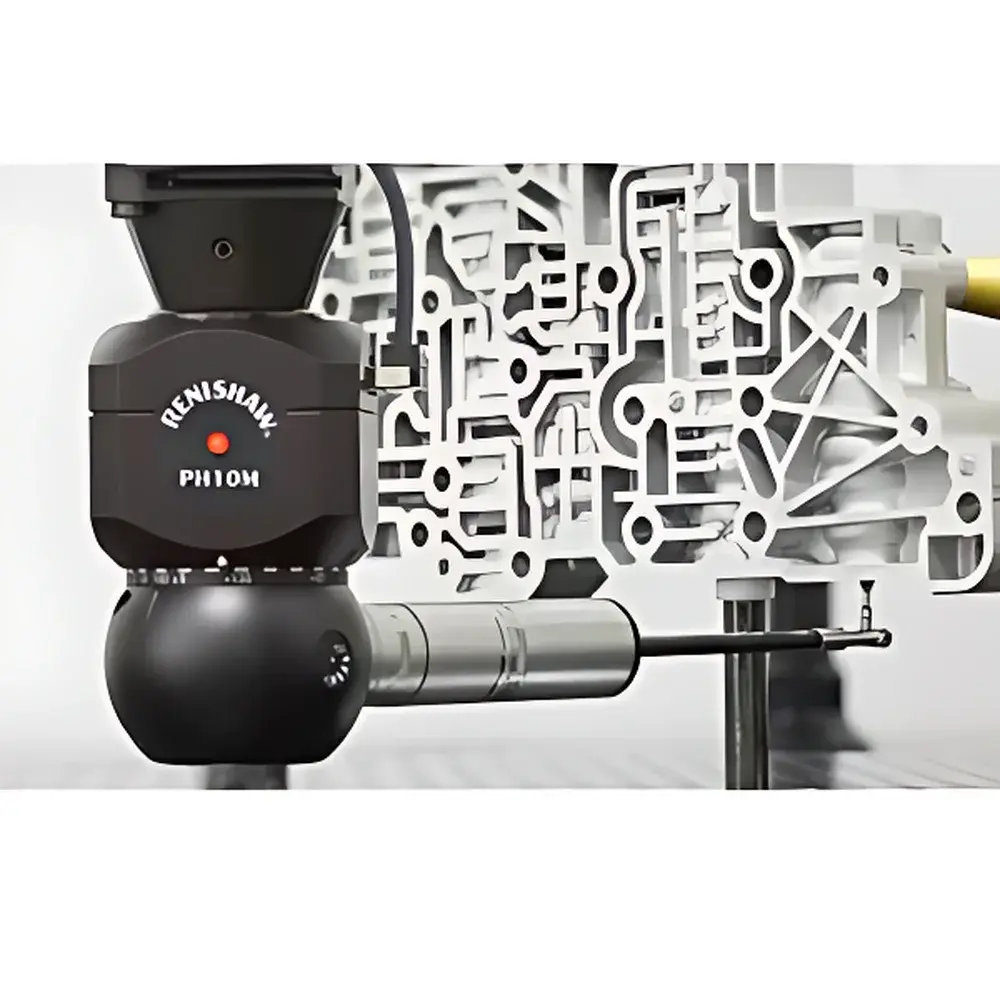
Renishaw PH10 Motorized Indexing Probe Head
| Brand | Renishaw |
|---|---|
| Origin | United Kingdom |
| Model | PH10 |
| Interface Compatibility | AutoJoint (PH10M/MQ) or M8 threaded (PH10T) |
| Maximum Probe Extension | 300 mm |
| Compatible with | ACR3 automatic probe changer, SP25M 3-axis scanning probe (2000 points/sec, 100 mm/s scan speed), TP20/TP200 touch-trigger probes |
| Regulatory Compliance | Designed for integration into ISO/IEC 17025-accredited CMM environments |
| Software Integration | Native support for PC-DMIS, QUINDOS, and MODUS metrology software suites |
Overview
The Renishaw PH10 is a motorized, indexing probe head engineered for high-precision coordinate measuring machine (CMM) applications requiring repeatable, programmable angular positioning of tactile and scanning probes. Based on Renishaw’s proven kinematic AutoJoint (for PH10M/MQ variants) or robust M8-threaded (for PH10T variant) interface architecture, the PH10 delivers deterministic orientation control across five axes—two rotational (A and B) with ±105° and ±105° angular range respectively—enabling full accessibility to complex part geometries without manual reconfiguration. Its closed-loop stepper motor system ensures positional repeatability better than ±0.5 arcsec under calibrated thermal conditions, making it suitable for first-article inspection, GD&T verification, and production metrology workflows where traceable angular positioning is critical. The PH10 operates as an integral subsystem within a full CMM metrology chain—its motion synchronized with machine controller via standard I/O or serial protocols—and conforms to the mechanical and electrical interface specifications defined in ISO 10360-2 for CMM probing systems.
Key Features
- Motorized 5-axis indexing (A/B) with programmable angular resolution of 0.001° and bidirectional repeatability ≤ ±0.5 arcsec
- Dual interface variants: PH10M/MQ with Renishaw AutoJoint for rapid, zero-force probe coupling; PH10T with standardized M8 thread for broad compatibility with legacy and third-party tactile probes
- Maximum supported probe stack length: 300 mm—including extensions, styli, and sensor modules—maintaining dynamic stiffness sufficient for high-speed scanning (e.g., SP25M at 100 mm/s)
- Integrated thermal compensation algorithm that adjusts for ambient drift using internal temperature sensors, aligned with ISO 10360-3 environmental uncertainty modeling
- Native firmware-level handshake with Renishaw’s ACR3 automatic probe changer, enabling fully automated multi-probe routines without operator intervention
- EMC-compliant design per EN 61326-1, rated for industrial workshop environments (IP54 equivalent when mated with compatible probe bodies)
Sample Compatibility & Compliance
The PH10 is not a standalone measurement device but a precision motion interface designed exclusively for integration into ISO 10360-compliant coordinate measuring machines. It supports tactile probes (e.g., TP20, TP200) and high-bandwidth scanning probes (e.g., SP25M, SP600) meeting ISO 10360-5 volumetric performance criteria. When deployed in accredited laboratories, its angular positioning accuracy contributes directly to the CMM’s overall expanded measurement uncertainty (k = 2), and calibration procedures align with ISO/IEC 17025 requirements for metrological traceability. All interface geometries comply with Renishaw’s published mechanical interface specifications (document REF: H-1000-1925-01), ensuring interchangeability across PH10 generations and compatibility with certified stylus holders and extension bars.
Software & Data Management
The PH10 communicates with CMM controllers through Renishaw’s UCC (Universal CMM Controller) protocol or industry-standard RS-232/USB virtual COM interfaces. It is natively supported by major metrology software platforms including PC-DMIS (v2022+), QUINDOS 8.x, and Hexagon’s MODUS—enabling full scripting of indexing sequences, probe qualification routines, and error-mapping compensation. Audit trails for all probe head movements are logged in accordance with FDA 21 CFR Part 11 requirements when used in regulated manufacturing (e.g., aerospace, medical device QA). Firmware updates are delivered via Renishaw’s Metrology Software Suite (MSS), with version-controlled release notes traceable to ISO 9001 configuration management records.
Applications
- GD&T evaluation of turbine blades, impellers, and injection-molded plastic housings requiring multi-angle access to datum features
- Automated first-article inspection of automotive powertrain components (e.g., cylinder heads, transmission cases) using mixed-probe strategies
- High-mix, low-volume aerospace component verification where rapid reconfiguration between scanning and touch-trigger modes reduces fixture dependency
- Calibration laboratory use for angular artifact verification (e.g., index plates, polygon prisms) under ISO/IEC 17025 scope
- Research-grade dimensional metrology in national metrology institutes where probe head angular uncertainty must be quantified and budgeted into total measurement uncertainty models
FAQ
Is the PH10 compatible with non-Renishaw CMMs?
Yes—provided the CMM controller supports Renishaw’s UCC protocol or offers configurable serial/IO interfacing, and mechanical mounting follows Renishaw’s published flange specifications (REF: H-1000-1924-01).
What is the maximum allowable overhang when using 300 mm probe extensions?
At full 300 mm extension, static deflection under 0.5 N probe trigger force remains within ±1.2 µm (per ISO 10360-2 Annex D test methodology), assuming rigid stylus material and proper torque application during assembly.
Does PH10 require periodic recalibration?
While the PH10 itself does not require standalone calibration, its angular positioning performance must be verified as part of the CMM’s annual ISO 10360-2 acceptance and reverification testing—typically using calibrated sphere artifacts and vector-based residual analysis.
Can PH10 be used in temperature-controlled metrology labs only?
It is rated for operation between 15–30 °C per ISO 10360-1; outside this range, thermal drift compensation becomes non-linear and must be accounted for in the measurement uncertainty budget.
Is firmware update capability available in-field?
Yes—via USB-connected MSS software and signed firmware packages distributed through Renishaw’s secure customer portal, with change logs aligned to ISO 9001 revision control requirements.