Renishaw QC20-W Wireless Ballbar System
| Brand | Renishaw |
|---|---|
| Origin | United Kingdom |
| Model | QC20-W |
| Type | Precision Geometric Measurement Instrument |
| Core Technology | Dual-Point Kinematic Interferometric Displacement Measurement |
| Communication | Bluetooth 5.0 (Class 1, up to 30 m range in line-of-sight) |
| Sensor Principle | Non-contact capacitive linear displacement sensing with integrated thermal compensation |
| Mechanical Design | Telescopic carbon-fiber arm (standard 100 mm–300 mm extension range, ISO 230-4 compliant length stability ±0.1 µm/°C) |
| Compliance | Fully compatible with ISO 230-4:2022, ANSI B5.54-2020, and VDI/VDE 2617 Part 6 |
| Software Platform | Renishaw Ballbar20 v4.x (Windows 10/11, 64-bit), supports FDA 21 CFR Part 11 audit trail, GLP/GMP-compliant report generation, and automated test sequence scripting |
Overview
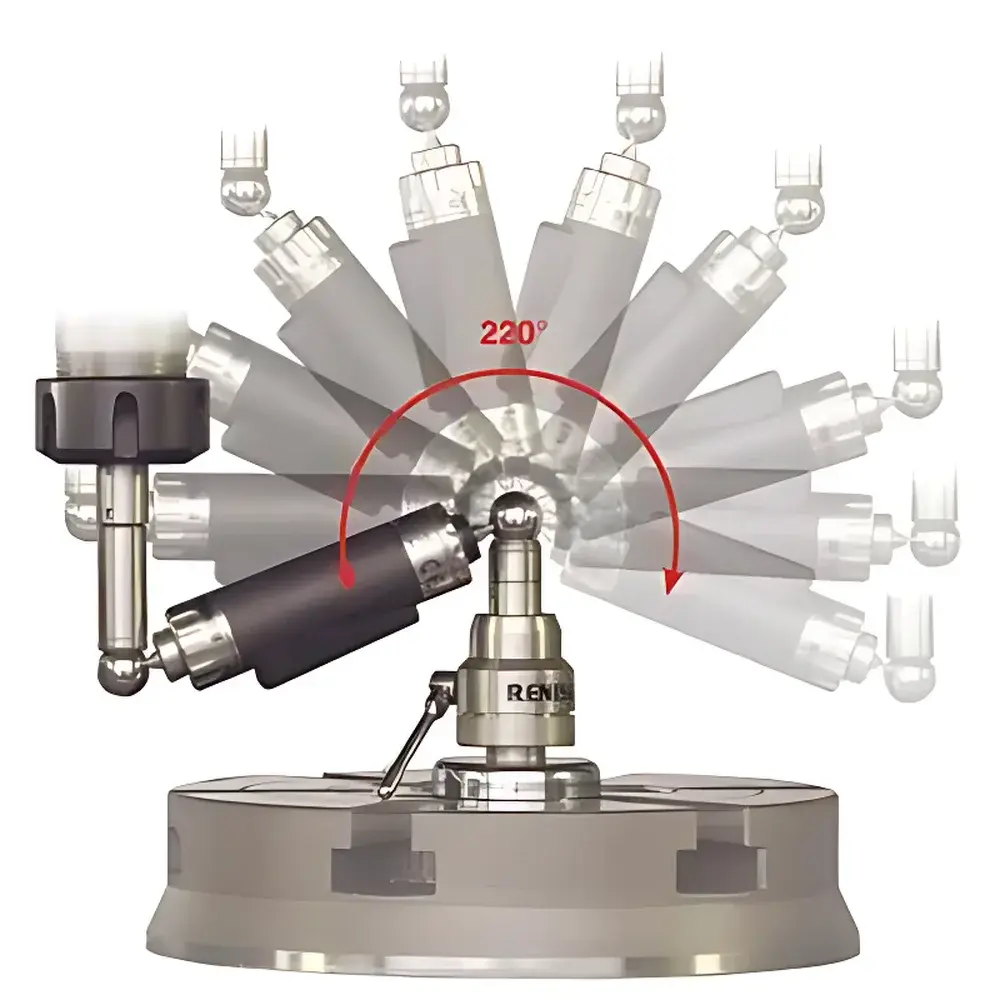
The Renishaw QC20-W Wireless Ballbar System is an advanced, ISO 230-4:2022–compliant diagnostic instrument engineered for high-reproducibility measurement of volumetric positioning errors in CNC machine tools. Unlike conventional laser interferometers that require multi-axis alignment and extensive setup time, the QC20-W employs a kinematic dual-point measurement principle: one end mounts rigidly to the machine spindle (via precision collet or HSK adapter), while the other attaches to the machine table (using vacuum or magnetic base). As the machine executes a circular interpolation program in XY, YZ, or ZX planes, the system continuously records radial deviation between the two points—capturing real-time positional discrepancies arising from servo mismatch, backlash, stick-slip motion, axis scaling errors, squareness deviations, and thermal drift. Its core innovation lies in the integration of a proprietary capacitive linear displacement sensor with on-board thermal compensation and Bluetooth 5.0 wireless telemetry—eliminating cable constraints and enabling fully enclosed “door-closed” testing under operational safety interlocks.
Key Features
- Wireless operation via Bluetooth 5.0 Class 1 module, supporting reliable data transmission up to 30 meters (line-of-sight) without signal degradation or electromagnetic interference susceptibility.
- Telescopic carbon-fiber arm with 100–300 mm adjustable length, maintaining dimensional stability within ±0.1 µm/°C per ISO 230-4 Annex C requirements.
- Three-plane testing capability (XY, YZ, ZX) enabled by a single, reconfigurable mounting bracket—reducing mechanical setup time by >60% versus legacy two-plane systems.
- Backward compatibility with all QC10 hardware interfaces, CNC macros, and test templates; identical arm length preserves existing G-code programs and calibration workflows.
- Integrated thermal drift compensation algorithm, synchronized with ambient and machine-tool temperature sensors (optional external probes supported).
- Ruggedized portable case with CNC-machined foam insert, designed for IP54-rated transport and field deployment across shop-floor environments.
Sample Compatibility & Compliance
The QC20-W is validated for use on vertical/horizontal machining centers, 5-axis mill-turn systems, gantry mills, and coordinate measuring machines (CMMs) equipped with standard ISO 30–ISO 50 spindle tapers or HSK tooling interfaces. It complies with ISO 230-4:2022 (Test Code for Positioning Accuracy of Numerical Control Machines), ANSI B5.54-2020 (Methods for Performance Evaluation of Machine Tools), and VDI/VDE 2617 Part 6 (Geometric Accuracy of Coordinate Measuring Machines). All measurement data files adhere to ASTM E2917-21 (Standard Practice for Calibration of Linear Variable Differential Transformers), and software-generated reports include traceable metadata required for ISO/IEC 17025 accredited laboratories. The system meets CE, UKCA, and RoHS directives, with full documentation available for FDA 21 CFR Part 11 electronic record validation.
Software & Data Management
Ballbar20 v4.x software provides deterministic real-time data acquisition at 1 kHz sampling rate, with synchronized timestamping and lossless binary logging. It supports automated test sequencing—including pre-programmed circular paths, multi-radius sweeps, and dwell-point analysis for stick-slip quantification. Reporting modules generate ISO 230-4–formatted summary tables, polar error plots, harmonic decomposition (up to 12th order), and root-cause diagnostic flags (e.g., “X-Y coupling anomaly detected at 0.8 Hz”). Audit trails log user actions, parameter changes, and calibration events with digital signature support. Data export formats include CSV, PDF/A-2b (archival), XML (for MES integration), and native .bb2 binary for cross-platform analysis with third-party metrology suites.
Applications
The QC20-W is deployed in aerospace component manufacturing for validating five-axis contouring accuracy prior to NADCAP audits; in automotive powertrain facilities for rapid verification of cylinder head milling machine volumetric error budgets; and in precision mold shops for diagnosing thermal-induced drift in EDM sinker machines. It serves as a primary tool in predictive maintenance programs—tracking long-term degradation of ball screws, linear scales, and servo loop gains. Universities and metrology institutes utilize it for teaching geometric error modeling and validating compensation algorithms in Siemens SINUMERIK and Heidenhain TNC controllers. Its ability to isolate individual error contributors (e.g., separating reversal error from proportional gain mismatch) makes it indispensable for closed-loop NC optimization and post-compensation validation.
FAQ
Is the QC20-W compatible with existing QC10 fixtures and CNC programs?
Yes—the mechanical interface, arm length, and G-code syntax remain identical. No machine reprogramming is required.
Does Ballbar20 software support automated report generation for ISO 230-4 certification?
Yes—preconfigured templates generate compliant reports with uncertainty budgets, environmental condition logs, and operator sign-off fields.
Can the system operate inside fully enclosed machine enclosures with safety doors locked?
Yes—Bluetooth wireless architecture eliminates tethering, enabling safe, repeatable “door-closed” testing per OSHA 1910.212 and ISO 13857 requirements.
What is the measurement uncertainty of the QC20-W at 20 °C?
According to Renishaw’s UKAS-accredited calibration certificate, expanded uncertainty (k=2) is ±0.25 µm for radial deviation over 150 mm radius, traceable to NPL standards.
Is firmware update capability included, and how is version control managed?
Yes—over-the-air updates via Ballbar20 software; each firmware release includes SHA-256 checksums and revision history logged in the audit trail.