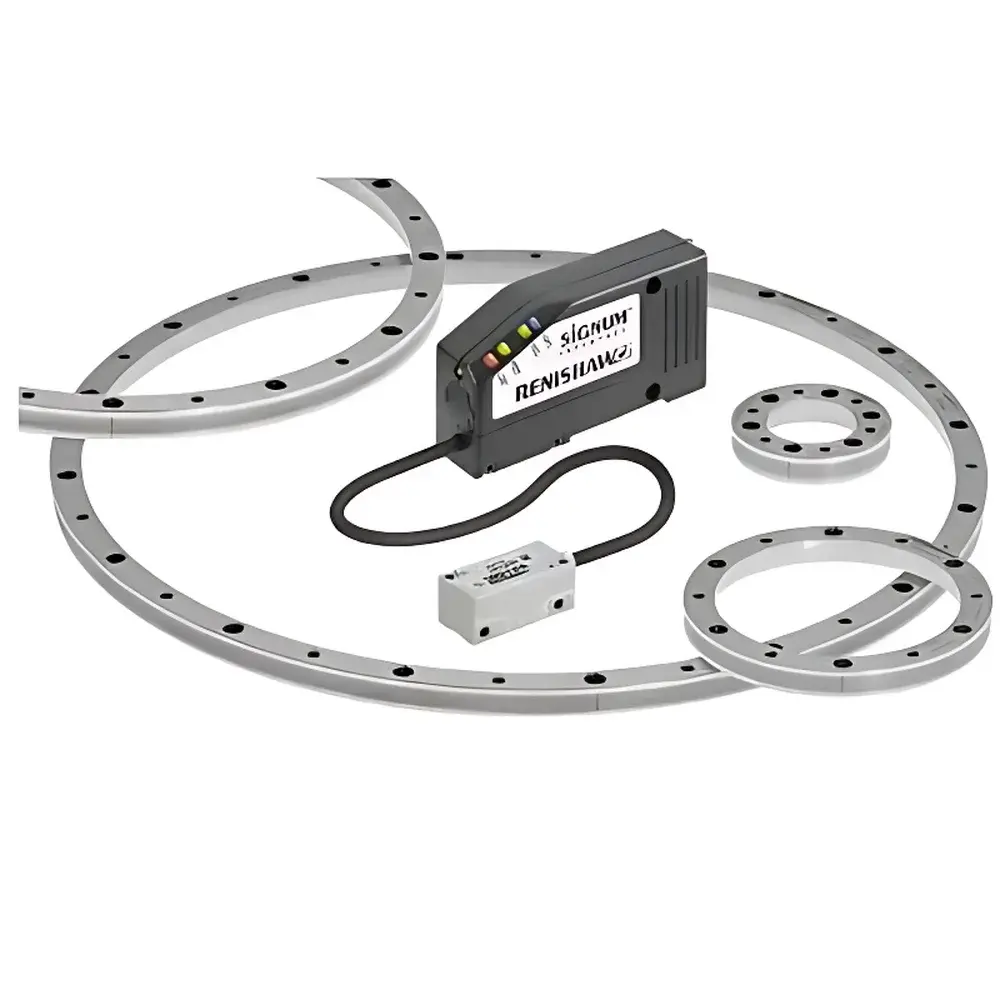
Renishaw SiGNUM™ Series Intelligent Encoder with FANUC Communication Interface
| Brand | Renishaw |
|---|---|
| Origin | United Kingdom |
| Model | SiGNUM™ |
| Enclosure Rating | IP64 (SR readhead) |
| Thermal Operating Range | −10 °C to +85 °C |
| Maximum Speed | >3600 rpm (at Ø52 mm) |
| Angular Accuracy | ±0.5 arc seconds |
| Repeatability | 0.02 arc seconds |
| Subdivision Error | <±40 nm |
| Scale Pitch | 20 µm |
| Scale Material | Stainless Steel (RESM ring) |
| Installation Flexibility | Tapered Mounting System |
| Signal Processing | SiGNUM™ Intelligent Interpolation |
| Zero Reference | IN-TRAC™ Bidirectional Optical Reference Marks |
| Compliance | RoHS, CE, UKCA |
Overview
The Renishaw SiGNUM™ Series Intelligent Encoder with FANUC Communication Interface is a high-performance, non-contact angular position feedback system engineered for precision motion control in demanding industrial environments—particularly CNC machine tools, rotary tables, and high-dynamics servo axes. Built upon Renishaw’s proprietary optical encoding architecture, the system combines the RESM stainless steel ring scale, SR series readhead, and Si interface electronics to deliver metrological-grade angular measurement. Its core operating principle relies on high-stability laser-based optical interpolation of 20 µm pitch graduations, enhanced by IN-TRAC™ bidirectional optical zero reference marks that enable deterministic homing without mechanical indexing. The SiGNUM™ intelligent signal processing engine actively compensates for installation misalignment, thermal drift, and contamination-induced signal degradation—ensuring sub-arcsecond repeatability and ultra-low cyclic error (<±40 nm) across the full operational envelope.
Key Features
- Native FANUC communication support via industry-standard serial protocols (FSSB-compatible interface), enabling seamless integration with FANUC CNC controllers without external protocol converters.
- IN-TRAC™ optical zero reference system provides bidirectional, repeatable homing with <0.1 arc second positional uncertainty—even after power cycling or axis movement.
- RESM ring scale fabricated from precision-ground stainless steel with direct-write 20 µm pitch graduations; available in diameters from Ø52 mm to Ø550 mm and multiple line counts (e.g., 1,024 to 20,480 lines per revolution).
- Tapered mounting system eliminates radial runout and eccentricity errors during installation—reducing setup time and eliminating the need for iterative shimming or post-installation calibration.
- SR readhead rated to IP64, with operational capability up to 85 °C ambient temperature and rotational speeds exceeding 3600 rpm at Ø52 mm—validated under continuous coolant exposure and brief submersion conditions.
- Si interface electronics support remote mounting (up to 30 m cable length), featuring USB connectivity for real-time diagnostics and configuration via SiGNUM™ Setup Software.
Sample Compatibility & Compliance
The SiGNUM™ system is compatible with standard FANUC α-i/β-i series servo motors and M-series CNC controls. It meets electromagnetic compatibility requirements per EN 61326-1:2013 and safety standards per EN 61800-5-1:2017. All components comply with RoHS Directive 2011/65/EU, CE marking requirements, and UKCA regulations. While not certified for SIL or ASIL applications, its design adheres to principles aligned with ISO 230-2 (machine tool testing) and ISO 10791-6 (rotary table performance evaluation). Traceable calibration data is provided with each RESM ring scale, supporting GLP-compliant metrology workflows.
Software & Data Management
SiGNUM™ Setup Software (v4.0+) runs on Windows OS and connects directly to the Si interface via USB. It enables real-time signal optimization—including gain balancing, offset correction, and harmonic error mapping—during installation and maintenance. The software logs diagnostic parameters (e.g., signal amplitude, DC offset, interpolation stability index) with timestamped records exportable as CSV. Audit trails are retained locally; while the system does not natively support FDA 21 CFR Part 11 electronic signature functionality, its logging structure permits integration into validated LIMS or MES platforms through API-enabled middleware.
Applications
- Precision rotary axes in multi-axis machining centers requiring sub-arcsecond positioning fidelity and long-term thermal stability.
- High-speed indexing tables used in automotive powertrain component manufacturing where repeatable homing and minimal cyclic error are critical for gear hobbing and cam grinding.
- Aerospace component inspection turntables subject to stringent AS9100-aligned calibration intervals and environmental resilience requirements.
- Robot joint feedback systems where compact form factor, low inertia, and immunity to magnetic interference outweigh the need for absolute multi-turn capability.
- Research-grade goniometers and synchrotron beamline rotation stages demanding ultra-low jitter and traceable angular metrology.
FAQ
Does the SiGNUM™ FANUC interface support absolute position reporting?
No—the SiGNUM™ FANUC interface operates in incremental mode only. Absolute position is derived by the FANUC CNC controller using IN-TRAC™ zero reference marks upon power-up or reference return.
Can the RESM ring be mounted directly onto a hollow shaft?
Yes—its large internal diameter (ID) design supports direct mounting on hollow spindles up to Ø550 mm; mechanical clamping force is applied via the tapered mount, avoiding distortion of thin-walled structures.
Is the Si interface compatible with third-party motion controllers other than FANUC?
The Si interface outputs industry-standard A/B/Z quadrature signals and supports RS422 differential output; however, native FANUC protocol translation requires the dedicated FANUC communication option board.
What is the maximum recommended cable length between the SR readhead and Si interface?
For optimal signal integrity, Renishaw specifies ≤30 m for shielded twisted-pair cables meeting IEC 61000-4-3 immunity requirements; longer runs require active repeaters or fiber-optic conversion kits.
How frequently should the system be recalibrated in production environments?
Renishaw recommends annual verification against a traceable angular standard (e.g., autocollimator or laser interferometer); interim verification may be performed using the built-in signal quality metrics in SiGNUM™ Setup Software.