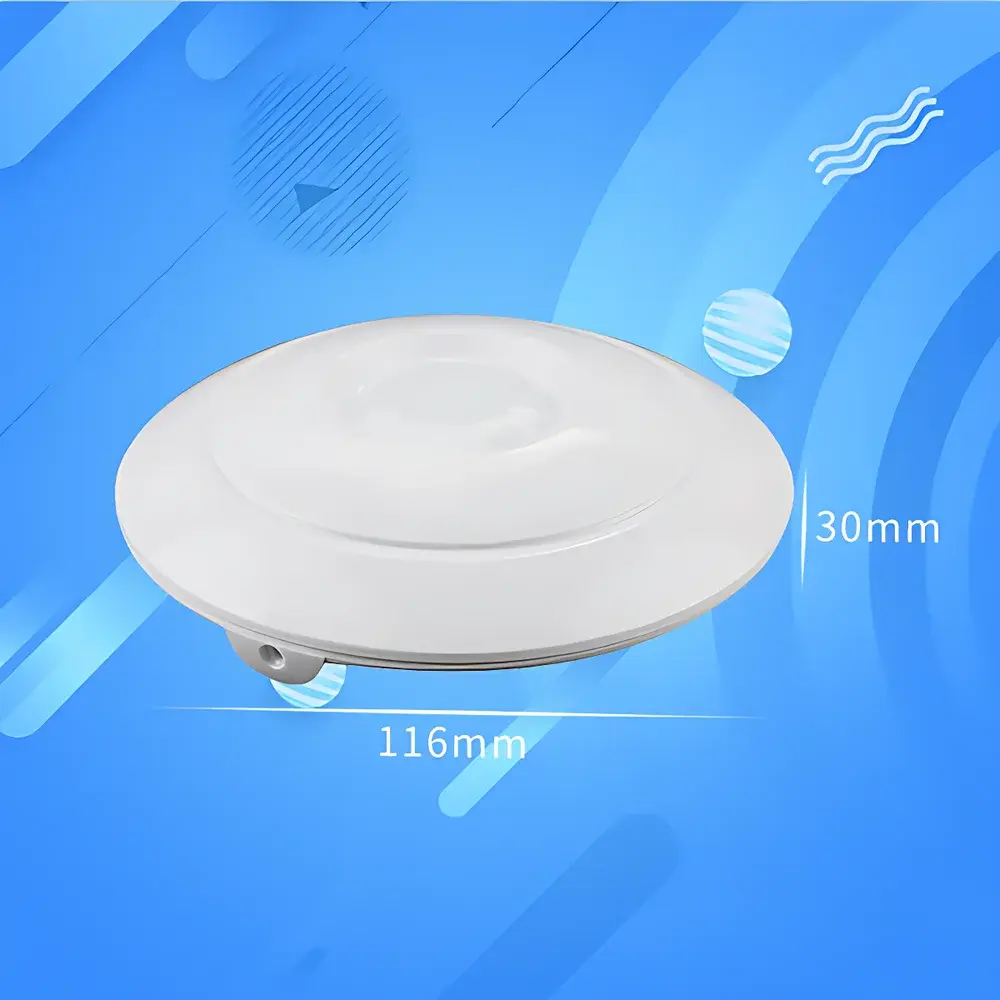
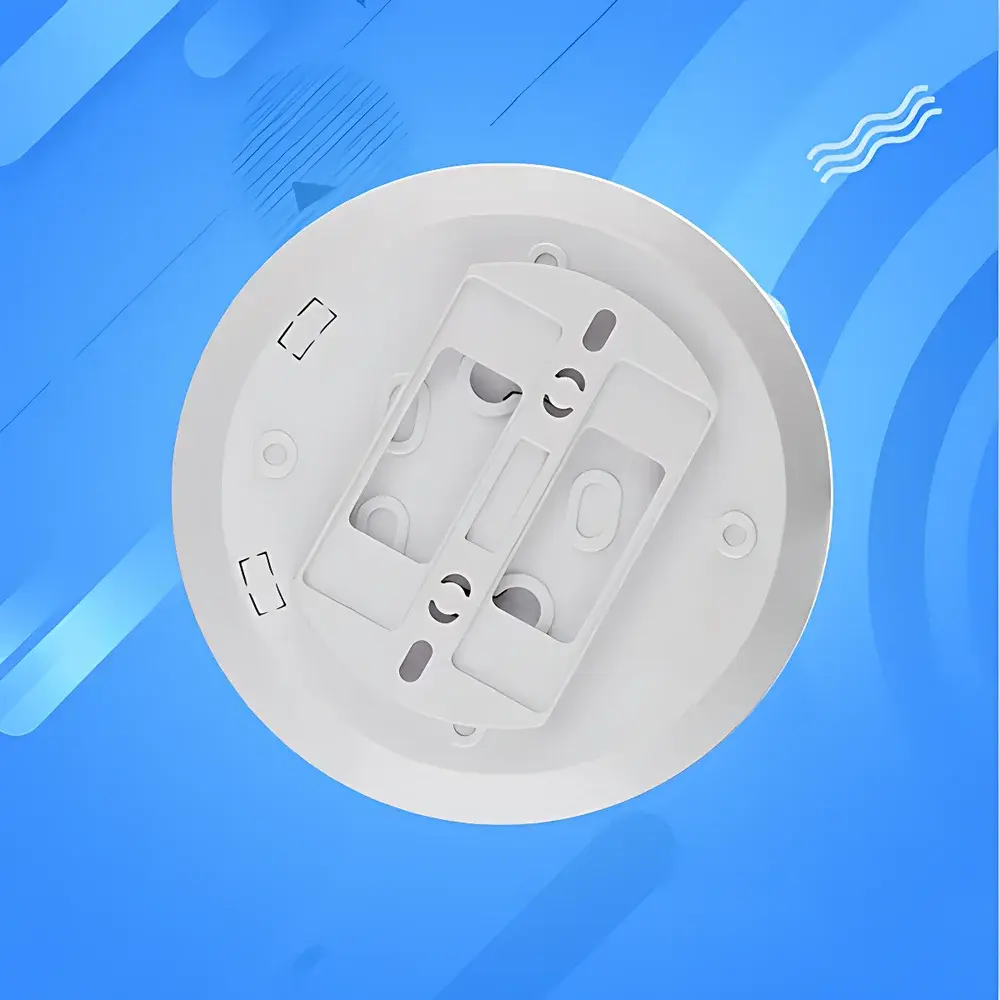
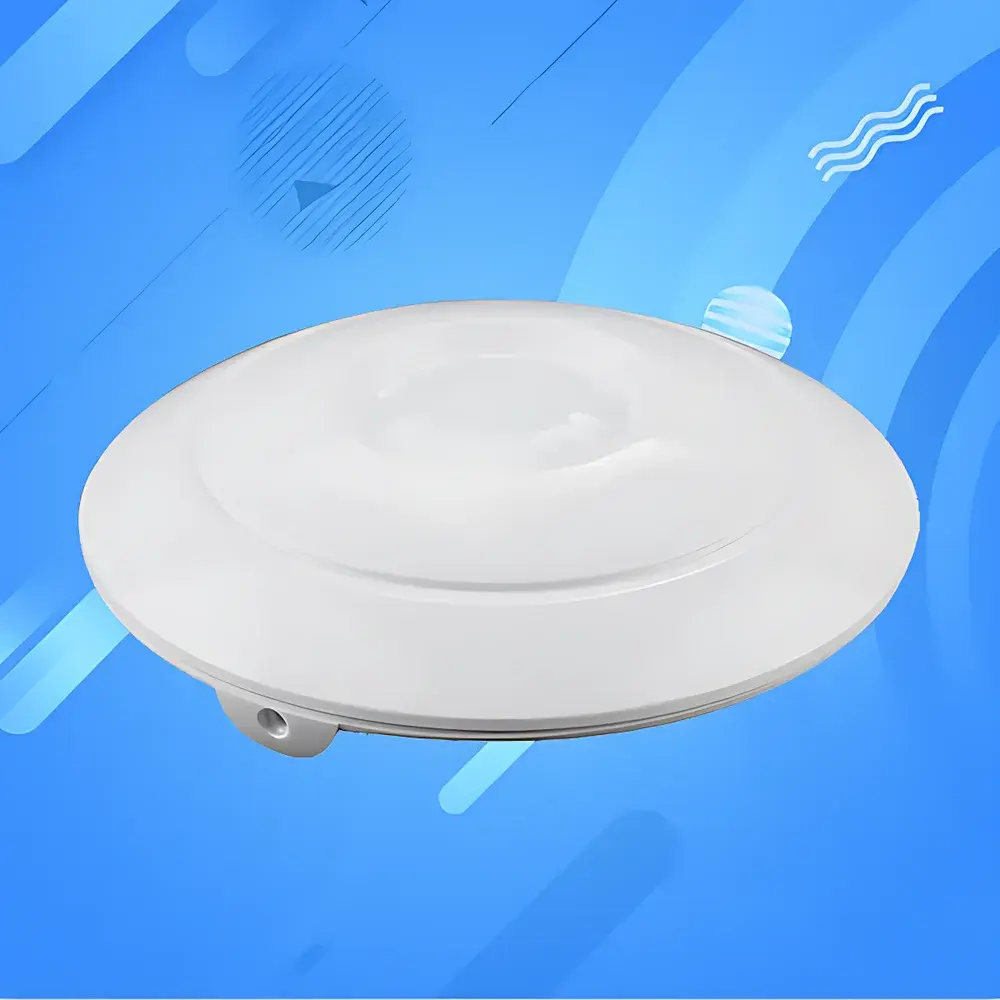
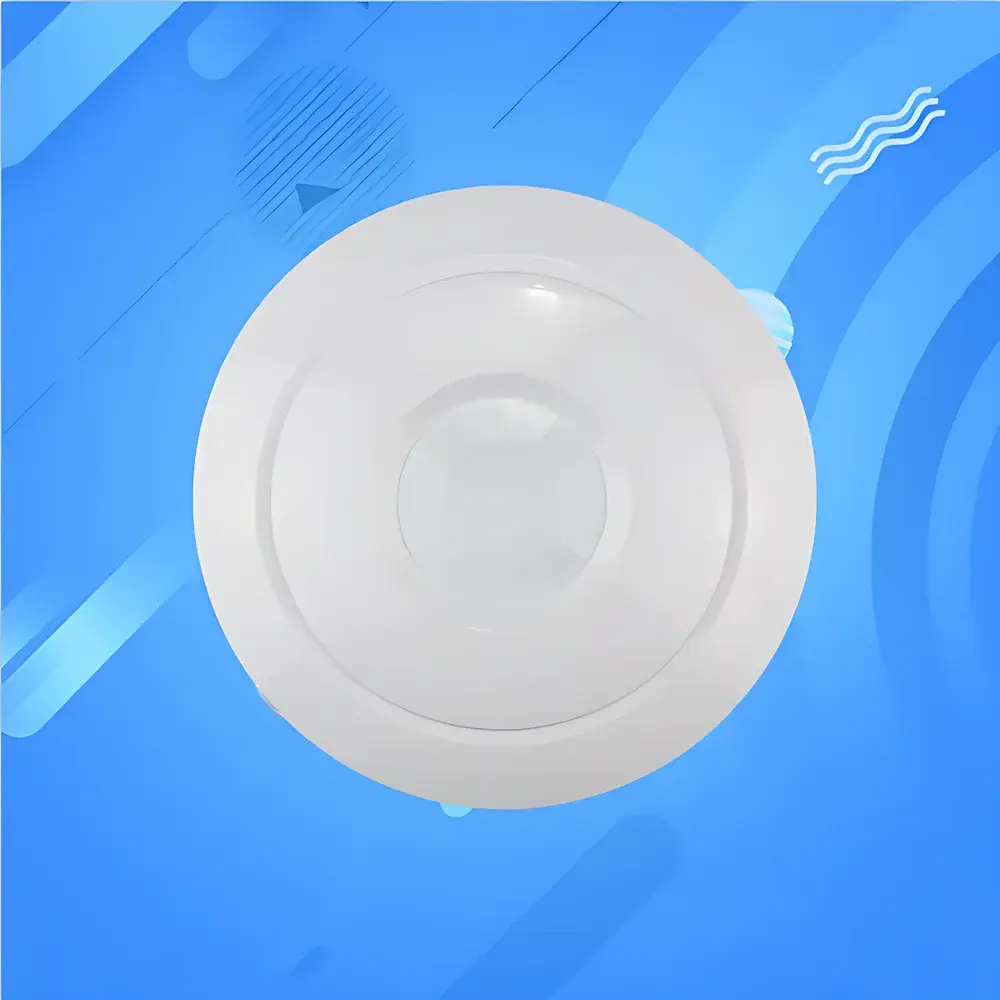
RenKe RS-HW-N01 Ceiling-Mounted Passive Infrared (PIR) Motion Detector
| Brand | RenKe |
|---|---|
| Origin | Shandong, China |
| Manufacturer Type | Manufacturer |
| Product Category | Domestic |
| Model | RS-HW-N01 |
| Instrument Type | Fixed-mount |
| Power Supply | 10–30 V DC |
| Power Consumption | 0.4 W |
| Sensor Type | Dual-element pyroelectric infrared (PIR) sensor |
| Alarm Duration Options | 5 s / 10 s / 30 s (configurable) |
| Delay-on-Alarm | Software-configurable |
| Mounting Method | Ceiling-mounted |
| Installation Height | 2.5–6 m |
| Detection Range | Ø6 m (at 3.6 m mounting height) |
| Detection Pattern | Omnidirectional 360° horizontal coverage |
| Output Interface | RS-485 |
| Communication Protocol | Modbus-RTU |
| Operating Temperature | −10 °C to +50 °C |
| Operating Humidity | ≤95% RH (non-condensing) |
| RFI Immunity | 20–1000 MHz |
| Microcontroller | 8-bit low-power CMOS |
| Auto Temperature Compensation | Yes |
Overview
The RenKe RS-HW-N01 is a fixed-mount, ceiling-installed passive infrared (PIR) motion detector engineered for reliable intrusion detection in commercial and industrial environments. It operates on the principle of pyroelectric sensing—detecting minute changes in infrared radiation emitted by warm-bodied objects (e.g., humans) moving across its field of view. Unlike active sensors, the RS-HW-N01 emits no energy; instead, it passively monitors thermal flux differentials between background surfaces and moving targets. Its dual-element PIR architecture enables differential signal processing, significantly improving immunity to false triggers caused by ambient temperature drift, HVAC airflow, or localized light fluctuations. Designed for integration into larger security or building management systems (BMS), the device features standardized RS-485 physical layer connectivity and full compliance with Modbus-RTU protocol specifications (Function Codes 03/04 for holding/input register access), enabling seamless interoperability with PLCs, SCADA platforms, and custom HMI applications.
Key Features
- Omnidirectional 360° horizontal detection pattern optimized for ceiling deployment in open-plan spaces
- Configurable alarm duration (5 s, 10 s, or 30 s) and software-defined pre-alarm delay for adaptive response logic
- Integrated auto temperature compensation algorithm to maintain consistent sensitivity across operating temperatures (−10 °C to +50 °C)
- Robust electromagnetic interference (EMI) rejection—certified immunity to RF fields from 20 MHz to 1000 MHz, including cellular bands (GSM, LTE, 5G NR sub-6 GHz)
- Low-power 8-bit CMOS microcontroller architecture delivering <0.4 W typical power draw, suitable for long-term operation on centralized DC distribution systems
- Modbus-RTU register map supports real-time status polling (e.g., alarm state via Holding Register 0x0003), facilitating audit-ready event logging and remote diagnostics
- Mechanically optimized optical lens design ensures uniform sensitivity within ±15° vertical acceptance angle at nominal 3.6 m mounting height
Sample Compatibility & Compliance
The RS-HW-N01 is intended for indoor use in non-hazardous, dry-to-humid environments (≤95% RH, non-condensing). It complies with IEC 61000-4-3 (radiated RF immunity) and IEC 61000-4-4 (electrical fast transient/burst immunity) standards at industrial severity levels. While not certified to UL 2075 or EN 50131 for standalone alarm system certification, its Modbus-RTU interface and deterministic response timing make it suitable as a supervised input device within Class B or C security systems conforming to EN 50131-1 and EN 50131-2-2 when integrated under a certified control panel. The device meets CE marking requirements for EMC Directive 2014/30/EU and RoHS Directive 2011/65/EU. No intrinsic safety or explosion-proof rating is assigned; installation in classified hazardous locations is prohibited.
Software & Data Management
Data exchange occurs exclusively via ASCII-hex encoded Modbus-RTU frames over RS-485 (2-wire, half-duplex). The default configuration is 9600 bps, 8N1, no parity, with slave address 1 (adjustable via external configuration tool or register write). Key registers include: 0x0003 (alarm status, read-only), 0x0004–0x0007 (configuration parameters, read/write), and 0x000A (firmware version). All register accesses support CRC-16 (Modbus) validation. When deployed in multi-drop networks, the device supports up to 32 nodes per segment (per TIA/EIA-485-A), provided proper termination (120 Ω) and daisy-chained topology are maintained. For regulatory traceability in GxP environments, integration with SCADA or MES platforms must implement audit trails for register writes (e.g., alarm delay changes), satisfying ALCOA+ principles under FDA 21 CFR Part 11 where electronic records are used for critical safety decisions.
Applications
- Perimeter monitoring in warehouses and logistics centers—triggering lighting, access control, or CCTV pan-tilt-zoom (PTZ) activation upon motion detection
- Occupancy-based HVAC load modulation in office buildings and educational facilities, reducing energy consumption during unoccupied periods
- Asset protection in retail backrooms and inventory staging zones, interfacing with alarm panels via Modbus gateway
- Integration into smart campus or industrial IoT architectures where standardized serial telemetry is required for edge-level decision logic
- Supervised personnel presence verification in cleanrooms or controlled manufacturing areas, where non-intrusive, contactless detection is mandated
FAQ
What is the default Modbus slave address, and how can it be changed?
Default address is 0x01 (decimal 1). Address modification requires writing to register 0x0004 using Function Code 06 (preset single register); this operation must be performed prior to network commissioning to avoid address conflicts.
Why does the device fail to respond to Modbus queries?
Possible causes include incorrect COM port selection, mismatched baud rate/parity settings, unterminated RS-485 bus, reversed A/B wiring, or insufficient polling interval (<200 ms between successive requests). Verify terminal resistance (120 Ω) at both ends of the bus for segments >100 m.
Is the RS-HW-N01 suitable for outdoor installation?
No. It lacks IP65 or higher ingress protection and is rated only for indoor use under non-condensing conditions. Exposure to rain, direct sunlight, or freeze-thaw cycles will compromise optical performance and sensor longevity.
Does the device support event timestamping or buffered alarm history?
No. The RS-HW-N01 provides real-time status only. Timestamping and historical logging must be implemented externally in the host controller or SCADA system.
Can multiple detectors share the same RS-485 bus without signal degradation?
Yes—up to 32 units may coexist on one bus if total cable length remains ≤1200 m, impedance-matched, and powered independently (no shared ground loops). Use repeaters or isolated RS-485 transceivers for extended topologies.