
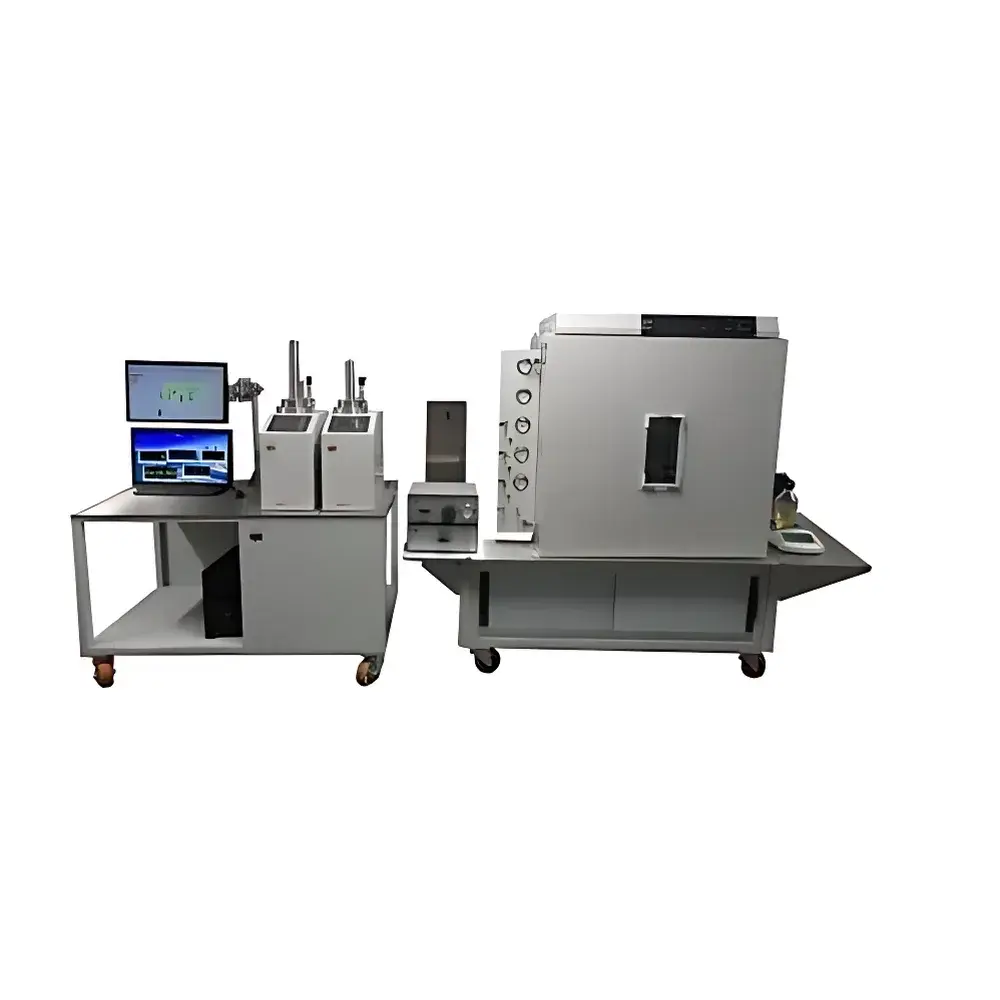
Reservoir Damage Evaluation System FDS 700 by VINCI
| Brand | VINCI |
|---|---|
| Origin | France |
| Model | FDS 700 |
| Operating Temperature Range | Up to 200 °C |
| Maximum Confining Pressure | 70 MPa |
| Maximum Pore Pressure | 50 MPa |
| Flow Rate Range | 0.1–6,000 mL/min |
| Core Sample Diameter | 25.4 mm (1 in) and 38.1 mm (1.5 in) |
| Core Length | Up to 100 mm |
| Data Acquisition | 16-bit resolution, 1 kHz sampling rate |
| Control Interface | Ethernet-connected PC with proprietary software |
Overview
The VINCI FDS 700 Reservoir Damage Evaluation System is a fully automated, high-pressure/high-temperature (HPHT) core flooding platform engineered for quantitative assessment of formation damage mechanisms under representative reservoir conditions. It operates on the principle of controlled transient fluid injection through consolidated or unconsolidated rock cores while simultaneously monitoring differential pressure, flow rate, effluent composition, and real-time permeability evolution. Designed in accordance with industry-standard core analysis protocols—including API RP 40, ISO 11272, and ASTM D5125—the FDS 700 enables reproducible simulation of drilling, completion, stimulation, and workover operations. Its modular architecture integrates confining pressure control, pore pressure regulation, precision metering pumps, dynamic filtration modules, and thermally stabilized test cells to replicate downhole thermal gradients and mechanical stress states. The system supports both static and dynamic filtration modes, permitting evaluation of near-wellbore damage caused by solid invasion, clay swelling, emulsion blockage, wettability alteration, and chemical incompatibility.
Key Features
- Integrated HPHT core holder with dual-pressure capability: up to 70 MPa confining pressure and 50 MPa pore pressure, enabling testing at depths exceeding 4,500 m TVD.
- Dedicated shear-enhanced filtration module featuring tangential flow geometry—designed to emulate realistic mudcake deposition and erosion dynamics during drilling.
- Variable-speed positive displacement pump (0.1–6,000 mL/min) with programmable ramp profiles, supporting critical velocity determination and non-Darcy flow analysis.
- Modular fluid handling manifold compatible with aqueous, oil-based, synthetic-based, and nanoparticle-laden fluids—including acidizing solutions, cement filtrates, and surfactant systems.
- Real-time permeability calculation engine that computes absolute, effective, and restored permeability using Darcy’s law with compressibility-corrected mass balance.
- Automated sequence control via VINCI CoreLab™ software, supporting multi-step protocols with conditional logic, event-triggered actions, and hardware interlocks.
Sample Compatibility & Compliance
The FDS 700 accommodates standard cylindrical core plugs (25.4 mm and 38.1 mm diameter; up to 100 mm length), as well as irregular or fractured samples mounted in custom sleeves. It supports both dry and saturated core configurations, with optional resistivity and acoustic velocity monitoring ports. All wetted components are constructed from Hastelloy C-276 and 316L stainless steel to ensure compatibility with H₂S, CO₂, and low-pH stimulant fluids. The system complies with ISO/IEC 17025 requirements for testing laboratories and meets functional prerequisites for GLP-compliant data generation per 21 CFR Part 11 when configured with audit-trail-enabled software licensing and electronic signature modules.
Software & Data Management
VINCI CoreLab™ v4.2 provides full instrument orchestration, including closed-loop pressure regulation, adaptive flow scheduling, and synchronized data acquisition across up to 32 analog/digital channels. The software implements built-in calculation templates aligned with SPE Recommended Practices for formation damage evaluation—e.g., spurt loss quantification, filtrate invasion depth modeling, and permeability impairment ratio (PIR) derivation. Raw datasets are stored in HDF5 format with embedded metadata (sample ID, operator, timestamp, calibration certificates), ensuring traceability and interoperability with third-party reservoir simulators (e.g., CMG, Eclipse). Export options include CSV, Excel, and XML, with optional integration into LIMS environments via OPC UA or RESTful API.
Applications
- Quantification of drilling fluid-induced damage: static/dynamic filter cake formation, spurt loss, and permeability recovery after backflow.
- Evaluation of acidizing efficiency and secondary damage: wormholing onset, face dissolution, and fines migration under varying injection rates.
- Assessment of cement slurry filtrate invasion and its impact on near-wellbore permeability anisotropy.
- Screening of chemical diverters, scale inhibitors, and clay stabilizers under reservoir-relevant salinity and temperature conditions.
- Investigation of proppant embedment and fracture conductivity degradation during hydraulic fracturing fluid flowback.
- Support for experimental validation of formation damage models used in reservoir simulators and production forecasting tools.
FAQ
What types of rock samples can be tested on the FDS 700?
Standard cylindrical core plugs (1″ and 1.5″ diameter), whole-round cuttings, and artificially fractured samples—provided they fit within the specified dimensional and sealing constraints.
Does the system support real-time effluent analysis?
Yes—optional integration with inline conductivity, pH, and turbidity sensors enables continuous monitoring of filtrate chemistry and suspended solids concentration.
Can the FDS 700 simulate cyclic stress conditions during filtration?
The system supports programmed confining pressure modulation to emulate reservoir depletion or water influx scenarios, though true triaxial stress cycling requires external geomechanical add-ons.
Is remote operation supported?
Full remote access is available via secure VPN connection; however, safety-critical functions (e.g., emergency shutdown, pressure relief) require local hardware confirmation.
How is calibration traceability maintained?
All transducers are calibrated annually against NIST-traceable standards, with digital calibration certificates stored in the software’s instrument management database and linked to each test record.






