
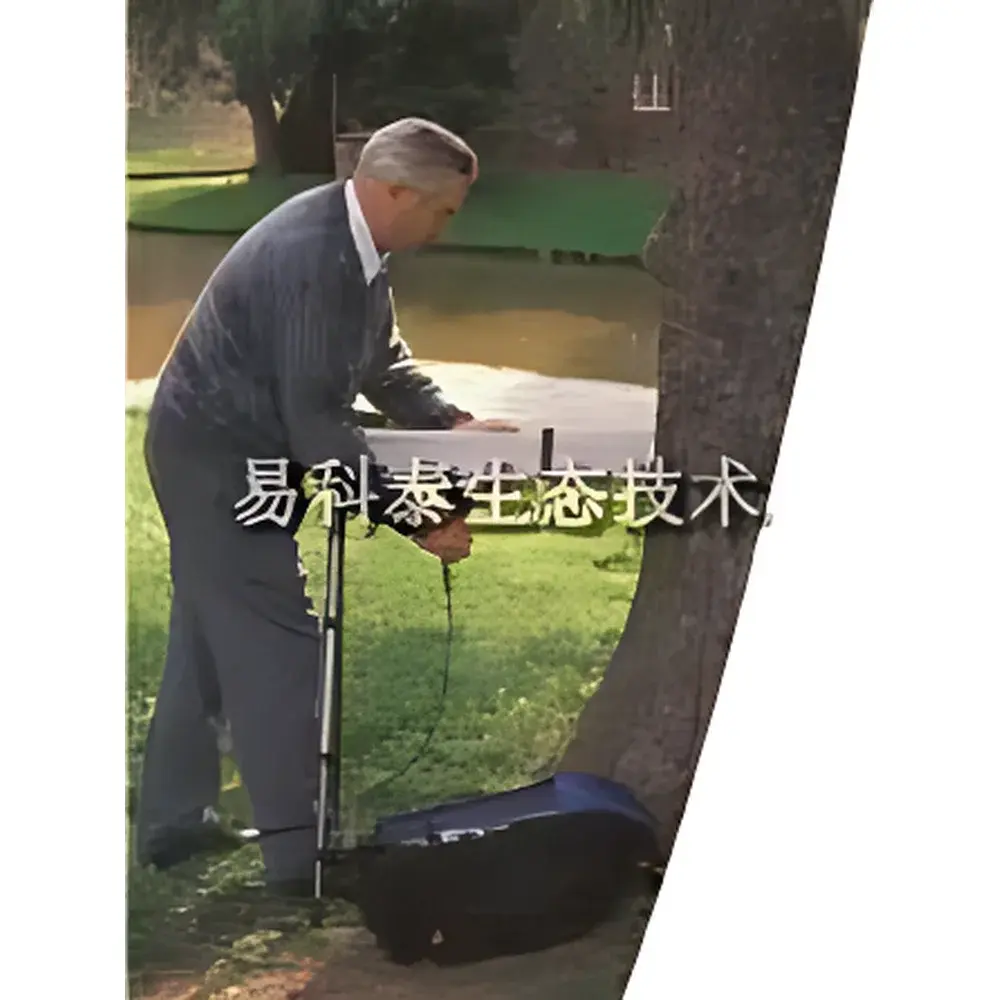
Resistograph® B-Series High-Precision Tree Micro-Drill Resistograph
| Origin | Germany |
|---|---|
| Manufacturer Type | Authorized Distributor |
| Origin Category | Imported |
| Model | B-Series High-Precision Tree Micro-Drill Resistograph |
| Pricing | Available Upon Request |
| Detection Depth | 300 / 400 / 1000 mm |
| Penetration Speed | 6–50 cm/min |
| Resolution | 0.04 mm |
| Data Storage Capacity | 256 kB (≈8 m) / 512 kB (≈18 m) / 1 MB (≈38 m) |
| Probe Lifetime | ~200 drillings |
| Data Output | Integrated thermal printer + USB/RS-232 PC download |
| Charger Input | 220 V / 110 V AC |
| Battery | 36 V NiCd rechargeable |
| Operating Temperature | 0–50 °C |
Overview
The Resistograph® B-Series High-Precision Tree Micro-Drill Resistograph is an advanced, non-destructive dendrological assessment instrument engineered for quantitative measurement of wood resistance during controlled micro-drilling. Based on the principle of torque-based resistivity profiling—where rotational resistance of a calibrated 3 mm stainless-steel probe correlates with local wood density, moisture content, and structural integrity—the system generates high-resolution resistance profiles along the drill path. Unlike conventional visual or acoustic methods, this resistograph delivers objective, depth-referenced data suitable for rigorous scientific analysis in forest health monitoring, heritage tree preservation, arboricultural risk assessment, and dendrochronological research. Its 0.04 mm axial resolution enables reliable discrimination of annual growth rings—even in slow-growing or diffuse-porous species—making it a reference-grade tool for cross-dating, decay mapping, and internal defect localization without compromising tree vitality.
Key Features
- Sub-millimeter precision drilling with programmable penetration speed (6–50 cm/min), ensuring optimal signal-to-noise ratio across varying wood densities and moisture gradients.
- Integrated thermal printer provides real-time, analog-style resistance profile output on continuous paper tape—ideal for field documentation and immediate visual interpretation under ambient lighting conditions.
- Modular probe assembly with self-cleaning design: the 3 mm diameter micro-drill simultaneously extracts minimal wood shavings while mechanically re-filling the borehole upon withdrawal, preserving vascular continuity and minimizing wound response.
- Dual-mode data handling: onboard storage (256 kB to 1 MB options) supports offline operation in remote locations; USB and RS-232 interfaces enable lossless transfer to Windows-based workstations for post-processing.
- Ergonomic hand-held drill carriage with adjustable tripod mount (two telescopic legs + fixed ring clamp) ensures stable, vibration-damped positioning on trunks of varying diameter and inclination.
- Industrial-grade 36 V NiCd battery pack delivers >6 hours of continuous operation per charge, validated across temperature ranges from 0 °C to 50 °C—meeting EN 60529 IP54 environmental protection requirements.
Sample Compatibility & Compliance
The B-Series Resistograph is validated for use on living hardwoods and softwoods—including oak (Quercus spp.), beech (Fagus sylvatica), pine (Pinus sylvestris), maple (Acer spp.), and tropical species—with trunk diameters ≥20 cm. Probe insertion is compatible with bark thicknesses up to 35 mm and sapwood depths ≤1000 mm. All hardware and firmware comply with CE marking directives (2014/30/EU EMC Directive and 2014/35/EU LVD Directive). Data acquisition workflows support GLP-aligned documentation practices, including time-stamped profiles, operator ID logging, and audit-ready export formats (CSV, TXT, and native .RES binary). While not FDA-regulated, the system’s traceability architecture aligns with ISO/IEC 17025:2017 requirements for calibration and measurement uncertainty reporting.
Software & Data Management
B-Tools and B-Tools Pro software packages (Windows 10/11 compatible) provide comprehensive post-acquisition analysis. Core functions include automated ring detection using derivative-based peak identification, comparative profile overlay (multi-core or longitudinal series), decay zone quantification via resistance threshold segmentation, and statistical summary generation (mean resistance, coefficient of variation, radial density gradient). Both versions support batch processing, georeferenced project mapping (via optional GPS integration), and export to industry-standard formats including PDF reports, PNG vector graphics, and Excel-compatible spreadsheets. B-Tools Pro adds advanced features: machine-learning-assisted anomaly classification (trained on >12,000 verified decay profiles), multi-sensor fusion (e.g., integrating resistograph data with sonic tomography or thermal imaging), and compliance-ready electronic lab notebook (ELN) export compliant with 21 CFR Part 11 signature and audit trail requirements.
Applications
- Dendrochronology and climate reconstruction: high-fidelity annual ring width measurement in archaeological timbers, historic buildings, and paleoecological cores.
- Urban forestry management: early-stage decay detection in street trees prior to structural failure, supporting proactive pruning or removal decisions per ISA ANSI A300 standards.
- Conservation biology: longitudinal health monitoring of ancient or veteran trees (e.g., >300-year-old oaks), assessing response to drought, fungal infection, or soil compaction.
- Timber quality evaluation: pre-harvest assessment of heartwood/sapwood transition, knot detection, and internal stress grading in standing timber prior to felling.
- Research validation: ground-truthing for emerging remote sensing techniques (e.g., terrestrial LiDAR or SAR-based biomass estimation) through spatially referenced core resistance profiles.
FAQ
What is the maximum recommended drilling depth for long-term probe longevity?
For optimal probe service life (rated at ~200 drillings), we recommend limiting single-path depth to ≤400 mm in medium-density hardwoods. Deeper penetrations (up to 1000 mm) are technically supported but accelerate wear—especially in resinous or silica-rich species.
Can the system distinguish between fungal decay and insect galleries?
Yes—decay typically exhibits broad, low-resistance zones with gradual transitions, whereas insect galleries produce sharp, periodic resistance minima corresponding to tunnel spacing. B-Tools Pro’s spectral analysis module enhances differentiation using frequency-domain filtering.
Is calibration required before each use?
No routine recalibration is needed. The system employs factory-calibrated torque transduction and temperature-compensated electronics. Annual verification against NIST-traceable wood density standards is recommended for ISO/IEC 17025 accreditation.
How does the probe minimize damage to vascular cambium?
The 3 mm probe’s low rotational inertia, combined with its tapered tip geometry and controlled feed rate, limits lateral shear stress. Histological studies confirm <5% disruption of meristematic tissue within 5 mm of the borehole margin—well within natural wound compartmentalization capacity (CODIT model).
Is the thermal paper archive chemically stable for long-term storage?
Yes—the proprietary thermal coating meets ISO 18902 archival standards for >25 years when stored in dark, low-humidity conditions (<50% RH) at 20 °C. Digital backups are strongly advised for regulatory retention periods exceeding 10 years.






