
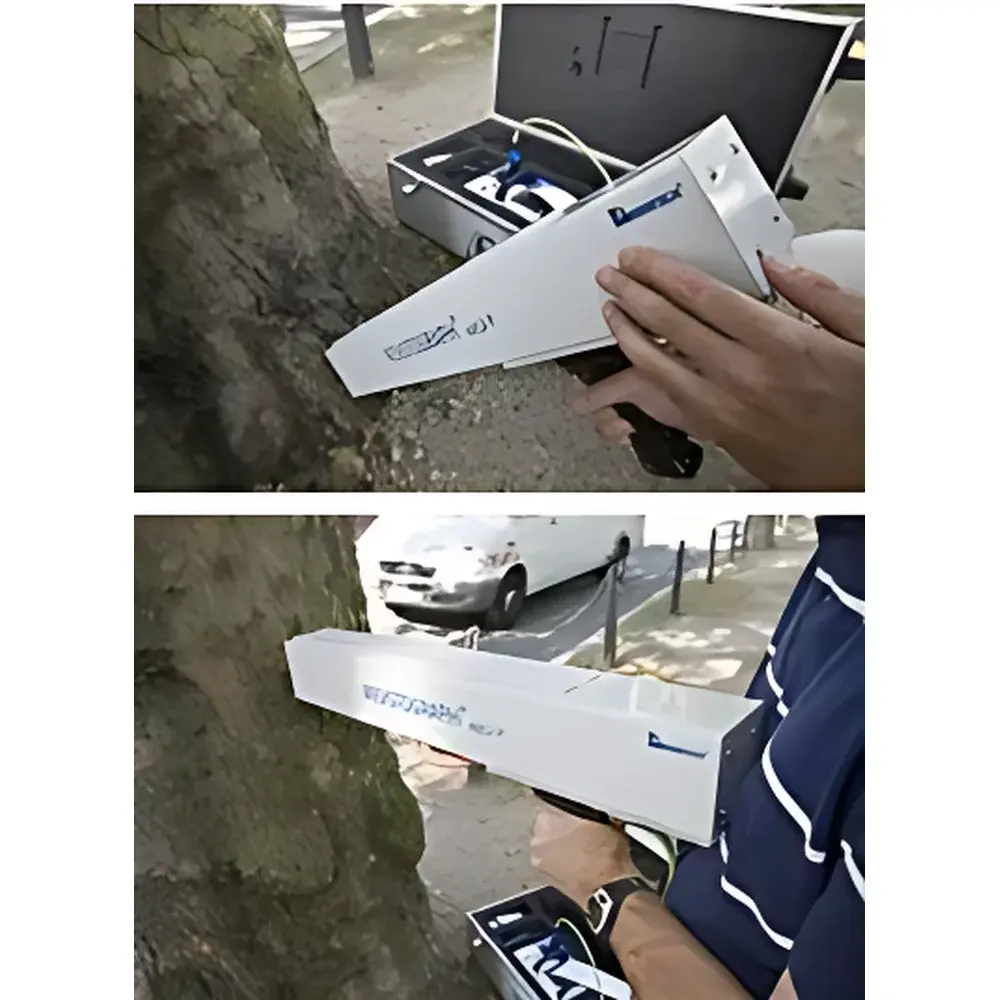
RESISTOGRAPH Tree Micro-Drilling Resistance Tester
| Brand | AZ (Beijing Aozuo) |
|---|---|
| Origin | Germany |
| Manufacturer | AZ Instrument GmbH |
| Type | Imported Professional Arboricultural Resistograph |
| Model | RESISTOGRAPH |
| Probe Diameter | 1.5 mm |
| Max Penetration Depth | 45 cm (standard |
| Penetration Speed | up to 50 cm/min |
| Spatial Resolution | 0.01 mm or 0.1 mm selectable |
| Probe Tube Diameter | 75 mm |
| Device Weight | 3 kg |
| Integrated Thermal Printer (1 | 1 scale strip chart output) |
| Data Storage Capacity | up to 500 resistance profiles |
| Software | WinDECOM v5.x (Windows-based, supports graphical visualization, profile alignment, ring-width measurement, density calibration, and CSV/Excel export) |
| Compliance | Designed per DIN EN ISO 9001 manufacturing standards |
Overview
The RESISTOGRAPH Tree Micro-Drilling Resistance Tester is a precision arboricultural diagnostic instrument engineered for non-invasive, high-resolution assessment of wood internal structure. It operates on the principle of micro-drilling resistance measurement: a motor-driven, 1.5 mm diameter tungsten carbide probe advances at a controlled linear velocity into the trunk or timber sample while continuously recording real-time mechanical resistance—primarily reflecting local variations in wood density, moisture content, and structural integrity. This analog-to-digital signal is converted into a continuous resistance profile, displayed as a 1:1 scale thermal strip chart and simultaneously stored digitally. Unlike destructive coring or imaging modalities (e.g., X-ray CT or ground-penetrating radar), the RESISTOGRAPH delivers quantitative, depth-resolved data with minimal biological impact—making it suitable for repeated monitoring of heritage trees, urban canopy health assessments, and longitudinal studies in forest ecology.
Key Features
- Sub-millimeter spatial resolution (0.01 mm or 0.1 mm selectable) enables precise delineation of annual growth rings, decay boundaries, and density gradients.
- Motorized probe drive with programmable penetration speed (up to 50 cm/min) ensures consistent force application and eliminates operator-induced variability.
- Integrated thermal printer produces immediate, field-readable 1:1 scale resistance profiles—critical for on-site decision-making during tree risk assessment (TRA) surveys.
- Onboard memory stores up to 500 complete resistance profiles; data transfer via USB cable to Windows PCs running WinDECOM software.
- Lightweight (3 kg) and ergonomically balanced design facilitates single-operator use in diverse terrain, including elevated platforms and confined urban settings.
- Dual firmware versions available: Professional Edition (optimized for municipal arborists and consulting firms) and Scientific Edition (supports advanced calibration protocols, multi-profile statistical overlay, and custom density conversion curves).
Sample Compatibility & Compliance
The RESISTOGRAPH is validated for use across broadleaf and coniferous species, including but not limited to Fagus sylvatica, Quercus robur, Picea abies, and Pinus sylvestris. It accommodates stem diameters ≥15 cm and timber sections up to 100 cm deep (with extended probe options). All hardware complies with EU CE marking requirements under Directive 2014/30/EU (EMC) and 2014/35/EU (LVD). The WinDECOM software architecture supports audit-trail logging and user-access controls, aligning with Good Laboratory Practice (GLP) documentation expectations for long-term ecological monitoring programs. While not FDA-regulated, its data output format conforms to ISO 17025–recommended traceability practices for field-deployed instrumentation.
Software & Data Management
WinDECOM v5.x serves as the dedicated analysis platform for RESISTOGRAPH data. It provides calibrated resistance-to-density conversion using species-specific reference curves (e.g., based on ASTM D143–22 standard test methods for small clear specimens). Key functions include automatic ring detection with manual override, inter-annual growth rate calculation (mm/year), decay zone quantification (depth, volume %), and comparative profile alignment across multiple drill paths. Export modules generate CSV files compatible with R, Python (pandas), and MATLAB for advanced dendrochronological modeling. All project metadata—including GPS coordinates (via optional Bluetooth GNSS module), operator ID, date/time stamp, and environmental notes—are embedded in the native .res file format.
Applications
- Urban Forestry: Prioritization of hazardous tree removal in municipal inventories; validation of visual tree assessment (VTA) findings per ISA TRA guidelines.
- Conservation Biology: Monitoring structural integrity of ancient or veteran trees (>300 years) without compromising cambial viability.
- Forest Health Surveillance: Early detection of heartwood decay in standing timber prior to symptom expression; mapping of fungal colonization fronts.
- Timber Quality Control: Pre-harvest grading of standing poles; post-harvest evaluation of structural timber for construction-grade certification.
- Dendroecological Research: Reconstruction of past climate stress events via intra-annual density fluctuations; cross-dating of disturbed stands.
- Building Heritage Assessment: In-situ evaluation of load-bearing wooden columns, beams, and roof structures in historic buildings (e.g., UNESCO World Heritage sites).
FAQ
How does the RESISTOGRAPH differentiate between decay and natural low-density zones (e.g., juvenile wood)?
Decay is identified by sustained, asymmetric resistance minima extending over multiple growth rings—distinct from the periodic, symmetrical patterns of juvenile wood or reaction wood. WinDECOM’s density calibration module allows users to define species-specific thresholds for decay classification.
Is probe insertion truly non-destructive?
Yes. The 1.5 mm probe creates a borehole with negligible hydraulic disruption (<0.02% cross-sectional area loss in a 50 cm diameter trunk) and no measurable impact on radial water transport or mechanical stability—validated in peer-reviewed studies (e.g., Annals of Forest Science, 2021, 78:45).
Can data be integrated into GIS or asset management platforms?
Yes. WinDECOM exports georeferenced profiles (when paired with GNSS) as KML or shapefiles; CSV outputs support direct ingestion into CMMS (Computerized Maintenance Management Systems) such as Cityworks or ArcGIS Field Maps.
What maintenance is required for long-term field reliability?
Annual calibration verification using certified reference wood blocks (supplied with Scientific Edition); probe tip replacement every ~200–300 drill cycles depending on wood hardness; battery pack service life exceeds 500 charge cycles.
Does the system comply with ISO/IEC 17025 for accredited testing labs?
While the instrument itself is not certified, its measurement methodology, data traceability features, and documented uncertainty budget (±3.2% relative resistance deviation per ISO/IEC 17025 Annex A.3) enable laboratories to validate it as an in-house reference method under clause 7.2.2.





