
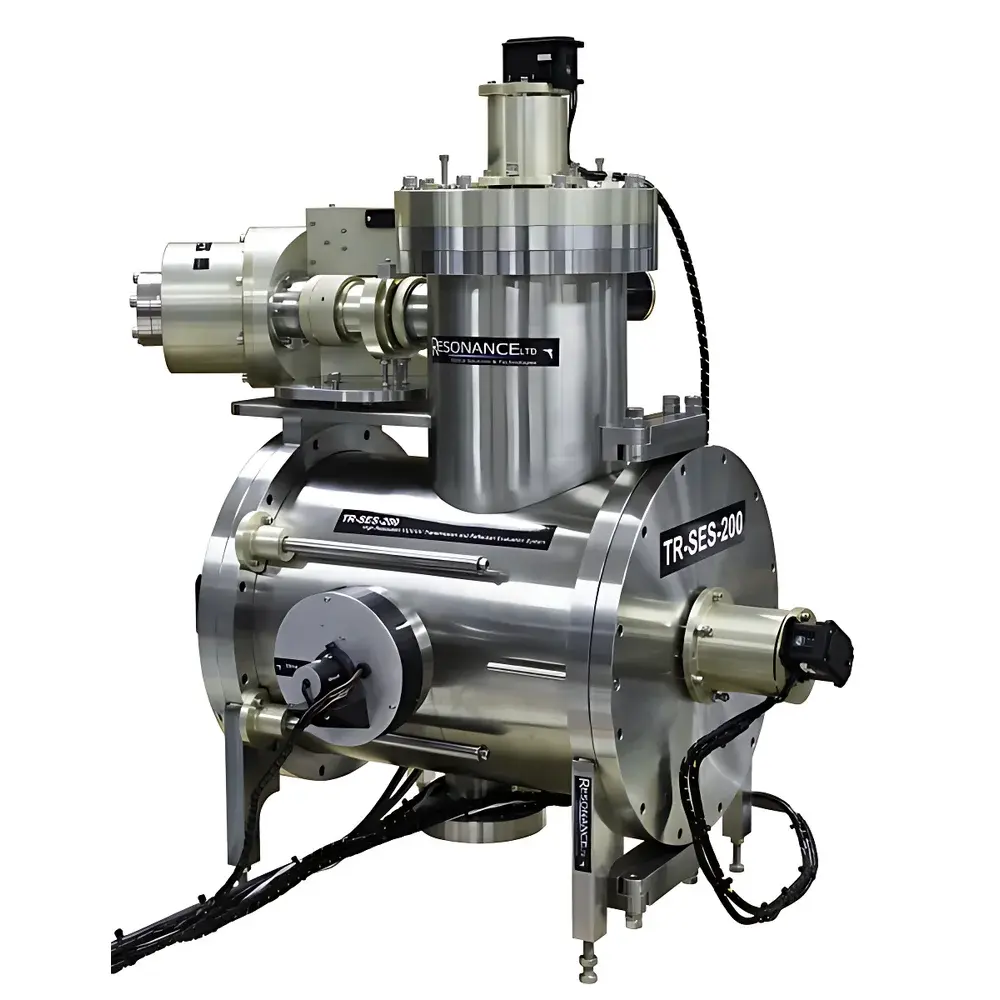
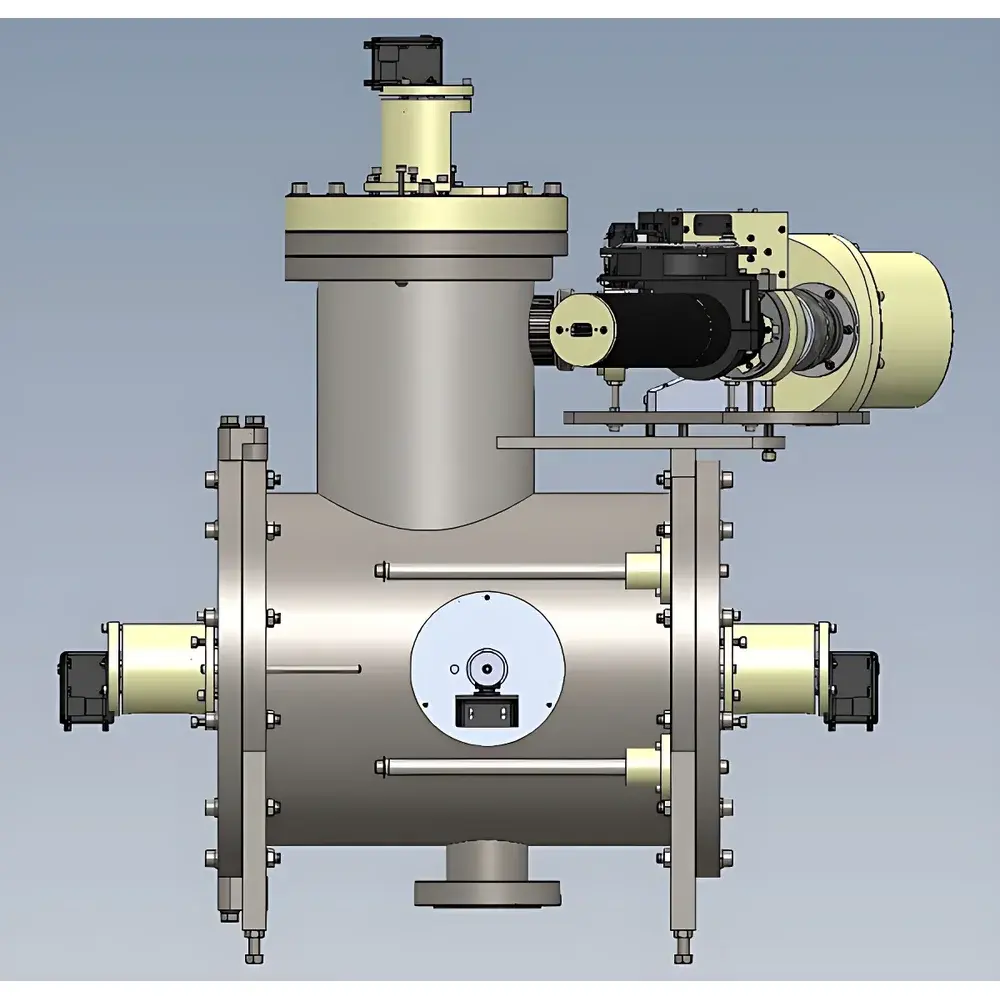
Resonance TR-SES200 Vacuum Ultraviolet (VUV) Transmission and Reflection Evaluation System
| Origin | Canada |
|---|---|
| Manufacturer Type | Authorized Distributor |
| Origin Category | Imported |
| Model | TR-SES200 |
| Instrument Form Factor | Benchtop |
| Wavelength Range | 115–400 nm (tunable, VUV–UV) |
| Monochromator | VM200 vacuum monochromator, 200 mm focal length |
| Light Source | Deuterium–Argon hollow-cathode lamp (D2ArCM-L), spectral output 115–400 nm, photon flux ≈ 2 × 10¹⁵ photons/s/steradian |
| Detector | Photomultiplier tube (PMT) with spectral response 115–320 nm |
| Optical Interface | SMA-threaded lamp mount at entrance slit |
| Grating | Holographic concave grating, 1200 lines/mm, 40 × 45 mm active area, Al/MgF₂ coating optimized for 100–300 nm, F/# 4.2, input focal distance 200 mm, output focal distance 187.9 mm, deviation angle 64° |
| Scanning Mechanism | Absolute-encoded grating drive (AEGD) |
| Software Platform | LabVIEW™-based control and data acquisition suite |
| Power Supply | 220 V AC |
Overview
The Resonance TR-SES200 Vacuum Ultraviolet (VUV) Transmission and Reflection Evaluation System is a precision-engineered benchtop instrument designed for quantitative optical characterization of materials in the deep ultraviolet to near-UV spectral region (115–400 nm). Unlike conventional UV-Vis spectrophotometers, the TR-SES200 operates under vacuum or purged nitrogen environments to eliminate atmospheric absorption—particularly critical below 190 nm where O₂ and H₂O vapor strongly attenuate radiation. Its core measurement principle relies on monochromatic VUV/UV beam incidence onto a sample, followed by simultaneous or sequential detection of specular reflectance and collimated transmittance using a calibrated photomultiplier tube (PMT) detector. The system enables absolute and relative measurements of optical constants—including reflectance (R), transmittance (T), and derived absorption coefficient (α) and refractive index (n)—for thin films, bulk solids, optical coatings, and semiconductor wafers used in lithography, space optics, and synchrotron beamline component development.
Key Features
- Vacuum-compatible optical path with integrated purge port for N₂ or dry air operation, ensuring stable signal integrity down to 115 nm
- Resonance D2ArCM-L hydrogen-based hollow-cathode lamp delivering high-brightness, continuous spectral output from 115 nm to 400 nm with photon flux up to 2 × 10¹⁵ photons/s/steradian
- VM200 vacuum monochromator featuring a 200 mm focal length, holographic concave grating (1200 l/mm, Al/MgF₂ coated), and absolute-encoded grating drive for repeatable, sub-nanometer wavelength positioning
- Adjustable entrance and exit slits with micrometer-controlled width (10–2000 µm), enabling resolution tuning from <0.2 nm (FWHM) at 120 nm to <0.5 nm at 300 nm
- LabVIEW™-based control software providing real-time spectral scanning, automated calibration routines, multi-sample batch sequencing, and raw data export in ASCII and HDF5 formats
- Modular mechanical design supporting optional accessories: cryogenic sample stage (77–400 K), in-situ film deposition port, and polarization modulation module (p- and s-polarized incidence)
Sample Compatibility & Compliance
The TR-SES200 accommodates flat, rigid samples up to 50 mm × 50 mm × 10 mm thickness, including fused silica, CaF₂, MgF₂ substrates, amorphous carbon films, SiC mirrors, and EUV multilayer stacks. Sample mounting uses kinematic vacuum-compatible holders with thermal anchoring options. All optical components meet ISO 10110 surface quality standards (scratch-dig 20–10), and the system’s mechanical and electrical architecture complies with IEC 61010-1:2012 for laboratory equipment safety. Data acquisition workflows support audit trails, electronic signatures, and metadata tagging aligned with GLP and FDA 21 CFR Part 11 requirements when deployed in regulated R&D environments.
Software & Data Management
Control and analysis are performed via a dedicated LabVIEW™ application running on an embedded industrial PC. The software implements full instrument orchestration—including lamp warm-up stabilization, monochromator wavelength calibration against known emission lines (e.g., He I at 58.4 nm), dark-current subtraction, and PMT gain optimization. Spectral data are stored with embedded experimental context: date/time stamp, lamp hours, vacuum pressure, slit widths, integration time, and user-defined sample ID. Export modules generate compliant reports compatible with LIMS integration and include ASTM E275-22 (Standard Practice for Describing and Measuring Performance of UV–Vis Spectrophotometers) metadata fields.
Applications
- Development and qualification of VUV-reflective coatings for space telescope mirrors (e.g., JWST secondary mirror metrology)
- Optical constant determination of low-k dielectrics and photoresists used in 13.5 nm EUV lithography
- In-line monitoring of thin-film growth kinetics during plasma-enhanced CVD of SiO₂ and SiNₓ
- Quantitative assessment of radiation-induced degradation in polymer optical components exposed to solar VUV flux
- Reference measurements for calibrating synchrotron beamline photodiodes and channeltrons
- Validation of first-principles optical models (e.g., Tauc-Lorentz, Drude-Lorentz) for novel 2D materials
FAQ
What vacuum level is required for optimal performance below 120 nm?
A base pressure ≤5 × 10⁻⁶ mbar is recommended; operation under continuous N₂ purge (dew point < −40 °C) is acceptable for measurements above 140 nm.
Can the system be upgraded to include polarization-resolved measurements?
Yes—the optical train includes standardized mounts for motorized rotating waveplates and wire-grid polarizers, with software-enabled Stokes parameter acquisition.
Is the D2ArCM-L lamp field-replaceable without realignment?
Yes—lamp replacement requires only SMA-thread engagement at the entrance slit; factory alignment tolerances ensure <0.1 mm beam displacement post-installation.
Does the system support automated long-term stability monitoring?
Yes—time-lapse spectral acquisition mode logs intensity drift at fixed wavelengths (e.g., 121.6 nm Lyman-α line) with statistical reporting of RMS variation over 24-hour periods.
What documentation is provided for IQ/OQ/PQ validation?
A complete GxP-ready validation package is included: URS, FDS, test protocols, raw result logs, and summary reports conforming to ISO/IEC 17025 and ASTM E2918-21 guidelines.





