
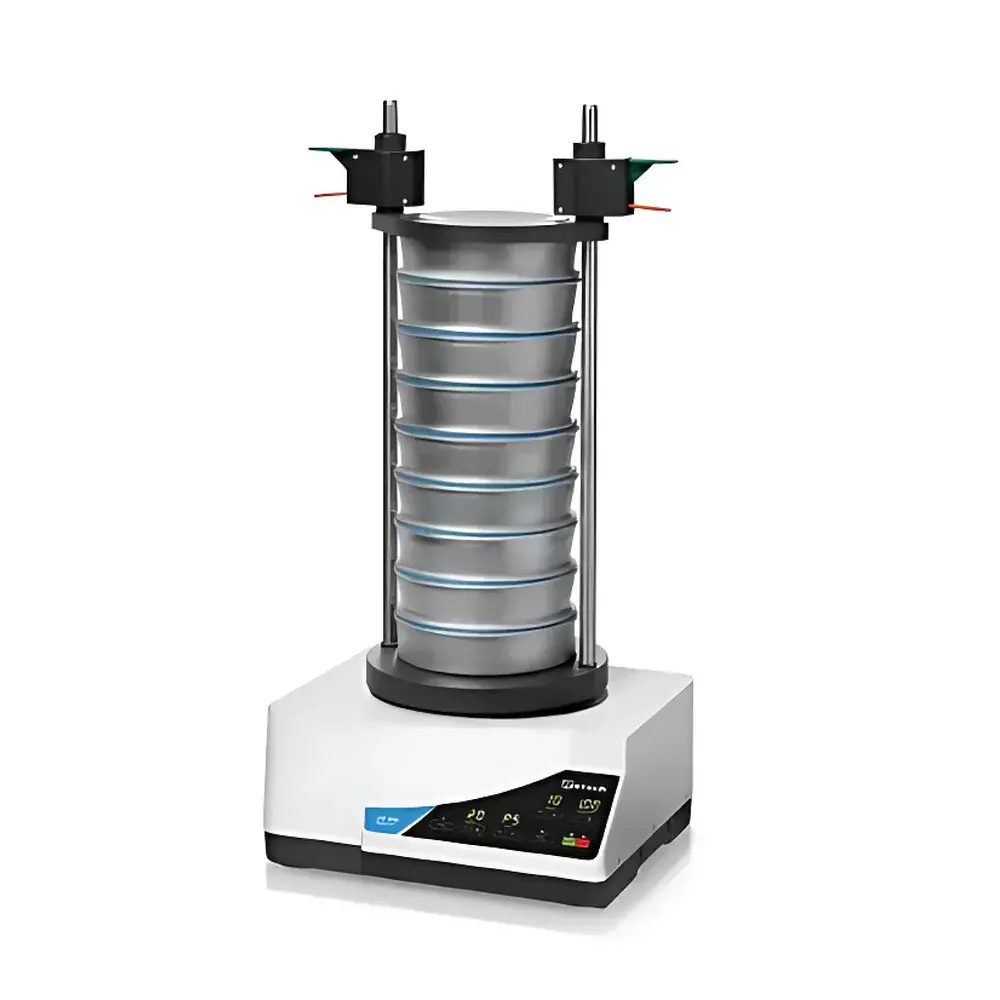
Retsch AS200 Control Vibratory Sieve Shaker
| Brand | Retsch |
|---|---|
| Origin | Germany |
| Model | AS200 Control |
| Principle | Electromagnetically Driven Vibratory Sieving |
| Measurement Range | 20 µm – 25 mm |
| Maximum Load | 3 kg |
| Sieve Stack Capacity | 11 or 22 sieves |
| Amplitude Range | 0.2–3 mm (digitally controlled) |
| Acceleration | 1.0–15.1 g |
| Sieving Time | 1–99 min (digital display) |
| Intermittent Mode | 1–99 s |
| Programmable Methods | 99 |
| Sieve Diameters Supported | 100 mm, 200 mm, 203 mm (8") |
| Max. Sieve Tower Height | 620 mm |
| Enclosure Rating | IP21 |
| Power Supply | 100–240 V, 50/60 Hz |
| Dimensions (W×H×D) | 417 × 212 × 384 mm |
| Net Weight | ~35 kg |
| Compliance | CE, ISO 9001 compatible, GLP/GMP-ready with audit trail-capable calibration documentation |
Overview
The Retsch AS200 Control is a high-precision electromagnetically driven vibratory sieve shaker engineered for reproducible, standardized particle size distribution analysis across research, quality control, and production environments. It operates on the principle of three-dimensional throwing motion—generated by a precisely regulated electromagnetic drive—to ensure uniform energy transfer across the entire sieve stack. This motion enables efficient stratification and separation of dry or wet particulate samples without mechanical wear or frequency drift, delivering consistent results compliant with international standards including ISO 2591-1, ISO 9047, ASTM E11, and USP . Designed for traceable metrology, the AS200 Control integrates digitally adjustable amplitude (0.2–3 mm) and acceleration (1.0–15.1 g), allowing method optimization for diverse material behaviors—from fragile agglomerates to dense mineral granules.
Key Features
- Electromagnetic drive system with zero mechanical backlash, ensuring long-term stability and minimal maintenance.
- Digital amplitude and acceleration control for method-specific optimization—critical for sensitive or cohesive powders.
- Up to 22-sieve stack capacity (with optional 203 mm diameter sieves), supporting multi-stage fractionation in a single run.
- 99 programmable sieve methods stored internally, each with independent time, amplitude, and intermittent cycle parameters.
- Integrated USB interface for firmware updates, data export, and integration into laboratory information management systems (LIMS).
- IP21-rated enclosure with robust steel housing, suitable for industrial QC labs and regulated environments.
- Calibration-ready architecture: includes factory-issued calibration certificate; supports user-performed verification per ISO/IEC 17025 requirements.
- Dual-mode operation: fully validated for both dry sieving (per ISO 9276-2) and wet sieving (per ISO 11277), with dedicated clamping systems (“Standard” and “Comfort” types).
Sample Compatibility & Compliance
The AS200 Control accommodates a broad spectrum of sample types—including free-flowing powders, friable granules, fibrous materials, and suspended solids—within a 3 kg maximum load limit. Its 20 µm to 25 mm measurement range covers applications from fine pharmaceutical actives to coarse construction aggregates. The instrument meets CE marking requirements and conforms to essential health and safety directives (2014/30/EU EMC, 2014/35/EU LVD). For regulated industries, its programmable, timestamped operation and calibration traceability support compliance with FDA 21 CFR Part 11 (when paired with validated software), ISO 9001 quality management systems, and GLP/GMP documentation workflows. All critical operational parameters—including amplitude, acceleration, duration, and start/stop timestamps—are logged and exportable for audit review.
Software & Data Management
While the AS200 Control operates as a standalone instrument with intuitive front-panel navigation, its USB port enables seamless connection to Retsch’s optional evaluation software (e.g., RETSCH Evaluation Software or third-party LIMS via CSV export). Each sieving run generates a timestamped record containing method ID, amplitude setting, acceleration value, total runtime, and intermittent cycle configuration. Calibration status and certificate expiry dates are stored and displayed on-screen. For laboratories requiring electronic records integrity, the system supports user-defined access levels, electronic signatures (via external software integration), and full audit trails—aligning with ALCOA+ principles for data reliability.
Applications
This vibratory sieve shaker serves cross-industry analytical needs: in pharmaceuticals, it verifies excipient uniformity and final blend particle distribution per USP ; in metallurgy and mining, it characterizes crushed ore gradation against ASTM E384 specifications; in food science, it assesses flour fineness or spice particle consistency under ISO 3310-1; in environmental labs, it performs soil texture analysis per USDA methodology; and in ceramics/glass manufacturing, it validates raw material batch homogeneity prior to sintering. Its dual dry/wet capability also supports slurry-based classification in wastewater treatment or pigment dispersion studies.
FAQ
Is the AS200 Control suitable for GMP-regulated environments?
Yes—its programmable methods, calibration traceability, and electronic record capabilities (when integrated with compliant software) support 21 CFR Part 11 and EU Annex 11 requirements.
Can I use standard ISO/USP-certified test sieves with this instrument?
Absolutely—the AS200 Control accepts all commercially available 100 mm, 200 mm, and 203 mm (8″) diameter sieves conforming to ISO 3310-1, ISO 3310-2, or ASTM E11 specifications.
What is the difference between “Standard” and “Comfort” clamping systems?
The Standard clamp uses manual screw tightening for dry sieving; the Comfort clamp features quick-release levers and integrated sealing gaskets for rapid, leak-proof wet sieving setups.
Does the instrument require periodic recalibration?
While the electromagnetic drive maintains inherent stability, annual verification using certified reference weights and amplitude sensors is recommended per ISO/IEC 17025 and internal quality protocols.
How does the three-dimensional throwing motion improve sieving efficiency compared to rotary shakers?
It ensures uniform particle agitation across the full sieve surface area, minimizing channeling and blinding—especially critical for irregular or electrostatically charged particles.



