
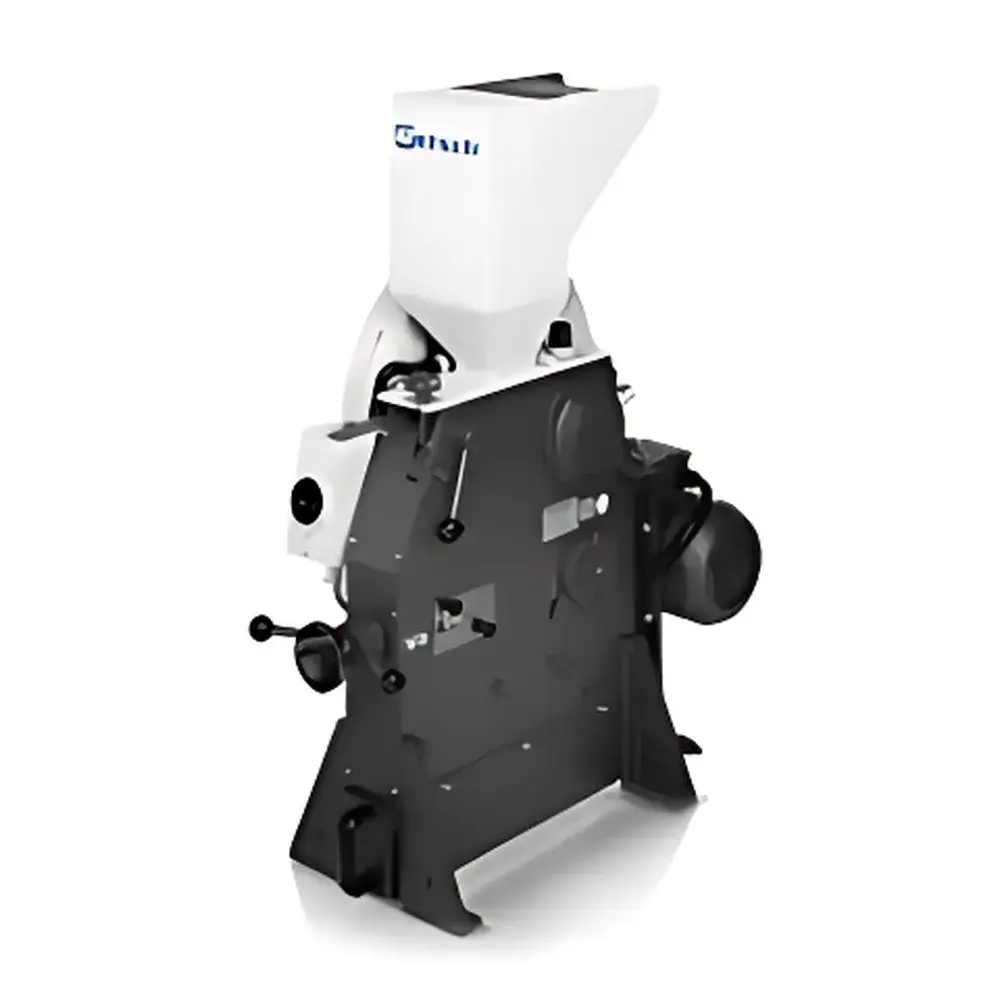
Retsch BB100 Jaw Crusher
| Brand | Retsch |
|---|---|
| Origin | Germany |
| Model | BB100 |
| Crusher Type | Jaw Crusher |
| Sample Type | Hard, brittle, medium-hard, and hard-tough materials |
| Max. Feed Size | < 50 mm |
| Final Particle Size (d90) | < 4 mm |
| Throughput | 200 kg/h |
| Jaw Width | 60 × 60 mm |
| Adjustable Gap Range | 0–20 mm |
| Gap Indication | Analog scale |
| Reversible Hopper | Yes |
| Dust Extraction Port | Yes |
| Motor Power | 750 W |
| Dimensions (W×H×D) | 320 × 960 × 800 mm |
| Net Weight | ~137 kg |
| Compliance | CE certified |
| Warranty | 12 months |
Overview
The Retsch BB100 Jaw Crusher is a robust, single-toggle laboratory and pilot-scale crusher engineered for reliable coarse and pre-crushing of solid, heterogeneous materials. Operating on the principle of compressive crushing—where material is subjected to controlled mechanical stress between two opposing jaw plates—one fixed and one moving in an elliptical motion driven by an eccentric shaft—the BB100 delivers consistent particle size reduction through progressive compression and gravitational feed. Its design conforms to fundamental mechanical crushing theory: particle breakage occurs primarily via cleavage and fragmentation under uniaxial pressure, with final output governed by the adjustable gap between jaws. This makes the BB100 particularly suited for applications requiring reproducible, high-throughput size reduction prior to downstream analysis (e.g., XRF, XRD, ICP-OES) or further grinding in planetary ball mills or rotor beater mills. The instrument is not intended for fine grinding or micronization; rather, it serves as a critical first-stage comminution tool where throughput, mechanical durability, and operator safety are paramount.
Key Features
- High-capacity throughput of up to 200 kg/h—optimized for batch and semi-continuous operation in quality control labs and raw material processing facilities
- Precision-adjustable jaw gap (0–20 mm), calibrated via analog scale with zero-point recalibration capability to compensate for jaw wear over time
- Reversible hopper design ensures splash-free sample introduction and rapid, tool-free positioning for ergonomic loading
- Dust extraction port compatible with standard laboratory vacuum systems (e.g., HEPA-filtered industrial vacuums), supporting occupational exposure limit (OEL) compliance
- Four interchangeable jaw plate materials available (manganese steel, hardened steel, tungsten carbide, ceramic)—selected based on sample abrasivity and contamination sensitivity
- Integrated safety features: motor brake system, emergency stop switch, and fully enclosed crushing chamber meeting EN 61000-6-2/6-4 EMC and EN ISO 12100 safety standards
- Centralized lubrication option (accessory) for extended maintenance intervals and reduced downtime in high-utilization environments
- Quick-access grinding chamber with minimal crevices—facilitating full visual inspection and residue-free cleaning per GLP cleaning validation protocols
Sample Compatibility & Compliance
The BB100 accepts feed particles up to 50 mm in maximum dimension and reliably reduces them to a d90 ≤ 4 mm output—ideal for homogenizing geological, metallurgical, cementitious, and industrial waste samples. It accommodates hard and brittle materials including basalt, granite, quartz, slag, coal, refractory bricks, and sintered oxides, as well as moderately tough alloys (e.g., tungsten carbide composites). Sample compatibility excludes fibrous, elastic, or highly adhesive substances that may clog the wedge-shaped crushing zone. The instrument complies with EU Machinery Directive 2006/42/EC and carries CE marking. All electrical components meet IEC 61000 electromagnetic compatibility requirements. While not inherently 21 CFR Part 11 compliant (as it produces no electronic records), its mechanical operation supports audit-trail integrity when integrated into documented SOPs for sample preparation workflows under ISO/IEC 17025 or GMP environments.
Software & Data Management
The BB100 is a standalone electromechanical instrument with no embedded firmware, touchscreen interface, or digital data logging capability. All operational parameters—including jaw gap setting, run duration, and batch identification—are manually recorded by the user. This analog architecture eliminates cybersecurity risks associated with networked devices and simplifies qualification (IQ/OQ) in regulated settings. For laboratories requiring traceability, integration with LIMS is achieved via external barcode scanning of sample containers before and after crushing, with jaw gap settings logged in standardized preparation worksheets. Optional accessories include a digital caliper kit for periodic gap verification and a calibration certificate traceable to national metrology institutes (e.g., PTB).
Applications
- Preparation of geological core samples for geochemical assay (e.g., Au, Cu, Fe quantification via fire assay or ICP-MS)
- Routine size reduction of cement clinker and fly ash prior to Blaine surface area testing (ASTM C204)
- Homogenization of metallurgical slags and ferroalloy residues for X-ray fluorescence (XRF) spectral analysis
- Crushing of construction and demolition waste (CDW) for leaching test specimens (EN 12457, TCLP)
- Primary comminution of ceramic raw materials (feldspar, kaolin) prior to wet milling and particle size distribution analysis (ISO 13320)
- Sample conditioning for thermal analysis (TGA/DSC) where representative bulk composition must be preserved across particle fractions
FAQ
What is the recommended maintenance schedule for the BB100?
Routine inspection of jaw plate wear, bolt tightness, and hopper alignment is advised after every 50 operating hours. Lubrication of the eccentric shaft bearing is required every 200 hours if using the central lubrication option; otherwise, manual greasing every 100 hours is recommended.
Can the BB100 be used for food-grade or pharmaceutical samples?
Only with stainless-steel or ceramic jaw plates and full validation of cleaning procedures per FDA guidance for equipment contact surfaces. Note: CE marking does not imply food or pharma regulatory approval.
Is the d90 < 4 mm specification guaranteed for all materials?
No—the stated d90 is achievable under standardized test conditions (dry, brittle reference material like limestone at optimal gap setting). Actual output depends on moisture content, fracture toughness, and heterogeneity, as noted in Retsch’s technical documentation.
Does Retsch provide IQ/OQ documentation support?
Yes—Retsch offers optional qualification packages including template protocols, test scripts, and witness reports aligned with ISO/IEC 17025 and ASTM E2500, though final approval rests with the end-user’s QA department.
How is jaw plate wear compensated during long-term use?
The zero-point calibration function allows users to reset the analog scale baseline after measurable wear, ensuring repeatable gap settings independent of accumulated surface erosion.



