
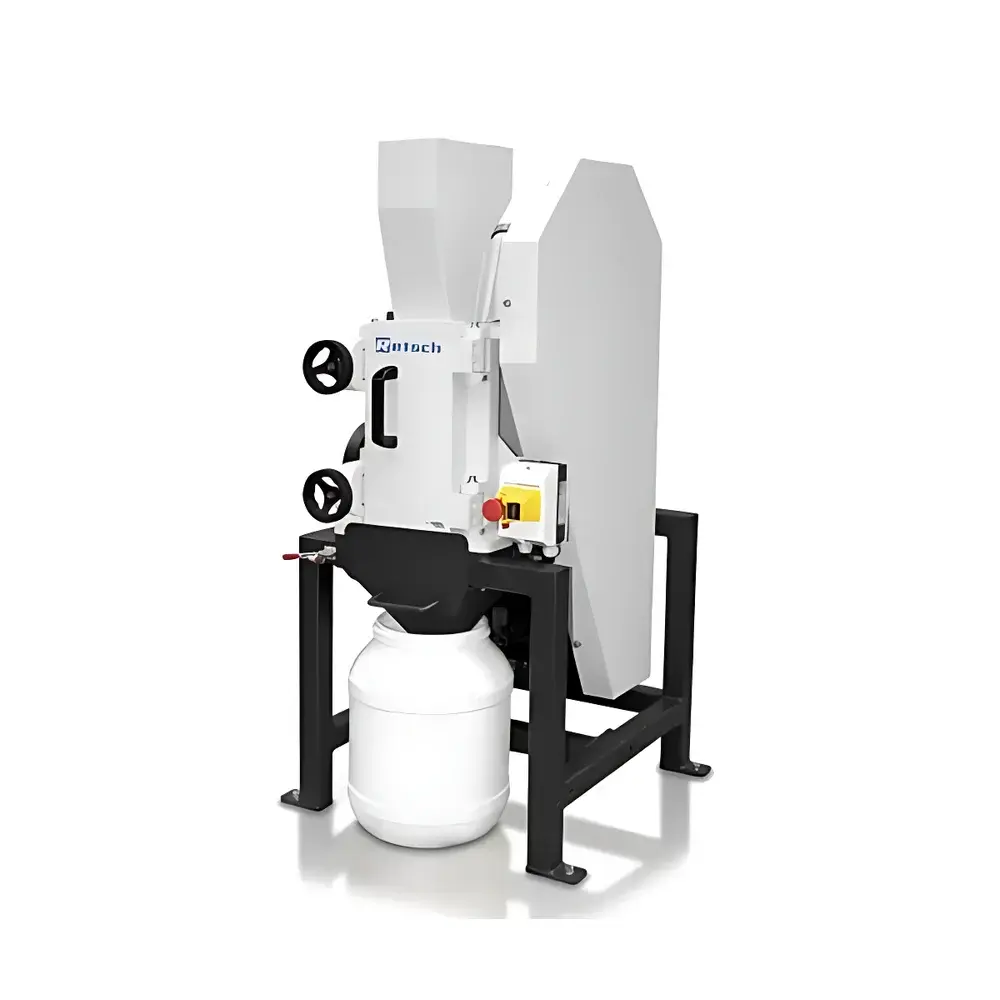
RETSCH BB250 Front-Loading Jaw Crusher
| Brand | RETSCH |
|---|---|
| Origin | Germany |
| Model | BB 250 |
| Instrument Type | Jaw Crusher |
| Sample Suitability | Medium-hard to hard, brittle materials |
| Max. Feed Size | < 120 × 90 mm |
| Final Particle Size | < 2 mm |
| Adjustable Crushing Gap | 0–30 mm (graduated scale, zero-point calibrated) |
| Throughput Capacity | up to 300 kg/h |
| Batch Volume | 10 L |
| Grinding Chamber Liner Materials | Manganese steel, stainless steel 316L, NiHard 4, tungsten carbide, heavy-metal-free grinding steel |
| Jaw Plate Width | 120 × 90 mm |
| Wear Indicator | Yes (down to −10 mm) |
| Feed Hopper | Spring-damped, front-access, removable |
| Optional Accessories | Dust extraction interface, central lubrication system, continuous-feed base frame |
| Drive | Three-phase motor, 3.0 kW |
| Power Supply | Variable voltage, three-phase |
| Protection Rating | IP 55 |
| Dimensions (W × H × D) | 695 × 1399 × 719 mm |
| Net Weight | ~350 kg |
| Compliance | CE-marked, designed and manufactured in accordance with EU Machinery Directive 2006/42/EC and EN 61000-6-2/-6-4 electromagnetic compatibility standards |
Overview
The RETSCH BB250 Front-Loading Jaw Crusher is an industrial-grade primary size reduction instrument engineered for reliable, high-throughput coarse comminution of medium-hard to hard, brittle materials. Based on the principle of compressive crushing—where material is subjected to controlled mechanical pressure between two opposing jaw plates—the BB250 delivers consistent particle size reduction through a robust eccentric drive mechanism. The fixed jaw plate and dynamically oscillating movable jaw generate an elliptical motion path, enabling efficient fracturing under wedge-type compression. Gravity-assisted discharge ensures continuous downward flow of processed material into the removable 10 L collection tray. Designed for laboratory-to-pilot-scale applications, the BB250 bridges the gap between benchtop preparation and pre-processing requirements in analytical workflows where representative bulk sampling and homogenization are critical prior to downstream analysis (e.g., XRF, ICP-OES, or sieve analysis).
Key Features
- Front-loading architecture with spring-damped feed hopper for safe, ergonomic sample introduction and reduced operator exposure to dust or splash hazards.
- Continuously adjustable crushing gap (0–30 mm), precisely indexed via calibrated scale with factory-zero calibration and wear-compensation capability down to −10 mm.
- High-capacity throughput of up to 300 kg/h, validated across quartz, basalt, concrete, ceramics, and electronic scrap under standardized operating conditions.
- Interchangeable jaw plate materials—including manganese steel, stainless steel 316L, NiHard 4, tungsten carbide, and heavy-metal-free grinding steel—to accommodate chemical compatibility, contamination control, and wear resistance requirements.
- IP 55-rated enclosure and CE-compliant construction ensure operational safety and suitability for regulated environments including GLP laboratories and ISO/IEC 17025-accredited testing facilities.
- Optional central lubrication system and continuous-feed base frame support extended unattended operation and integration into automated sample preparation lines.
Sample Compatibility & Compliance
The BB250 accepts feed particles up to 120 × 90 mm and reduces them to a nominal top size of < 2 mm, achieving a maximum size reduction ratio of 45:1. It is routinely deployed for sample preparation in geological surveying (rock, ore, slag), construction materials testing (concrete, asphalt, refractories), environmental solid waste characterization (e-waste, incinerator ash, contaminated soils), and advanced ceramics development. Jaw plate material selection follows application-specific compliance needs: stainless steel 316L for low-metal leaching in environmental testing; tungsten carbide for ultra-low abrasion in high-volume metallurgical labs; NiHard 4 for aggressive siliceous feedstocks. All configurations meet EN 61000-6-2 (immunity) and EN 61000-6-4 (emission) standards. Full CE documentation—including risk assessment, EC Declaration of Conformity, and user manual in English—is supplied with each unit.
Software & Data Management
The BB250 operates as a stand-alone mechanical system without embedded firmware or digital control interface. However, its design supports traceable operation within regulated workflows: calibrated gap settings are physically recorded and verifiable; wear indicators enable scheduled maintenance logging; and optional dust extraction integration allows linkage to facility-wide air quality monitoring systems. For laboratories operating under FDA 21 CFR Part 11 or ISO/IEC 17025, the BB250’s mechanical repeatability, documented calibration history, and CE-conformance provide foundational elements for equipment qualification (IQ/OQ). Maintenance logs, gap-setting records, and material compatibility charts may be maintained electronically using laboratory information management systems (LIMS) or electronic lab notebooks (ELN).
Applications
- Preparation of representative sub-samples from heterogeneous geological cores or mining drill cuttings prior to geochemical assay.
- Routine size reduction of construction aggregates for gradation analysis per ASTM C136 / ISO 2591-1.
- Homogenization of electronic waste fractions (PCBs, connectors, housings) for RoHS-compliant elemental screening by XRF.
- Crushing of ceramic green bodies or sintered samples for microstructural analysis or phase quantification via XRD.
- Primary comminution of contaminated soil matrices prior to TCLP or SPLP leaching protocols (EPA Method 1311/1312).
FAQ
What is the maximum feed size the BB250 can accept?
The BB250 accommodates feed particles up to 120 × 90 mm in dimension.
Can the final particle size be adjusted below 2 mm?
No—the BB250 is optimized for coarse crushing; final output is typically < 2 mm. For finer grinding, downstream equipment such as rotor beater mills (e.g., RETSCH SK series) or disc mills (e.g., RS 200) is recommended.
Is the BB250 suitable for moisture-sensitive or temperature-sensitive samples?
Yes—operation is purely mechanical and generates minimal heat; no internal heating elements or frictional hotspots are present. Ambient-condition processing preserves thermal and hygroscopic integrity.
How is wear on the jaw plates monitored?
A built-in wear indicator provides visual confirmation of jaw plate erosion, calibrated to detect loss down to −10 mm relative to original geometry.
Does the BB250 comply with international safety standards?
Yes—it carries full CE marking per EU Machinery Directive 2006/42/EC and conforms to EN 61000-6-2 and EN 61000-6-4 for electromagnetic compatibility.



