
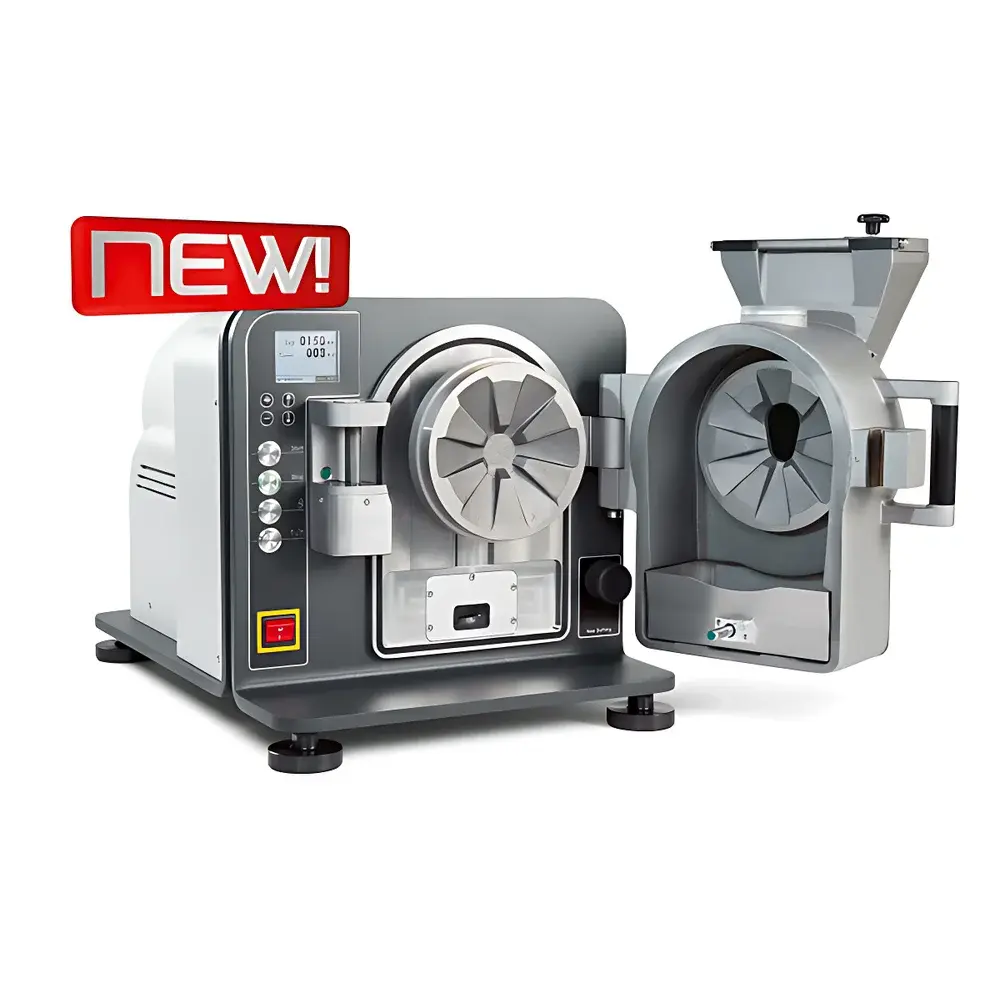
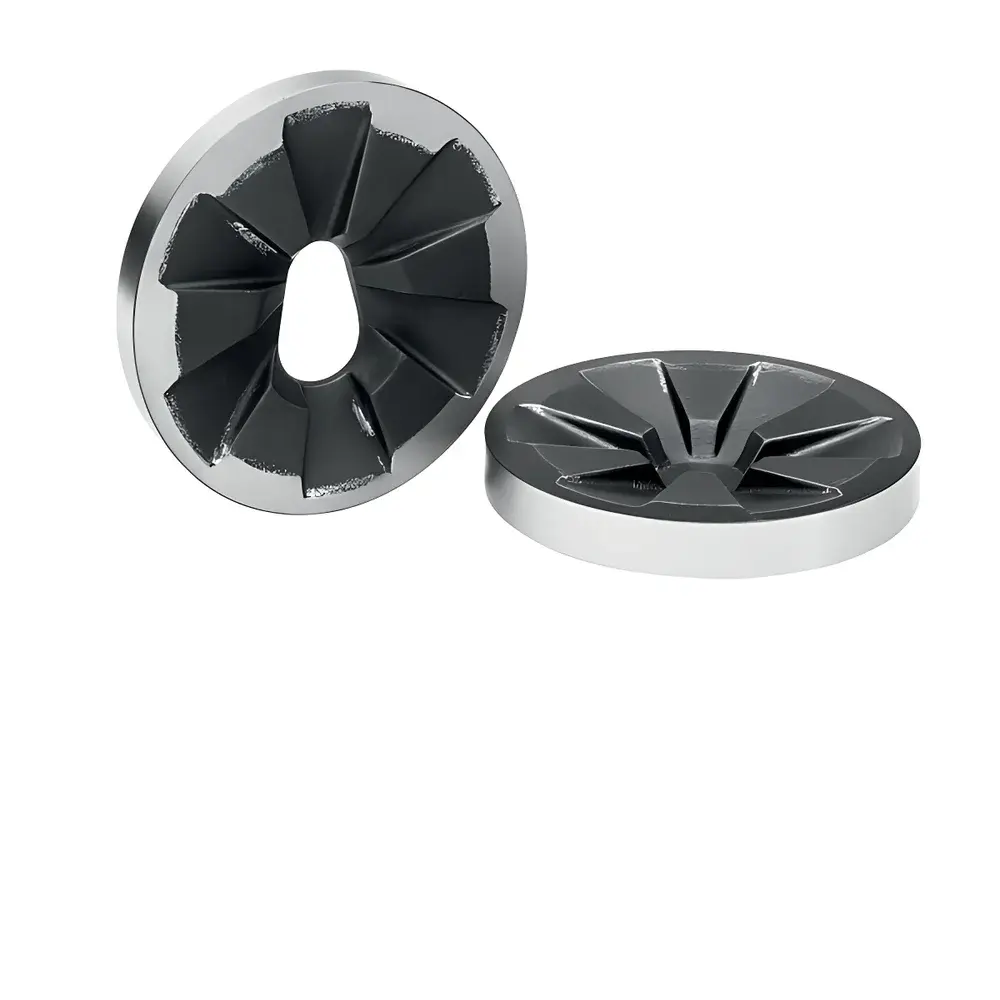
Retsch DM400 Disc Mill
| Brand | Retsch |
|---|---|
| Origin | Germany |
| Model | DM400 |
| Instrument Type | Disc Mill |
| Sample Suitability | Medium-hard to hard and brittle materials |
| Maximum Feed Size | < 20 mm |
| Final Particle Size | < 50 µm |
| Throughput | up to 150 kg/h |
| Grinding Gap Adjustment Range | 0.1–5 mm (motorized, digital display) |
| Motor Power | 1.5 kW |
| Drive | Three-phase AC geared motor |
| Speed | 440 min⁻¹ (50 Hz) / 528 min⁻¹ (60 Hz) |
| Receiving Container Volume | 2.5 L |
| Dimensions (W×H×D) | 520 × 630 × 1050 mm |
| Net Weight | ~240 kg |
| Protection Class | IP 55 |
| Compliance | CE-marked |
Overview
The Retsch DM400 Disc Mill is a high-capacity, industrial-grade laboratory disc mill engineered for reliable pre-crushing and fine grinding of medium-hard to hard, brittle materials. Operating on the principle of compressive force and shear friction between two vertically aligned, counter-rotating (one fixed, one driven) disc plates, the DM400 delivers consistent particle size reduction through controlled mechanical stress. Unlike impact or planetary mills, disc milling provides deterministic control over final particle size distribution via precise, motorized adjustment of the grinding gap—enabling reproducible results across batch and continuous operation modes. Its robust cast-iron frame, IP 55-rated enclosure, and reinforced drive train make it suitable for demanding environments including pilot-scale production lines, QA/QC laboratories in construction materials testing, and geochemical sample preparation facilities where dust containment, thermal stability, and long-term operational integrity are critical.
Key Features
- Motorized, digitally displayed grinding gap adjustment (0.1–5 mm range), ensuring traceable, repeatable process parameters and eliminating manual calibration drift.
- TFT touchscreen control panel with intuitive interface for real-time monitoring of speed, runtime, gap setting, and system status—fully compliant with GLP documentation requirements.
- Interlocked grinding chamber and collection vessel with automatic safety locking mechanism, meeting EN 61000-6-2/6-4 and Machinery Directive 2006/42/EC standards.
- Large-diameter, smooth-surface polymeric feed funnel (removable and autoclavable) minimizes sample retention and cross-contamination between runs.
- Modular grinding set options—including zirconium oxide, tungsten carbide, hardened steel, and manganese steel discs—to match material abrasivity and avoid metallic contamination in sensitive applications (e.g., cement clinker, pharmaceutical excipients).
- Integrated zero-point calibration function and self-aligning disc mounting system ensure geometric consistency and reduce maintenance downtime.
- Optional polymer-coated internal chamber surface for enhanced corrosion resistance and simplified cleaning when processing acidic or hygroscopic samples.
Sample Compatibility & Compliance
The DM400 accommodates a broad spectrum of inorganic and mineralogical matrices, including but not limited to cement slag, blast furnace slag, concrete aggregates, quartz, granite, bauxite, refractory clays, sintered ceramics, coke, coal, phosphate rock, gypsum, chalk, glass frits, porcelain insulators, and dried sewage sludge. It is routinely employed in ASTM C114 (chemical analysis of hydraulic cement), ISO 679 (cement testing), and EN 196-3 (fineness by Blaine method) sample conditioning workflows. All electrical and mechanical components conform to CE marking requirements under the Low Voltage Directive (2014/35/EU), Electromagnetic Compatibility Directive (2014/30/EU), and Machinery Directive (2006/42/EU). The unit supports audit-ready operation in regulated environments requiring adherence to FDA 21 CFR Part 11 (when paired with validated LIMS integration) and ISO/IEC 17025-compliant quality management systems.
Software & Data Management
While the DM400 operates as a standalone instrument with embedded firmware, its digital control interface supports RS232 and optional Ethernet connectivity for integration into centralized laboratory informatics platforms. Parameter logs—including gap position, rotational speed, cumulative operating time, and start/stop timestamps—are stored internally with non-volatile memory retention (≥10,000 cycles). Exportable CSV reports enable traceability for SOP compliance and root-cause analysis during method validation. Optional Retsch “RETSCHconnect” software enables remote configuration, firmware updates, and preventive maintenance scheduling based on operational metrics. Full audit trail functionality satisfies GLP/GMP data integrity expectations, including user authentication, electronic signatures, and change history tracking.
Applications
The DM400 serves as a primary size-reduction tool in analytical workflows requiring representative sub-sampling prior to XRF, XRD, ICP-OES, or laser diffraction analysis. It is widely deployed in cement manufacturing QC labs for homogenizing clinker and raw meal; in geological survey laboratories for preparing rock core composites; in recycling R&D centers for characterizing construction and demolition waste fractions; and in ceramic R&D for standardizing glaze and body formulations. Its ability to operate continuously at up to 150 kg/h throughput—while maintaining <50 µm d₉₀ output—makes it uniquely suited for bridging lab-scale development and technical-scale process qualification.
FAQ
What types of materials are incompatible with the DM400?
Highly elastic, fibrous, or thermoplastic materials (e.g., rubber, PVC, polymers above their glass transition temperature) are not recommended due to clogging risk and insufficient compressive fracture behavior.
Can the DM400 be used for wet grinding?
No—the instrument is designed exclusively for dry grinding. Moisture content exceeding 1% w/w may impair flow dynamics and cause agglomeration or chamber adhesion.
Is routine calibration required for gap positioning accuracy?
The motorized gap actuator includes factory-traceable linear encoder feedback; however, annual verification using certified gauge blocks per ISO 17025 is recommended for accredited laboratories.
How often should grinding discs be replaced?
Service life depends on abrasive load and hardness; typical replacement intervals range from 200–1,000 operating hours—monitored via integrated wear indicators and documented in the maintenance log.
Does the DM400 meet explosion protection requirements for combustible dust environments?
Standard configuration does not include ATEX certification; however, customized versions with static-dissipative components and inert gas purging capability are available upon request for Class 20/21 dust hazard zones.



