
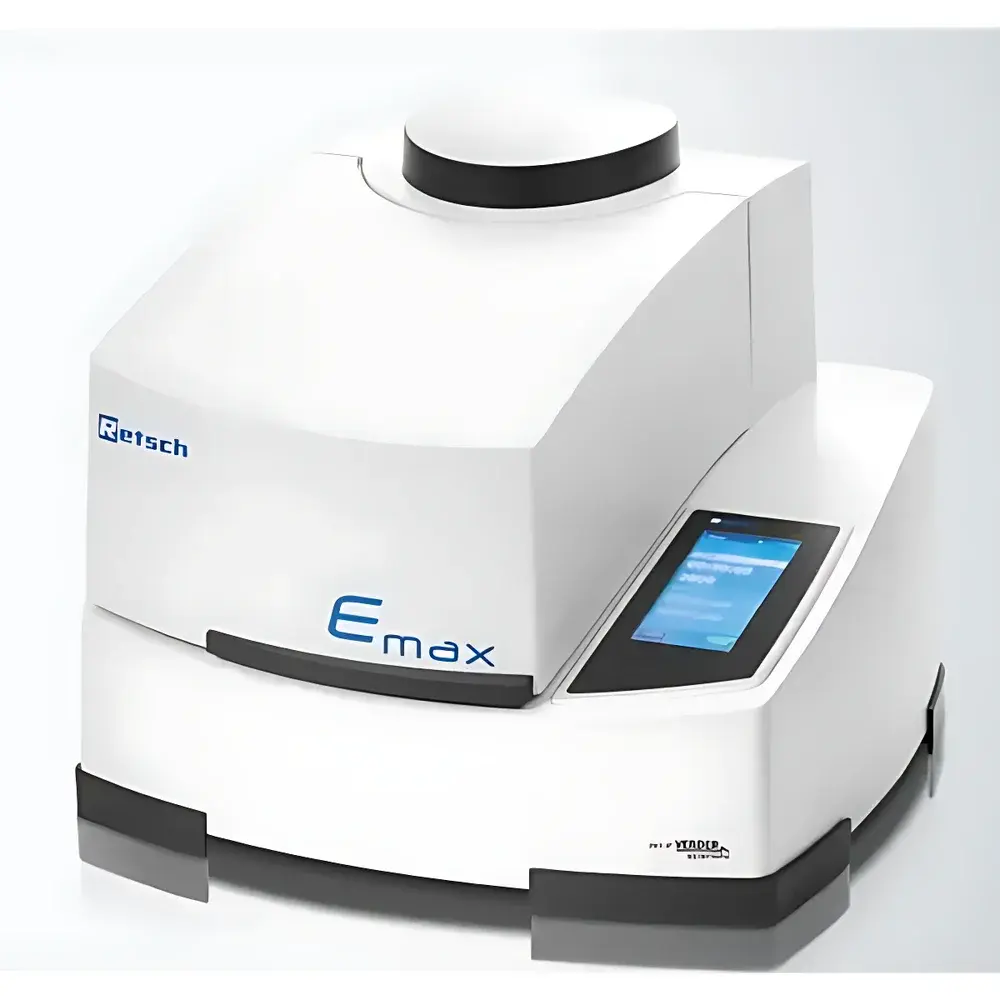
Retsch Emax High-Energy Ball Mill
| Brand | Retsch |
|---|---|
| Origin | Germany |
| Model | Emax |
| Instrument Type | High-Energy Ball Mill |
| Sample Suitability | Hard, brittle, fibrous, and medium-hard materials |
| Feed Size | < 5 mm |
| Final Particle Size (d90) | < 80 nm |
| Batch Capacity | 2 × 45 mL (dual grinding stations) |
| Speed Range | 300–2000 rpm |
| Cooling | Integrated water-cooled grinding chamber with external chiller interface |
| Programmable Runtime | 00:01:00–99:59:99 |
| Stored Methods | Up to 10 user-defined protocols |
| Drive Power | 2600 W |
| Dimensions (W×H×D) | 625 × 525 × 645 mm |
| Net Weight | ~120 kg |
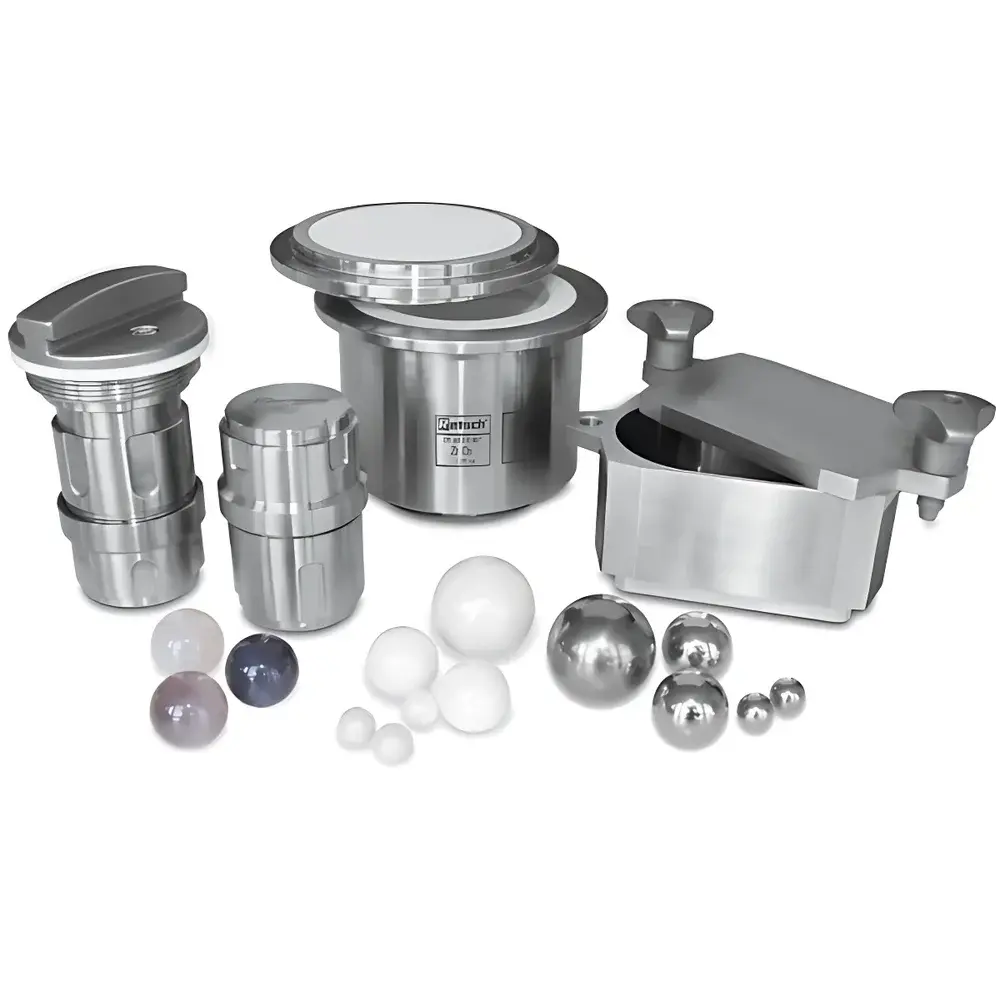
| Grinding Jar Materials | Stainless steel, tungsten carbide, agate, zirconium oxide, PTFE-lined options available |
Overview
The Retsch Emax High-Energy Ball Mill represents a paradigm shift in mechanical comminution technology. Engineered for precision nanoscale particle size reduction and mechanochemical synthesis, the Emax operates on the principle of high-frequency impact and shear forces generated by centrifugal acceleration in a dual-station planetary configuration. Unlike conventional planetary ball mills limited to ≤800 rpm, the Emax achieves rotational speeds up to 2000 rpm—delivering kinetic energy densities sufficient for rapid amorphization, solid-state alloying, and top-down nanoparticle generation. Its design integrates dynamic force transmission, thermal management, and process reproducibility into a single robust architecture, making it suitable for demanding applications in materials science, catalysis research, pharmaceutical development, and advanced ceramics processing.
Key Features
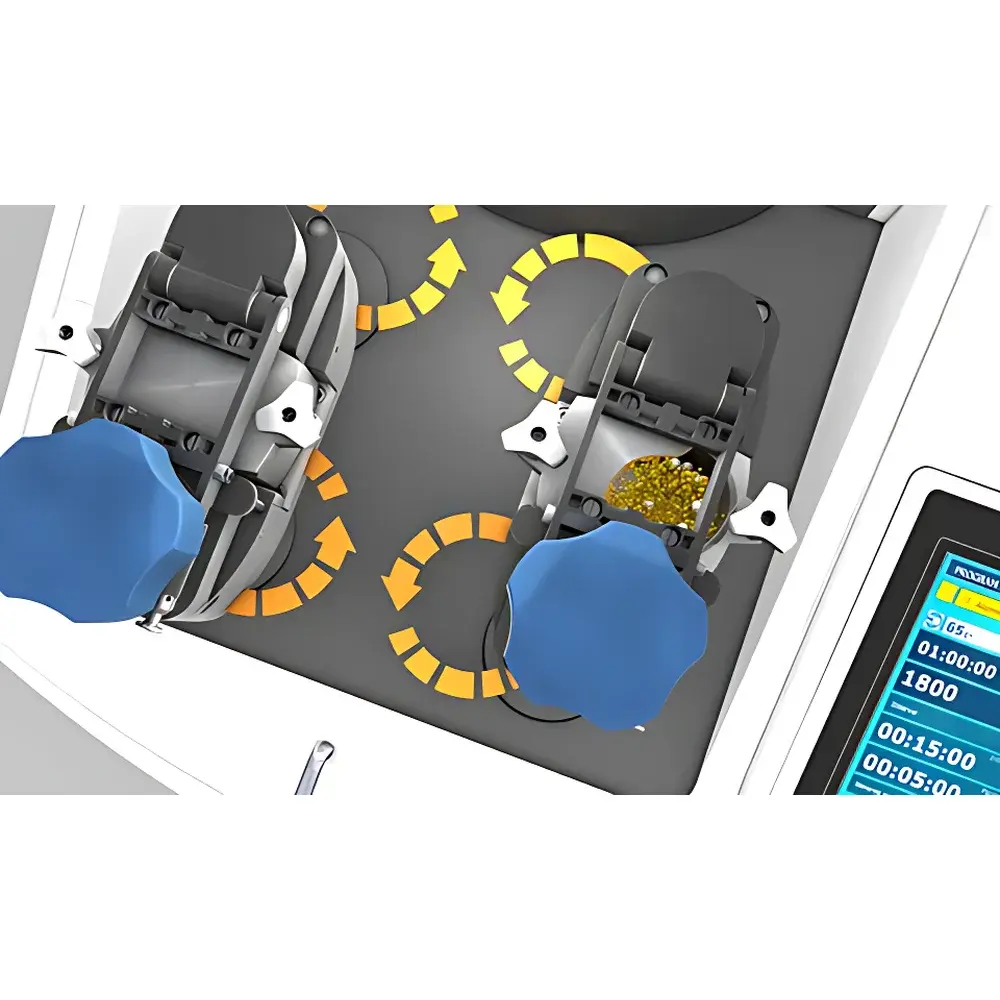
- Dual-Station Planetary Drive: Two independently controlled grinding stations enable parallel processing or comparative method development while maintaining identical mechanical energy input per jar.
- 2000 rpm Maximum Speed: Unmatched rotational velocity ensures exceptional impact energy transfer—critical for breaking covalent and metallic bonds in hard and brittle materials such as quartz, silicon carbide, and metal oxides.
- Integrated Water-Cooled Grinding Chamber: Precision-machined cooling channels embedded in the grinding platform actively extract heat from jars during operation. Compatible with external chillers (e.g., 10–25 °C supply) or tap-water circulation for sustained thermal stability.
- Intelligent Temperature Control: Real-time monitoring enables programmable upper/lower temperature thresholds; automatic pause/resume functionality prevents thermal degradation of thermolabile samples (e.g., polymers, biomaterials, MOFs).
- Secure Jar Locking Mechanism: Patented bayonet-style clamping system guarantees vibration-resistant fixation under extreme centrifugal loads—eliminating jar displacement risks at full speed.
- Touchscreen Interface with Method Storage: Intuitive 7-inch color display supports time-, speed-, and temperature-based protocol definition; up to 10 methods can be saved with timestamped execution logs.
- Material-Adapted Jar Options: Available in stainless steel (316L), tungsten carbide, agate, zirconium oxide, and PTFE-lined variants—ensuring compatibility with corrosive, reactive, or contamination-sensitive samples.
Sample Compatibility & Compliance
The Emax accommodates a broad spectrum of inorganic and organic solids—including minerals (quartz, feldspar), alloys (Al–Fe, Cu–Ni), catalysts (TiO₂, Pt/C), pharmaceutical excipients, and biological matrices (bone, plant tissue). Dry and wet grinding modes are supported, with solvent compatibility verified for ethanol, isopropanol, toluene, and aqueous electrolytes. All grinding components comply with ISO 8502-3 for surface cleanliness and EU Directive 2014/30/EU (EMC) and 2014/35/EU (LVD). The instrument’s firmware supports audit trails and electronic signatures per FDA 21 CFR Part 11 requirements when integrated with validated LIMS environments.
Software & Data Management
Operation is managed via the built-in embedded controller—no external PC required. Each run records speed, duration, temperature profile, and power consumption. Exportable CSV logs include timestamps, jar identification codes, and deviation alerts (e.g., overtemperature events). Optional Retsch Software Suite (RS-Connect) enables remote monitoring, multi-instrument scheduling, and GLP-compliant report generation—including calibration history, maintenance logs, and user access control. All data files are stored locally on encrypted internal flash memory with write-protection options.
Applications
- Nanoparticle Synthesis: Top-down production of sub-100 nm particles from bulk precursors (e.g., TiO₂ d90 = 87 nm after 30 min at 2000 rpm).
- Mechanical Alloying: Solid-state formation of metastable phases and amorphous alloys without melting—validated for Fe–Al, Ni–Nb, and Mg–Ni systems.
- Crystal Structure Modification: Induced phase transitions (e.g., anatase → rutile in TiO₂) and lattice disorder quantified via XRD peak broadening analysis.
- Homogenization & Dispersion: Uniform blending of multi-component composites (e.g., polymer–nanofiller masterbatches) and deagglomeration of aggregated pigments.
- Reaction Initiation: Solvent-free mechanochemical synthesis of co-crystals, metal–organic frameworks (MOFs), and organometallic compounds.
- Reference Material Preparation: Certified homogenization of geological standards (e.g., NIST SRM 2710a) prior to elemental analysis by ICP-MS or XRF.
FAQ
What is the maximum recommended continuous runtime at 2000 rpm?
For optimal thermal management and mechanical longevity, uninterrupted operation at full speed is rated for up to 60 minutes with active chiller cooling (≤15 °C inlet). Extended runs require intermittent pauses or reduced speed profiles.
Can the Emax perform cryogenic grinding?
No—the integrated water-cooling system is designed for active heat extraction above ambient temperatures. Cryo-grinding requires liquid nitrogen–compatible mills (e.g., Retsch MM 400) with specialized insulation and feed mechanisms.
Is validation support available for GMP environments?
Yes. Retsch provides IQ/OQ documentation templates, calibration certificates traceable to DKD/DAkkS standards, and optional 21 CFR Part 11 compliance packages including role-based access control and electronic signature workflows.
How does jar material selection affect final particle contamination?
Wear debris from grinding media directly influences elemental background. Tungsten carbide jars introduce W and Co traces; agate minimizes metallic contamination but limits use to non-abrasive samples. Stainless steel is suitable for general-purpose milling where Fe/Cr/Ni carryover is acceptable.
Does the Emax support variable-speed ramping during a single run?
No—speed is held constant throughout a defined program. However, sequential multi-step methods (e.g., coarse breakage at 1000 rpm followed by fine milling at 2000 rpm) can be chained using stored protocols.



