
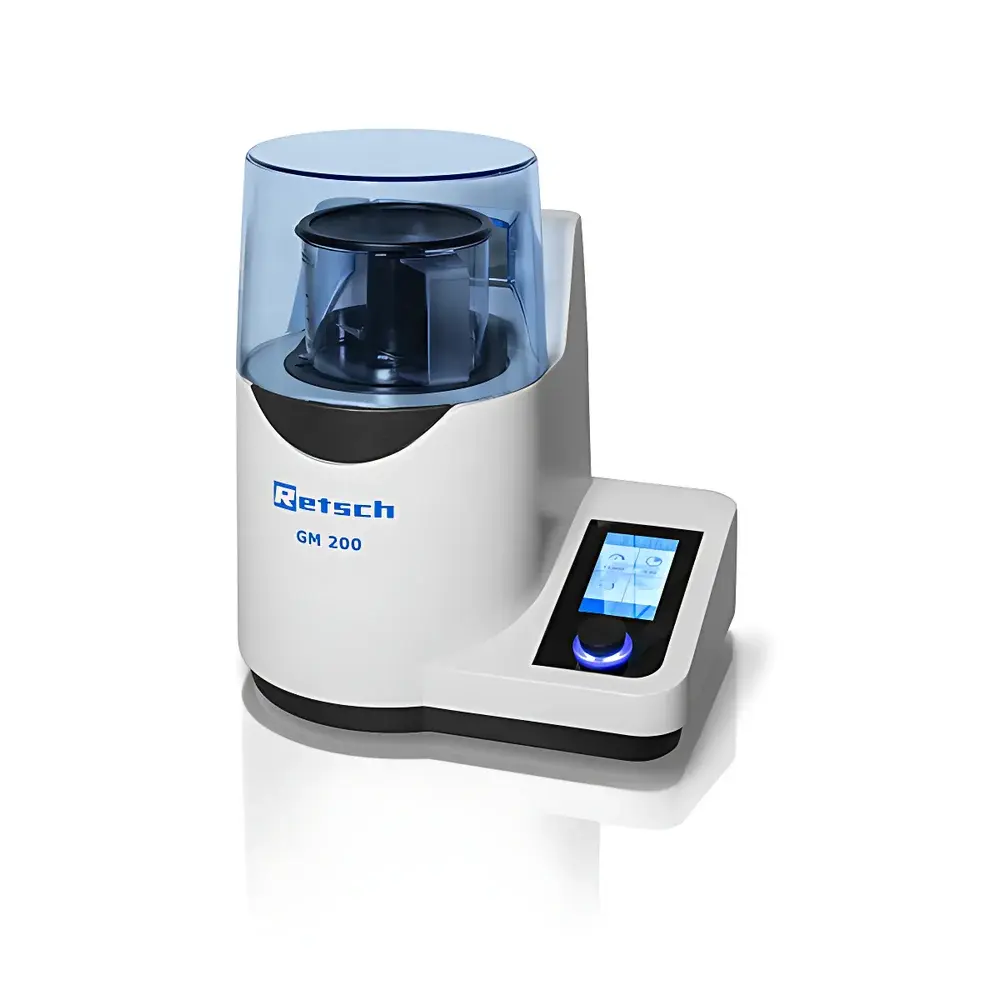
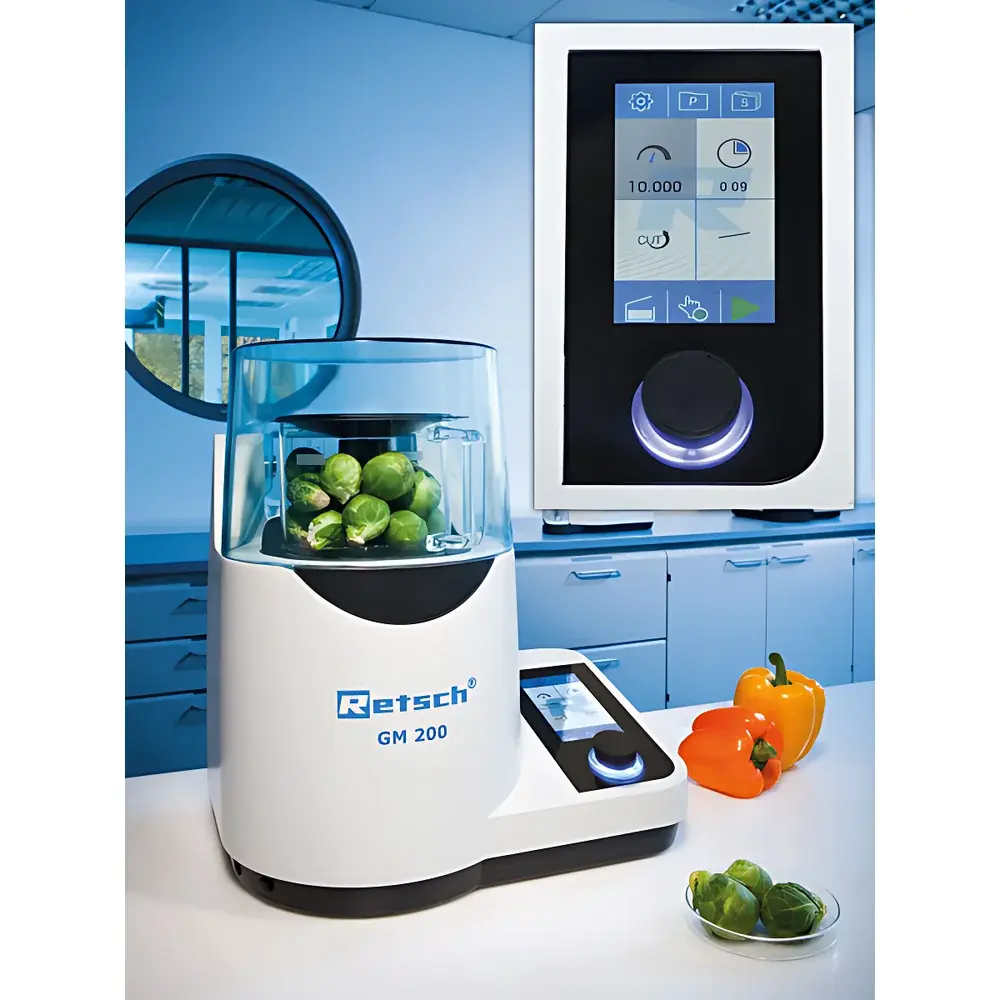
Retsch GM200 Knife Mill
| Brand | Retsch |
|---|---|
| Origin | Germany |
| Model | GM200 |
| Sample Type | Soft to moderately hard, elastic, fibrous, moist/fatty/oily, dry |
| Max Feed Size | 40 mm |
| Final Particle Size | <300 µm |
| Batch Volume (Standard Lid) | 700 mL |
| Chamber Volume (Standard Lid) | 1000 mL |
| Speed Range | 2,000–10,000 rpm (BOOST up to 14,000 rpm) |
| Motor Power | ~1000 W |
| Drive | Digital intermittent motor |
| Programmable Methods | 8 SOPs, 4 sequential programs |
| Compliance | CE-certified |
| Enclosure Rating | IP42 |
| Dimensions (W×H×D) | 350 × 275 × 392 mm (open: 350 × 410 × 553 mm) |
| Weight | ~10 kg |
Overview
The Retsch GM200 Knife Mill is a high-performance, digitally controlled laboratory knife mill engineered for rapid, reproducible size reduction and homogenization of soft, elastic, fibrous, and moisture-rich biological and food matrices. Operating on the principle of high-speed rotational cutting—where two precisely aligned stainless steel or titanium blades rotate perpendicular to the drive shaft within a sealed grinding chamber—the GM200 delivers consistent particle size distribution through controlled shear and impact forces. Unlike conventional blenders or rotor-stator homogenizers, the GM200’s dual-blade geometry, adjustable blade clearance, and programmable intermittent operation enable precise control over energy input and thermal load—critical for preserving analyte integrity in sensitive applications such as nutrient analysis, DNA/RNA extraction prep, or residual pesticide quantification. Its robust architecture, CE-compliant design, and IP42-rated enclosure ensure safe, reliable operation in regulated laboratory environments including ISO 17025-accredited testing labs and GLP-compliant food safety facilities.
Key Features
- Dual-blade cutting system with vertically mounted, hardened stainless steel or titanium knives—optimized for low-heat, high-efficiency fragmentation of wet, fatty, or fibrous samples
- Digital speed control from 2,000 to 10,000 rpm in 500-rpm increments, plus BOOST mode (up to 14,000 rpm) for demanding pre-crushing tasks
- Eight user-programmable SOPs with up to four sequential steps per method—including time, speed, direction (forward/reverse), and pause intervals
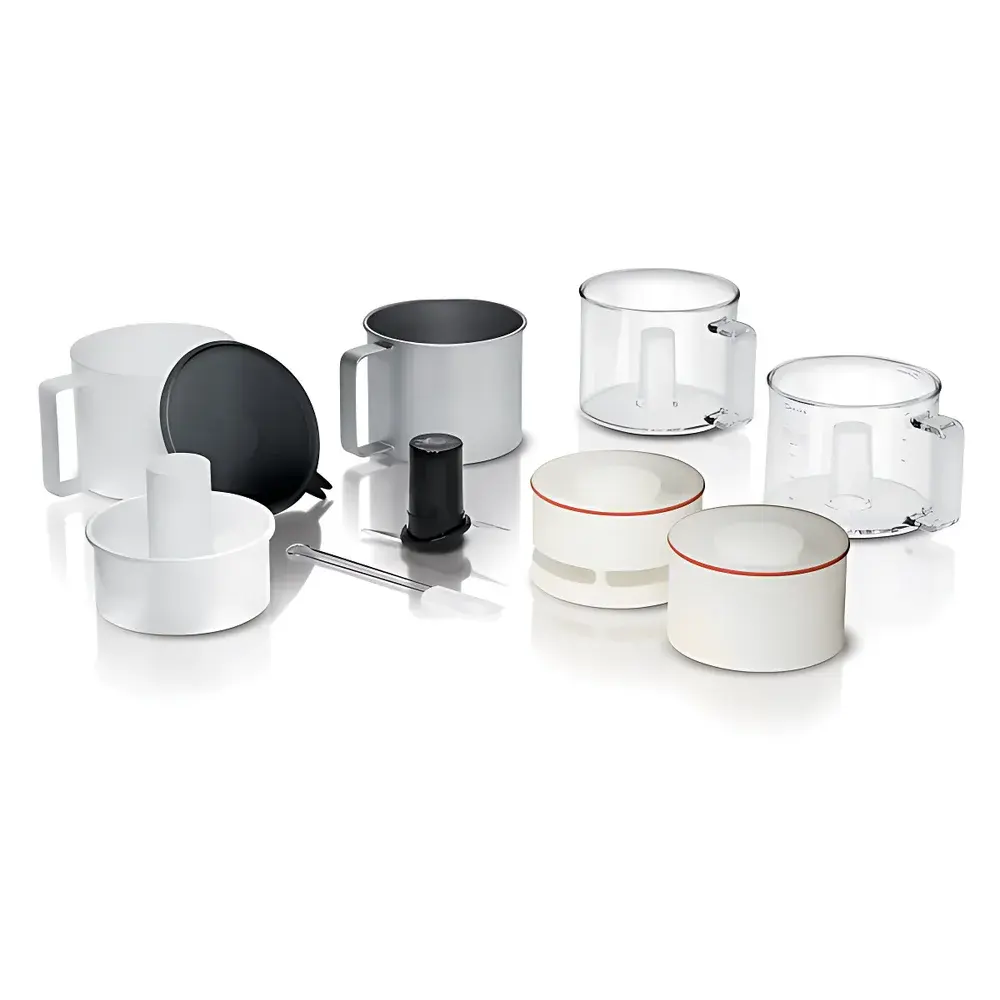
- Three interchangeable lid configurations: standard (1000 mL chamber, 700 mL max batch), gravity feed (400–800 mL chamber), and reduced-volume lid (300/500 mL chamber, 150–300 mL batch) for improved homogeneity with small or viscous samples
- Grinding vessels available in autoclavable polypropylene (PP), chemically resistant PVDF, stainless steel, and borosilicate glass—ensuring compatibility with diverse sample chemistries and cleaning protocols
- Integrated thermal management and intermittent drive mode minimize sample temperature rise during extended processing—essential for enzymatic or volatile compound preservation
- QR-code enabled interface linking directly to Retsch’s global application database: access validated methods, video tutorials, grinding reports, and regulatory documentation (e.g., ASTM D5630, ISO 13320, USP <725>)
Sample Compatibility & Compliance
The GM200 is validated for soft-to-moderately hard organic materials including fresh/frozen fruits and vegetables, meat, fish, cheese, sausages, dairy powders, cereal grains, seeds, sprouts, animal feed pellets, and herbal matrices. It accommodates samples with high water, oil, or fat content without clogging or blade slippage—thanks to its optimized blade profile and self-cleaning rotational dynamics. All wetted parts comply with FDA 21 CFR §177.1520 (food-contact plastics) and EU Regulation (EC) No. 1935/2004. The instrument supports audit-ready data integrity via timestamped method logs and electronic records compatible with 21 CFR Part 11–enabled LIMS integration. CE marking confirms conformity with the Machinery Directive 2006/42/EC and Electromagnetic Compatibility Directive 2014/30/EU.
Software & Data Management
Operation is managed via an intuitive front-panel digital interface with LED display, supporting real-time parameter monitoring and method recall. Each run generates a traceable log file containing date/time stamp, selected SOP ID, speed profile, total runtime, and cycle count—exportable via USB for QA/QC documentation. Optional Retsch LabManager software (v3.0+) enables remote configuration, multi-instrument fleet monitoring, and automated report generation aligned with ISO/IEC 17025 clause 7.7 (result reporting). All firmware updates are digitally signed and version-controlled to maintain validation status across GxP workflows.
Applications
- Food safety testing: Homogenization of composite samples prior to mycotoxin, heavy metal, or pathogen analysis (ISO 22000, AOAC 2012.01)
- Agricultural research: Preparation of plant tissue for NIR calibration, fiber analysis (AOAC 978.10), or genomic DNA isolation
- Pharmaceutical QC: Uniform blending of herbal extracts or nutraceutical powders prior to dissolution or content uniformity testing (USP <905>)
- Environmental labs: Processing of soil-plant composites or compost samples for organic carbon or PAH determination (EPA Method 3545A)
- Clinical nutrition: Standardized comminution of dietary supplements and fortified foods for vitamin A/D/E/K quantification (AOAC 992.16)
FAQ
What types of samples are incompatible with the GM200?
Samples with excessive hardness (e.g., bones, stones, dried mineral clays) or high abrasive content (e.g., silica sand, ceramic particles) are not recommended, as they may accelerate blade wear and compromise particle size reproducibility.
Can the GM200 be used under inert atmosphere conditions?
No—the standard grinding chamber is not gas-tight; however, optional stainless steel vessels with O-ring seals support limited nitrogen purging for oxygen-sensitive samples.
Is validation documentation available for GMP environments?
Yes—Retsch provides IQ/OQ templates, performance qualification protocols, and traceable calibration certificates compliant with Annex 15 and ASTM E2500-13.
How often should the blades be replaced?
Under typical food-lab usage (≤50 batches/week), stainless steel blades retain dimensional stability for ≥12 months; titanium blades extend service life by 2–3× in high-fat applications.
Does the GM200 meet requirements for accredited proficiency testing schemes?
Yes—it is routinely employed in FAPAS and RIQAS interlaboratory studies for homogenization consistency, with documented RSDs ≤3.2% for d90 particle size across 10 replicate runs of minced pork.



