
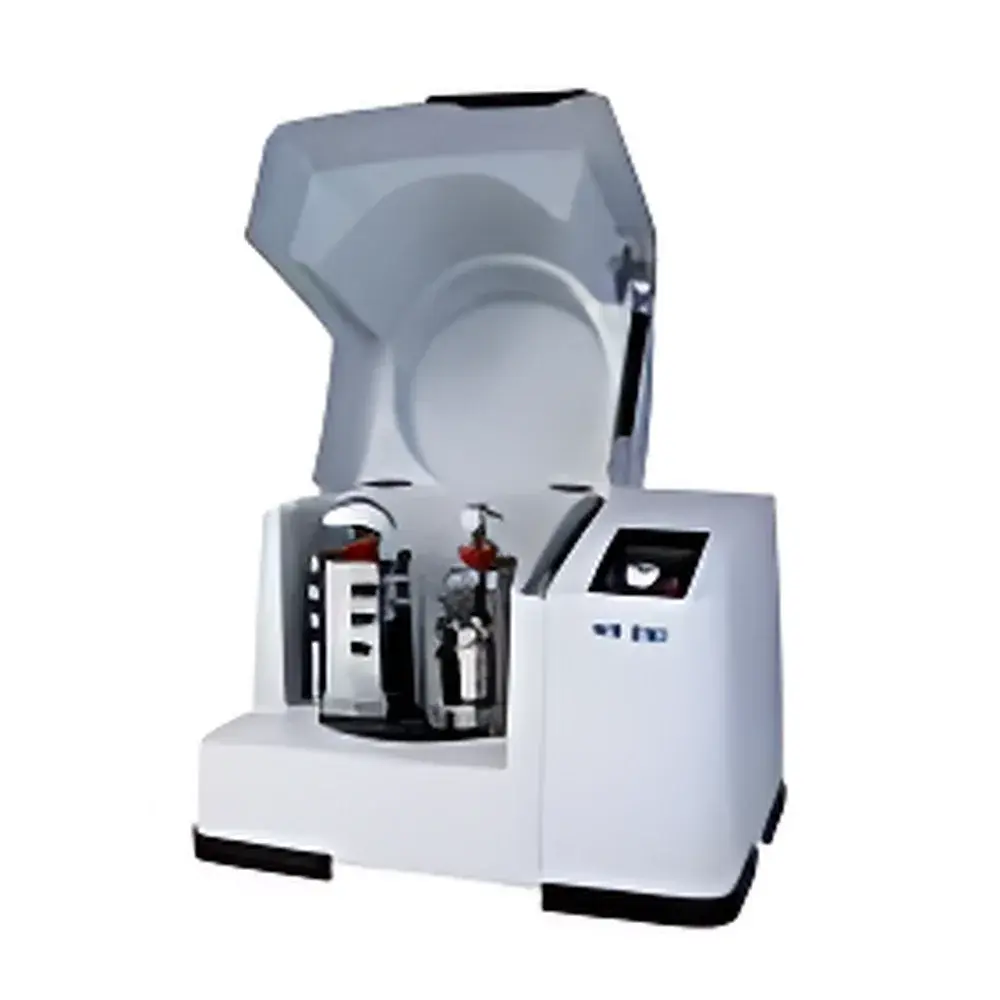
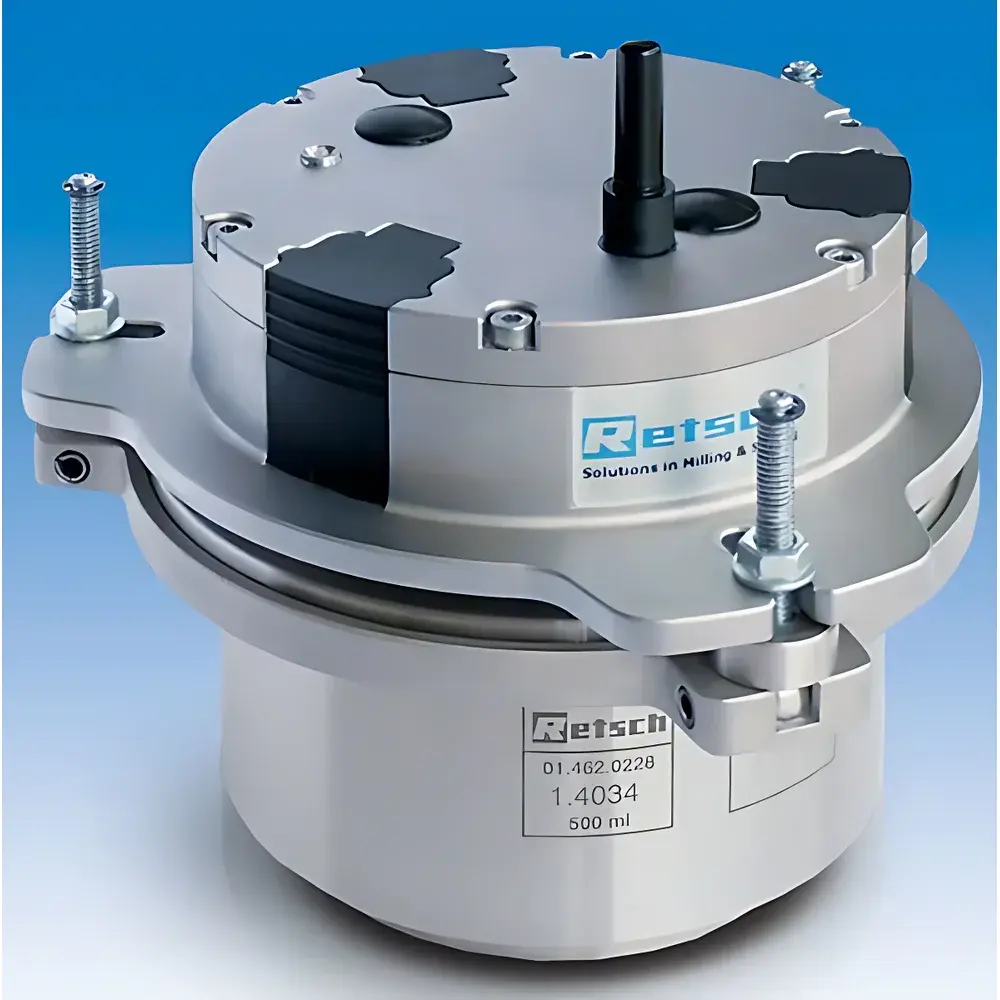
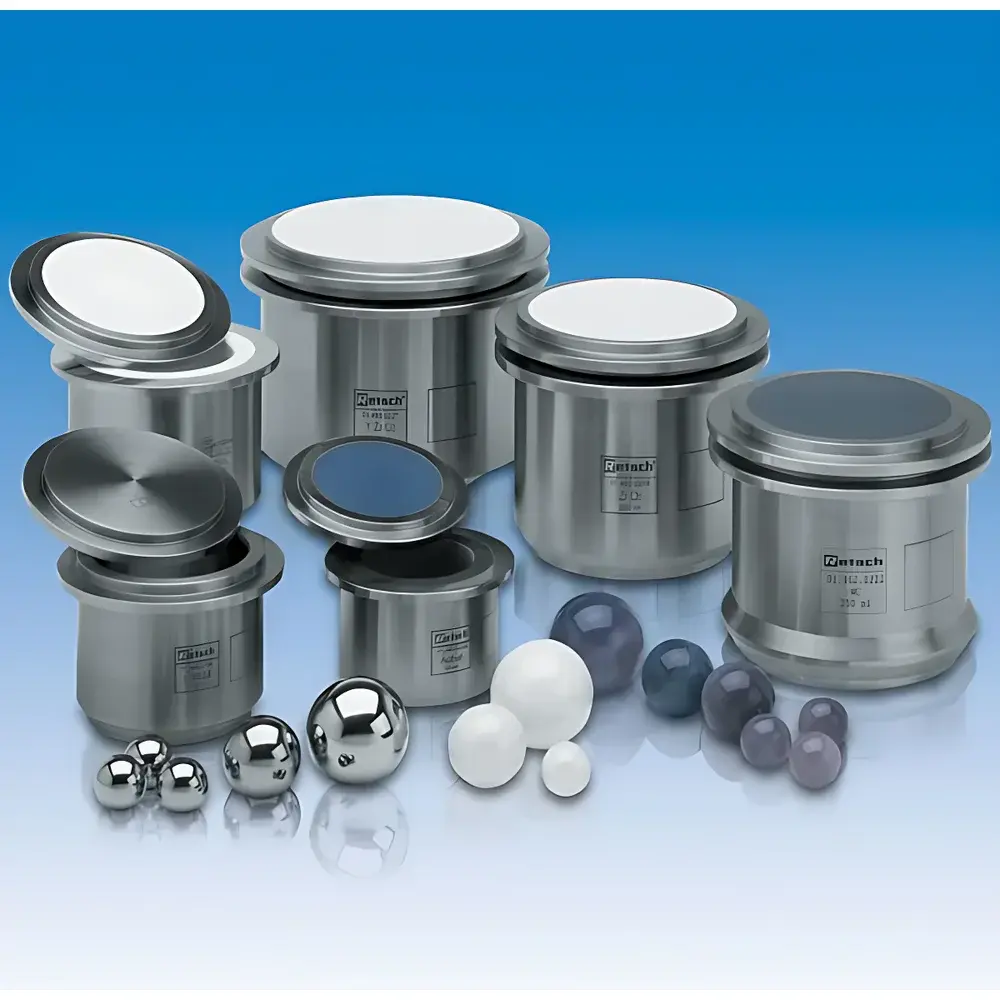
Retsch PM200 Planetary Ball Mill
| Brand | Retsch |
|---|---|
| Origin | Germany |
| Model | PM200 |
| Instrument Type | Planetary Ball Mill |
| Sample Applicability | Hard, brittle, fibrous, and elastic materials |
| Feed Size | ≤ 4 mm |
| Final Particle Size | < 1 µm (down to 0.1 µm for colloidal grinding) |
| Batch Capacity | up to 2 × 50 mL |
| Sun Wheel Speed | 100–650 rpm |
| Speed Ratio | 1:−2 |
| Drive Power | 750 W |
| Dimensions (W×H×D) | 630 × 468 × 415 mm |
| Net Weight | ~72 kg |
| Compliance | CE certified |
| Grinding Jar Options | 12, 25, 50, 80, 125 mL |
| Programmable Time Range | 00:00:01–99:59:59 |
| Direction Reversal Function | Yes |
| Parameter Memory | 10 presets |
| Safety Lock & Password Protection | Yes |
| Ventilation System | Integrated for solvent-based grinding |
Overview
The Retsch PM200 Planetary Ball Mill is a high-energy, dual-station laboratory mill engineered for reproducible, ultra-fine comminution of hard, brittle, fibrous, and elastic solid materials. Operating on the principle of planetary motion, the instrument simultaneously rotates grinding jars around their own axes while revolving in the opposite direction around a central sun wheel — generating combined Coriolis and centrifugal forces that accelerate grinding balls to high impact velocities. This kinematic configuration delivers intense mechanical energy transfer via repeated collision, shearing, and friction mechanisms, enabling particle size reduction down to sub-micron (<1 µm) and, under optimized colloidal grinding conditions, below 100 nm. Designed for precision materials science, geochemical analysis, pharmaceutical development, and advanced ceramic processing, the PM200 supports both dry and wet grinding protocols with full compliance to ISO 13320 (laser diffraction particle sizing) and ASTM E11-22 (specifications for test sieves), ensuring method traceability and inter-laboratory comparability.
Key Features
- Two independent grinding stations accommodating jars from 12 mL to 125 mL — ideal for parallel sample processing or comparative method development
- Precise digital control of sun wheel speed (100–650 rpm) with programmable time intervals (1 second to 99 hours, 59 minutes, 59 seconds)
- Reversible rotation mode with independently adjustable run/stop cycles — minimizes thermal load and improves homogeneity in heat-sensitive or amorphous phase studies
- Integrated ventilation system with solvent-compatible airflow management — enables safe, controlled wet grinding using ethanol, acetone, or other low-boiling-point media
- Intuitive LCD interface with 10 programmable memory slots — stores complete parameter sets including speed, duration, reversal timing, and pause intervals
- Robust cast-aluminum housing and vibration-damped base — ensures operational stability during extended runs (up to 99+ hours) without drift or misalignment
- CE-certified safety architecture featuring automatic motor cutoff upon lid opening, emergency stop button, and password-protected parameter locking
Sample Compatibility & Compliance
The PM200 accommodates a broad spectrum of inorganic and organic matrices: metallic alloys (e.g., Al–Mg, Fe–Cr), geological samples (quartz, feldspar, basalt), ceramics (Al2O3, ZrO2), polymers, plant tissues, soils, sludges, and composite waste streams. It supports grinding under inert atmosphere (via optional glovebox integration) and cryogenic conditions (with liquid nitrogen-cooled jars). All operational parameters comply with GLP and GMP documentation requirements; audit trails are maintainable through external data logging interfaces. The instrument meets IEC 61000-6-2 (EMC immunity) and IEC 61000-6-4 (EMC emission) standards, and its mechanical design conforms to EN 61000-3-12 (harmonic current limits). For regulated environments, optional firmware upgrades support 21 CFR Part 11-compliant electronic signatures and user-access tiering.
Software & Data Management
While the PM200 operates as a standalone benchtop unit with embedded firmware, it features RS-232 and USB-B ports for connection to external PCs running Retsch’s optional *RETSCH Control* software (v3.2+). This platform enables remote operation, real-time torque monitoring, automated method sequencing, and export of timestamped grinding logs in CSV or PDF formats — fully compatible with LIMS integration. All parameter changes are logged with user ID, timestamp, and version stamp, satisfying FDA audit expectations for method validation records. Calibration certificates (traceable to PTB/NIST standards) and maintenance history templates are included in the standard documentation package.
Applications
- Mechanical alloying of nanocrystalline metal powders for battery anode development
- Homogenization of heterogeneous catalyst precursors prior to XRD or BET surface area analysis
- Preparation of certified reference materials (CRMs) for environmental soil testing (EPA Method 6010D)
- Cell disruption and DNA/RNA extraction support in botanical genomics workflows
- Particle size distribution refinement for pharmaceutical excipients per USP milling guidance
- Production of reactive nano-oxides for sol-gel synthesis and thin-film deposition processes
FAQ
What is the maximum recommended feed particle size for the PM200?
The nominal upper limit is 4 mm; however, for optimal throughput and jar longevity, pre-crushing to ≤2 mm is advised for highly abrasive samples such as silicon carbide or tungsten carbide.
Can the PM200 perform cryogenic grinding?
Yes — when equipped with stainless steel jars and appropriate cooling jackets, the system supports liquid nitrogen-assisted grinding for thermolabile organics and elastomers.
Is wet grinding with organic solvents supported?
Yes — the integrated ventilation module maintains positive pressure differential and vapor extraction, meeting ATEX Zone 2 requirements when used with explosion-proof exhaust ducting.
How many grinding jars can be operated simultaneously?
Two jars may be mounted concurrently, each independently configurable for speed, time, and direction reversal settings.
Does the PM200 include validation documentation for regulated labs?
Standard delivery includes Factory Acceptance Test (FAT) report, CE Declaration of Conformity, and IQ/OQ protocol templates aligned with ISO/IEC 17025 and ASTM E2500-22 guidelines.



