
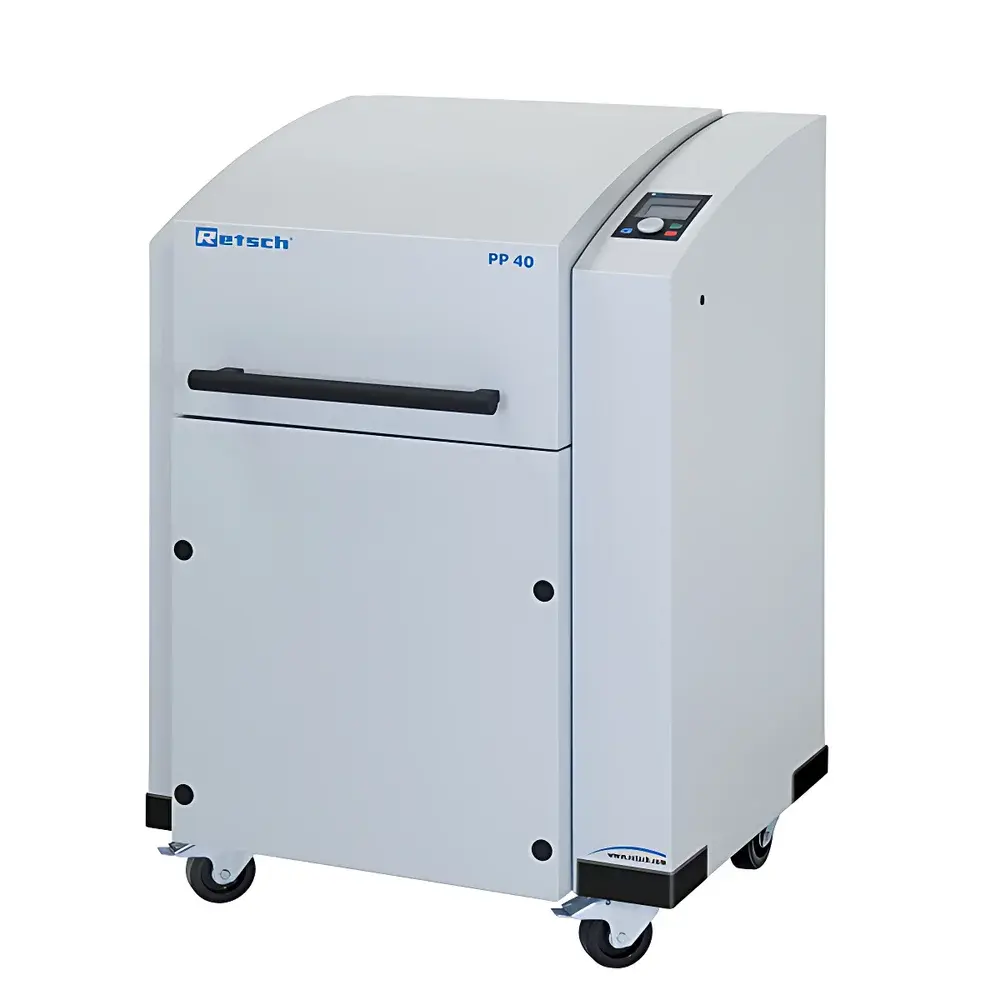
Retsch PP40 Automatic Pellet Press
| Brand | Retsch |
|---|---|
| Origin | Germany |
| Model | PP40 |
| Maximum Pressure | 400 kN |
| Pressure Range | 10–400 kN |
| Compression/Decompression Time | 5–600 s |
| Die Ring Dimensions (OD/ID) | 51.5/35 mm, 40/35 mm, 40/32 mm |
| Aluminum Cup OD | 40 mm |
| Dimensions (W×D×H) | 836 × 1220 × 780 mm |
| Net Weight | 345 kg |
| Automation Level | Fully Automatic |
| Application Focus | XRF Sample Preparation |
Overview
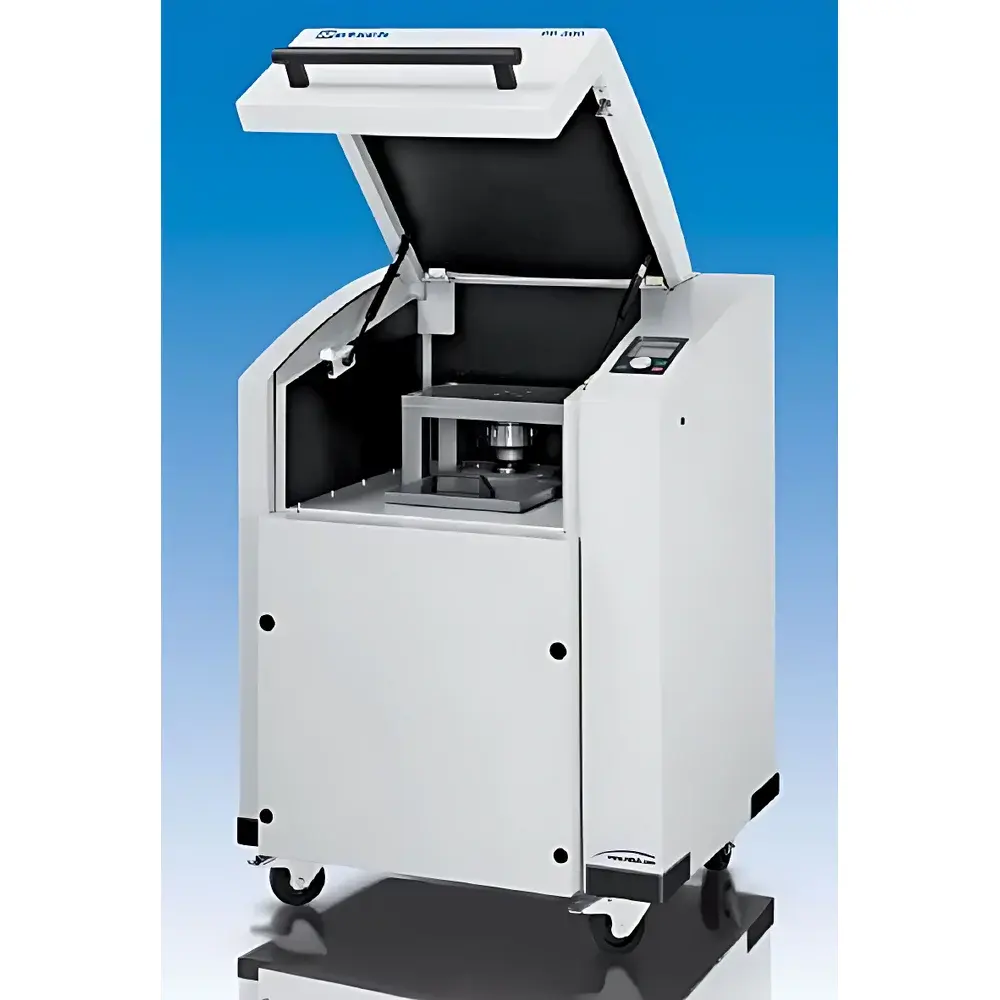
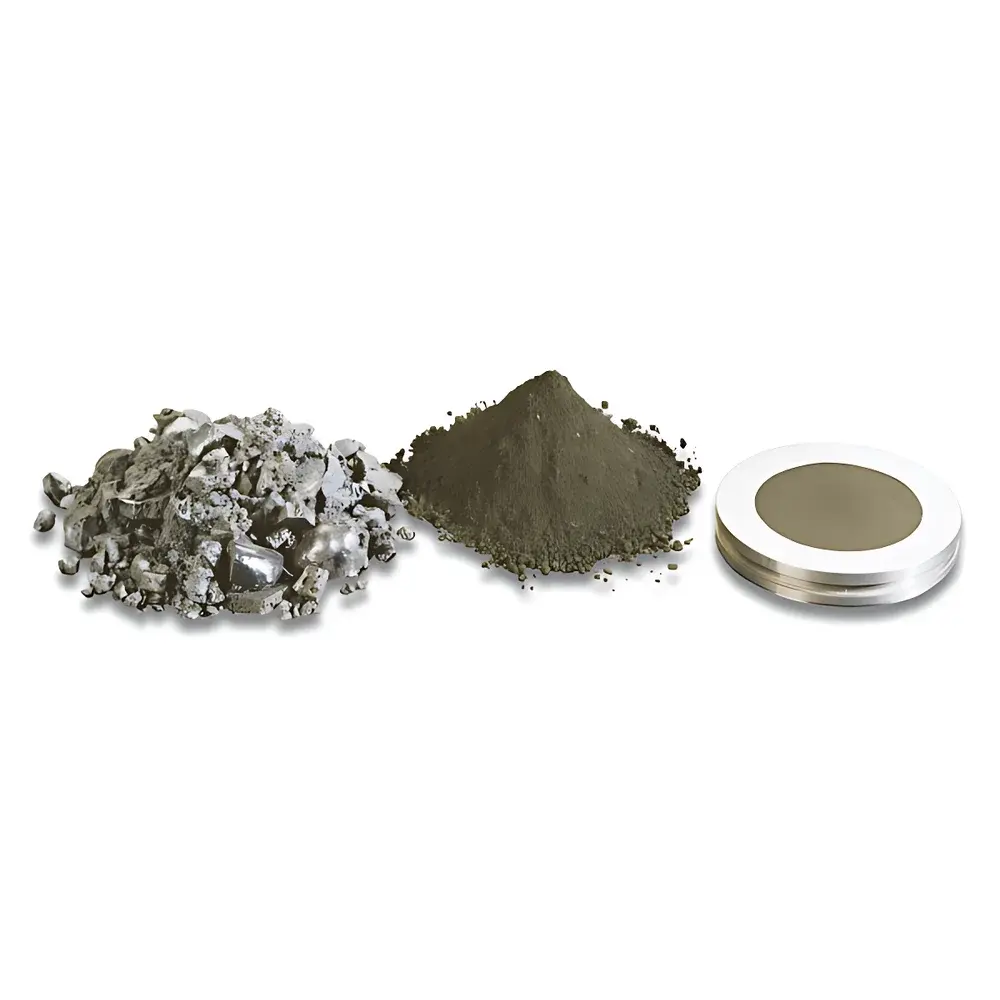
The Retsch PP40 Automatic Pellet Press is an industrial-grade, fully automated hydraulic press engineered for high-precision sample compaction in analytical laboratories. Designed specifically for X-ray fluorescence (XRF) spectroscopy sample preparation, the PP40 applies controlled uniaxial pressure to convert powdered or granular materials—including ores, cement clinker, slag, fly ash, geological samples, and metallurgical residues—into homogeneous, mechanically stable pellets. Its operation is based on programmable hydraulic force application with real-time pressure feedback and closed-loop control, ensuring reproducible density, minimal particle segregation, and minimized matrix effects during subsequent XRF analysis. The system complies with ISO 29581-1 (cement analysis), ASTM C114 (chemical analysis of hydraulic cement), and USP guidelines for instrument qualification in regulated environments.
Key Features
- Hydraulic force generation up to 400 kN (40 metric tons), adjustable in 1 kN increments across a 10–400 kN operating range
- Digital touchscreen interface with intuitive one-touch operation and real-time pressure, time, and displacement monitoring
- Internal memory for up to 32 user-defined compression programs, each storing target pressure, dwell time, ramp rate, and decompression profile
- Interchangeable die sets accommodating multiple standard geometries: steel rings with OD/ID combinations of 51.5/35 mm, 40/35 mm, and 40/32 mm; aluminum cups with 40 mm outer diameter
- Carbide-tungsten (WC-Co) hardened pressing platens providing exceptional wear resistance and dimensional stability over >100,000 cycles
- Integrated safety interlocks, emergency stop circuitry, and CE-certified mechanical guarding compliant with EN 692 and EN 13857
- Modular design enabling rapid cleaning, tool-free die exchange, and field-serviceable hydraulic components
Sample Compatibility & Compliance
The PP40 accommodates a broad spectrum of inorganic powders requiring consolidation prior to elemental analysis. It supports binder-free pelletization of refractory oxides (e.g., Al2O3, SiO2, Fe2O3), fluxed mixtures (e.g., Li2B4O7 fused beads), and heterogeneous process residues. All contact surfaces are chemically inert and non-contaminating, validated per ISO 17025 requirements for trace-level analysis. The system meets GLP documentation standards through audit-trail-capable parameter logging and supports 21 CFR Part 11 compliance when integrated with validated LIMS or ELN platforms via RS232/USB interfaces.
Software & Data Management
The embedded firmware records full compression cycle metadata—including applied force, hold duration, platen displacement, ambient temperature, and timestamp—for every pressed pellet. Exportable CSV logs facilitate QA/QC trending, SPC charting, and root-cause analysis of pellet cracking or density variation. Optional Retsch LabSuite software enables remote program deployment, multi-instrument fleet monitoring, and electronic signature-enabled method locking. All stored methods include version control, change history, and operator ID tagging to satisfy ISO/IEC 17025 clause 7.2.2 and GMP Annex 11 expectations.
Applications
- Routine XRF calibration standard preparation (e.g., certified reference materials for geochemical surveying)
- Quality control of raw materials and final products in cement, mining, and steel production
- Environmental monitoring of heavy metals in soil and sediment extracts
- Research-scale development of ceramic green bodies and battery electrode composites
- Preparation of pressed pellets for wavelength-dispersive (WDXRF) and energy-dispersive (EDXRF) spectrometers from Bruker, Thermo Fisher, Rigaku, and PANalytical
FAQ
What is the minimum recommended sample mass for consistent pellet density?
For optimal reproducibility, a minimum of 5 g is advised for 40 mm diameter pellets; mass tolerance should be maintained within ±0.01 g using Class I analytical balances.
Can the PP40 be integrated into automated sample preparation lines?
Yes—the device features dry-contact I/O ports and Modbus TCP support for synchronization with robotic sample handlers, auto-feeders, and downstream XRF autosamplers.
Is routine calibration required, and what standards are used?
Annual force verification using NIST-traceable load cells is recommended; Retsch provides certified calibration kits with uncertainty ≤0.5% of full scale.
How does the PP40 mitigate die wall friction effects during high-pressure compaction?
The system employs programmable dual-stage pressure profiles: initial low-force seating followed by controlled ramping, reducing shear-induced density gradients and improving radial homogeneity.
What maintenance intervals are specified for hydraulic oil and seals?
Hydraulic fluid replacement is scheduled every 2,000 operating hours or biennially; O-ring inspection and replacement occur during annual preventive maintenance per Retsch Service Bulletin SB-PP40-2023.



