
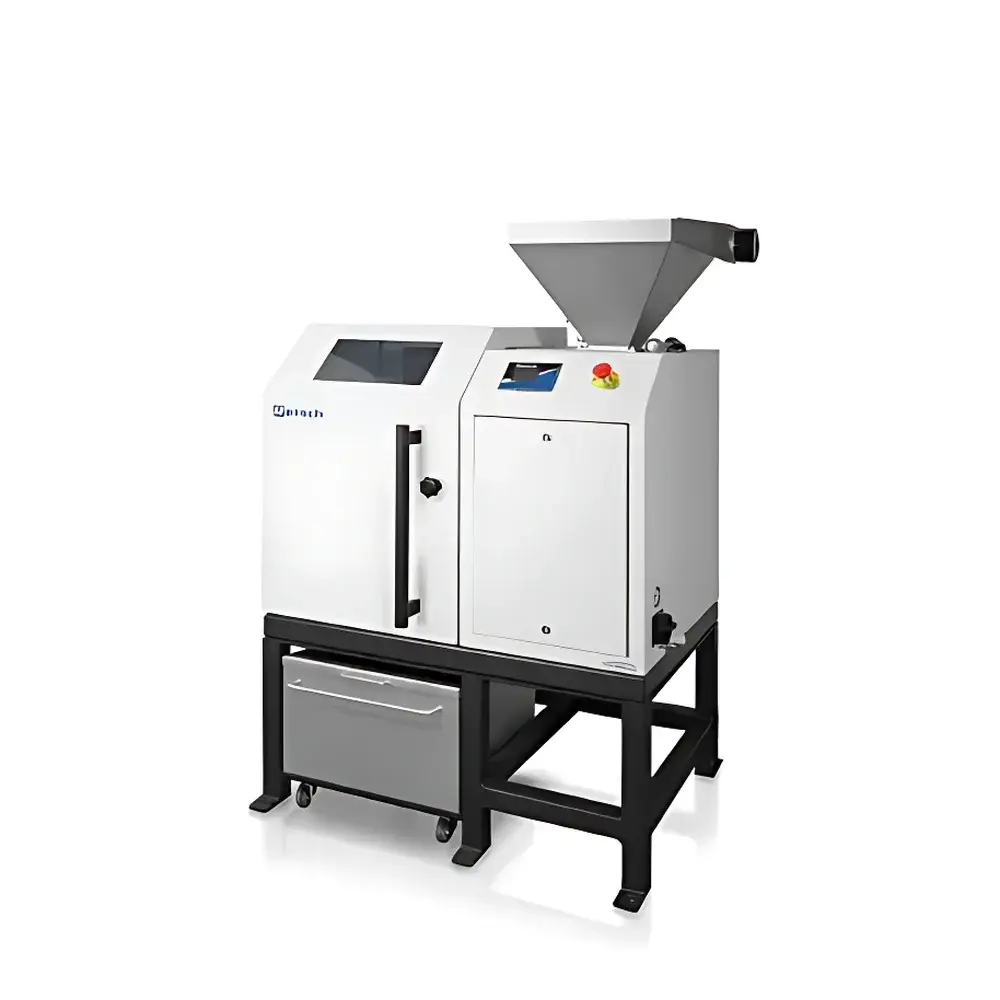
Retsch PT300 Rotary Sample Divider
| Brand | Retsch |
|---|---|
| Origin | Germany |
| Model | PT300 |
| Sample Division Principle | Rotational Gravity-Based Splitting |
| Dividing Modules | 6-, 8-, or 10-way (batch) / 1-way (with reject) |
| Feed Particle Size | ≤ 30 mm |
| Rotational Speed | 18–53 rpm |
| Feed Volume Options | 3,000 / 3,750 / 5,000 / 7,500 mL (module-dependent) |
| Reject Container Capacity | 40 L |
| Vibration Feeder | Digitally Adjustable |
| Power Supply | 240 V, 50 Hz, Single-Phase |
| Dimensions (W×H×D) | 1180 × 1510 × 750 mm |
| Net Weight | ~209 kg (incl. vibratory feeder) |
| Compliance | CE-marked, Designed for GLP-Compliant Sampling Environments |
Overview
The Retsch PT300 Rotary Sample Divider is an industrial-grade, gravity-driven sample division system engineered for high-fidelity representative sampling of bulk granular and powdered materials. Based on the principle of rotational splitting—where a rotating drum with precisely engineered radial dividers evenly distributes material across multiple collection channels—the PT300 eliminates segregation bias and minimizes particle size stratification during division. Unlike static splitters or riffle samplers, its controlled rotational motion ensures dynamic homogenization prior to division, significantly improving sampling reproducibility for heterogeneous feeds. Designed in accordance with ISO 14855-1 (determination of ultimate aerobic biodegradability), ASTM D6938 (standard test method for in-place densities of soil and soil-aggregate), and aligned with GLP requirements for traceable sample handling, the PT300 serves as a critical pre-analytical tool in laboratories where analytical validity begins with sample integrity.
Key Features
- Modular dividing head system supporting 6-, 8-, or 10-way batch division—or single-stream processing with integrated reject channel for oversized particles
- Digitally adjustable rotational speed (18–53 rpm) enabling optimization for material flow behavior, density, and cohesiveness
- Vibratory feeder with digital amplitude control ensures consistent, dust-minimized feed rate and prevents bridging or rat-holing in fine or hygroscopic powders
- Illuminated observation window with tempered glass allows real-time visual monitoring of material flow, splitter alignment, and chamber filling—critical for method validation and troubleshooting
- Quick-release, tool-free access to all internal components—including divider plates, feed chute, and discharge funnels—for rapid cleaning and cross-contamination prevention
- Ergonomically adjustable support frame (height-adjustable base) accommodates varying operator heights and integrates seamlessly with downstream sieving, milling, or weighing stations
- Integrated digital timer and start/stop logic enable unattended batch processing with repeatable cycle timing and interlocked safety cutoffs
Sample Compatibility & Compliance
The PT300 accepts free-flowing or marginally cohesive bulk solids with maximum particle dimensions up to 30 mm—covering applications ranging from coarse mineral aggregates and crushed ores to milled pharmaceutical excipients and agricultural grains. Its stainless-steel construction (AISI 304 contact surfaces), non-lubricated drive train, and absence of internal seals ensure compatibility with food-grade, pharma-grade, and environmentally sensitive matrices. The instrument complies with EU Machinery Directive 2006/42/EC and carries full CE marking. While not intrinsically rated for ATEX environments, its design supports integration into explosion-protected facilities via external dust extraction (interface flange provided). Documentation packages include Factory Acceptance Test (FAT) reports, material certificates, and traceable calibration records for rotational speed and timer accuracy—supporting audit readiness under ISO/IEC 17025, FDA 21 CFR Part 11 (when paired with compliant LIMS), and GMP Annex 11 workflows.
Software & Data Management
The PT300 operates as a standalone electromechanical system with embedded microcontroller logic—no proprietary software required for basic operation. All operational parameters (speed setpoint, run duration, module configuration) are stored in non-volatile memory and recalled at power-up. Optional RS-485 interface enables integration into centralized lab automation systems for remote start/stop commands, status reporting (e.g., “feed complete”, “cycle finished”, “door open”), and event logging. When deployed in regulated environments, timestamped operational logs—including date/time stamps, speed values, and module ID—can be exported via serial output for inclusion in electronic batch records (EBRs). No onboard data storage or user accounts are implemented, preserving deterministic behavior and simplifying 21 CFR Part 11 compliance through external audit-trail management.
Applications
The PT300 delivers validated sample reduction across diverse sectors requiring statistically robust sub-sampling prior to elemental analysis, particle size distribution (PSD), moisture content, or chemical assay. In agrochemical QA labs, it prepares composite soil or fertilizer samples for ICP-OES metal screening. In cement manufacturing, it reduces hot-clinker or slag batches prior to XRF analysis—ensuring representative sampling despite thermal-induced segregation. For food safety testing, it subsamples roasted coffee beans or ground spices without inducing attrition or temperature rise that could volatilize aroma compounds. In metallurgy, it handles abrasive metal powders (e.g., Ni-based superalloys) prior to OES or LECO carbon/sulfur analysis. Environmental labs use it for homogenizing heterogeneous waste streams (e.g., shredded e-waste, fly ash) before TCLP leaching or heavy metal digestion. Its ability to process up to 7.5 L per cycle—while maintaining <2% relative standard deviation (RSD) in mass distribution across outlets—makes it suitable for both R&D scale-up and routine QC throughput.
FAQ
What standards does the PT300 comply with for representative sampling?
It adheres to core principles outlined in ISO 13320 (laser diffraction PSD), ISO 11712 (sampling of solid mineral fuels), and ASTM D75 (sampling of aggregates), with mechanical design validated against ISO 13322-1 for image-based particle characterization sample prep.
Can the PT300 handle moist or slightly sticky materials?
Yes—when used with the optional anti-static coating kit and reduced rotational speed (≤25 rpm), it accommodates materials with up to 8% moisture content; however, free-flowing behavior remains a prerequisite.
Is cleaning validation supported?
All wetted parts are accessible without tools, and surface roughness (Ra ≤ 0.8 µm) meets ISO 14644-1 Class 5 cleanroom requirements; swab recovery studies can be conducted using standard pharmacopeial protocols.
Does Retsch provide IQ/OQ documentation?
Yes—factory-verified Installation Qualification (IQ) and Operational Qualification (OQ) protocols are available upon request, including torque verification of divider plate fasteners and speed calibration against NIST-traceable tachometer standards.
How is sample cross-contamination prevented between runs?
The system features a dedicated reject channel for oversized particles, automatic purge cycles (via timed vibration post-run), and a fully demountable feed hopper with smooth-radius internal transitions to eliminate dead zones.



