
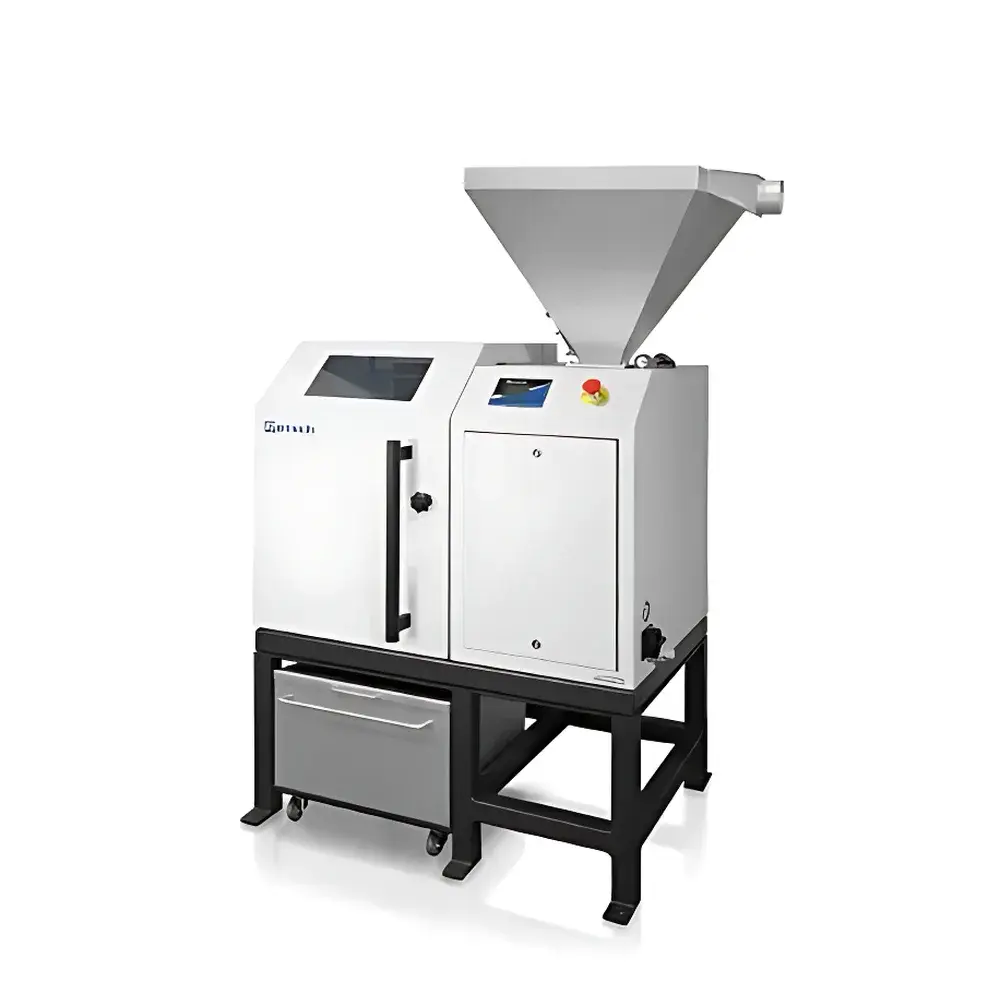
Retsch PT600 Rotary Sample Divider
| Brand | Retsch |
|---|---|
| Origin | Germany |
| Model | PT600 |
| Sample Capacity | 6,000–15,000 mL |
| Dividing Modules | 4 / 6 / 8 / 10-way (batch) or 1-way (with reject) |
| Rotational Speed | 18–53 rpm |
| Vibration Feeder | Digital control |
| Rejection Mode | Continuous single-stream discharge |
| Observation Window | Illuminated |
| Hopper Volume | 70 L |
| Dimensions (W×H×D) | 1180 × 1620 × 750 mm |
| Net Weight | ~230 kg |
| Power Supply | 240 V, 50 Hz, Single-phase |
| Compliance | CE-marked |
| Application Scope | Bulk granular & powdered materials in agriculture, geology, construction, pharma, food, metallurgy, environmental analysis |
Overview
The Retsch PT600 Rotary Sample Divider is an industrial-grade, gravity-fed sample division system engineered for high-fidelity representative sampling of bulk granular and free-flowing powders. Based on the principle of rotational sectoral division—where material flows continuously through a rotating, multi-chambered divider drum—the PT600 ensures statistically valid sub-sampling by eliminating segregation bias inherent in static or manual splitting methods. Its design adheres to ISO 14855-1 (determination of ultimate aerobic biodegradability), ASTM D6938 (sampling of asphalt mixtures), and ISO 13320 (laser diffraction particle size analysis) requirements for sample homogeneity prior to downstream analysis. Unlike riffle splitters or cone-and-quartering techniques, the PT600 delivers consistent mass distribution across all outlet channels due to its precisely balanced rotor geometry and controlled feed dynamics—critical when preparing samples for XRF, ICP-OES, sieve analysis, or moisture content determination.
Key Features
- Modular dividing head system supporting 4-, 6-, 8-, or 10-way batch division—or single-stream rejection mode for continuous process integration
- Digital speed control (18–53 rpm) enabling optimization for varying flow rates and material cohesiveness
- Illuminated observation window with tempered glass for real-time monitoring of feed uniformity and rotor fill level
- Integrated vibration feeder with digital amplitude adjustment, ensuring consistent material feed without bridging or rat-holing
- Ergonomic, height-adjustable support frame compliant with EN 1005-3 (safety of machinery – ergonomic design)
- Quick-release hopper and stainless-steel sample chutes designed for tool-free disassembly and residue-free cleaning
- CE-certified electrical architecture with IP54-rated enclosure for laboratory and pilot-plant environments
Sample Compatibility & Compliance
The PT600 accommodates dry, non-sticky, free-flowing materials with maximum particle dimensions up to 30 mm—including soils, crushed ores, cement clinker, agricultural grains, polymer granules, pharmaceutical excipients, and roasted coffee beans. It is not suitable for fibrous, hygroscopic, or electrostatically charged powders without pre-conditioning. All wetted surfaces are constructed from AISI 304 stainless steel, meeting FDA 21 CFR 178.3570 requirements for incidental food contact. The system supports GLP-compliant workflows via documented operational parameters (speed, duration, module configuration) and is routinely validated per ISO/IEC 17025:2017 clause 7.7 (sampling) in accredited testing laboratories.
Software & Data Management
While the PT600 operates as a standalone electromechanical instrument without embedded firmware or network connectivity, its digital controls log operational settings (rotational speed, run time, module selection) to internal non-volatile memory. These parameters can be manually recorded into laboratory notebooks or integrated into LIMS via standardized SOP templates. For audit readiness, users may generate calibration certificates for vibration amplitude and rotational speed using traceable metrology tools (e.g., laser tachometer, accelerometer). The system’s mechanical simplicity eliminates software validation burdens under FDA 21 CFR Part 11—making it ideal for regulated environments where deterministic, non-programmable hardware is preferred.
Applications
- Agriculture: Representative subsampling of grain lots prior to mycotoxin screening or protein content analysis
- Construction Materials: Division of heterogeneous concrete aggregates or slag for compressive strength testing
- Environmental Monitoring: Homogenization of composite soil cores before heavy metal extraction (EPA Method 3050B)
- Pharmaceutical QA: Preparation of uniform batches for dissolution testing or content uniformity assays (USP <905>)
- Mineral Processing: Splitting of exploration drill core composites for geochemical assay submission
- Food Industry: Portioning of milled flour or ground spices for microbiological enumeration (ISO 4833-1)
FAQ
What particle size range is compatible with the PT600?
Materials with a maximum nominal particle dimension of ≤30 mm are suitable. Oversized fragments must be pre-screened to prevent rotor jamming.
Can the PT600 handle moist or slightly agglomerated materials?
Only if moisture content remains below 5 wt% and no caking occurs during vibration feeding. For higher moisture, consider Retsch’s RS 200 rotor sieve or cryogenic milling pre-treatment.
Is the 70-L reject container included as standard equipment?
Yes—the polyethylene collection bin is supplied with the base configuration and features graduated volume markings and spill-resistant handles.
Does the PT600 require periodic recalibration?
No formal recalibration is mandated; however, annual verification of rotational speed accuracy (±1 rpm tolerance) and vibration amplitude linearity is recommended per ISO/IEC 17025 internal quality procedures.
How is traceability maintained during multi-step sample preparation?
By recording module type, speed setting, total feed volume, and run duration in the lab notebook—each parameter directly influences mass distribution ratio and must be retained for audit trails.



