
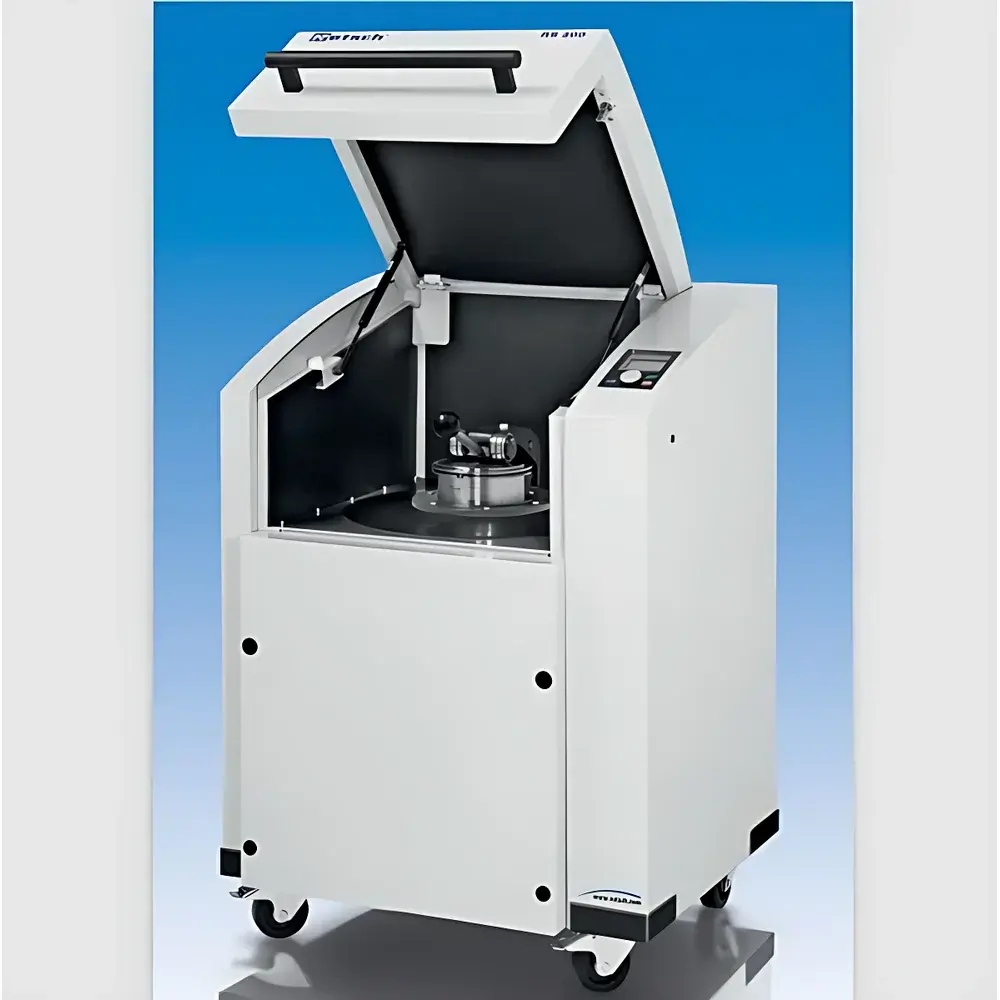
Retsch RS200 Vibratory Disc Mill
| Brand | Retsch |
|---|---|
| Origin | Germany |
| Model | RS200 |
| Grinding Principle | Horizontal circular vibration (700–1500 rpm) |
| Sample Type | Hard and brittle materials |
| Feed Size | ≤ 8 mm |
| Final Particle Size | ≤ 20 µm |
| Batch Volume | 10–190 mL |
| Grinding Chamber Volume | 50–250 mL |
| Motor Power | 400/700 W (3-phase AC, pole-switching) |
| Safety Features | Interlocked lid, acoustic shielding, automatic agate detection & speed limitation |
| Display | Large LCD with single-button control |
| Dimensions (W×D×H) | 836 × 1220 × 780 mm |
| Weight | ~210 kg |
| Rated Power | 1500 W |
Overview
The Retsch RS200 Vibratory Disc Mill is a high-performance, industrial-grade laboratory grinding instrument engineered for rapid, reproducible size reduction of hard, brittle, and heterogeneous solid samples. Operating on the principle of horizontal circular vibration, the RS200 subjects samples to simultaneous compressive, impact, and shear forces generated by centrifugally accelerated grinding elements—namely, a rotating grinding disc and stationary grinding ring—within a sealed, acoustically shielded chamber. This mechanical energy transfer enables efficient comminution without significant thermal load, preserving sample integrity for downstream analytical workflows such as X-ray fluorescence (XRF), X-ray diffraction (XRD), inductively coupled plasma (ICP) analysis, or cementitious phase quantification. Designed and manufactured in Haan, Germany, the RS200 conforms to stringent EU machinery directives (2006/42/EC) and electromagnetic compatibility standards (2014/30/EU), reflecting Retsch’s long-standing commitment to precision engineering and process reliability in analytical sample preparation.
Key Features
- Two selectable vibration frequencies: 700 rpm and 1500 rpm—optimized for material hardness and desired fineness
- Automatic agate recognition system: integrated sensor detects agate grinding chambers and enforces a safe maximum speed of 700 rpm to prevent fracture or wear
- Patented quick-clamp mechanism for secure, tool-free mounting of grinding bowls—reducing setup time and minimizing operator exposure to dust
- Acoustic enclosure with interlocked safety lid: physical lockout prevents lid opening during operation, complying with ISO 13857 and EN 61000-6-2 safety requirements
- Large backlit LCD display with intuitive single-button navigation—enabling precise parameter selection and real-time status monitoring
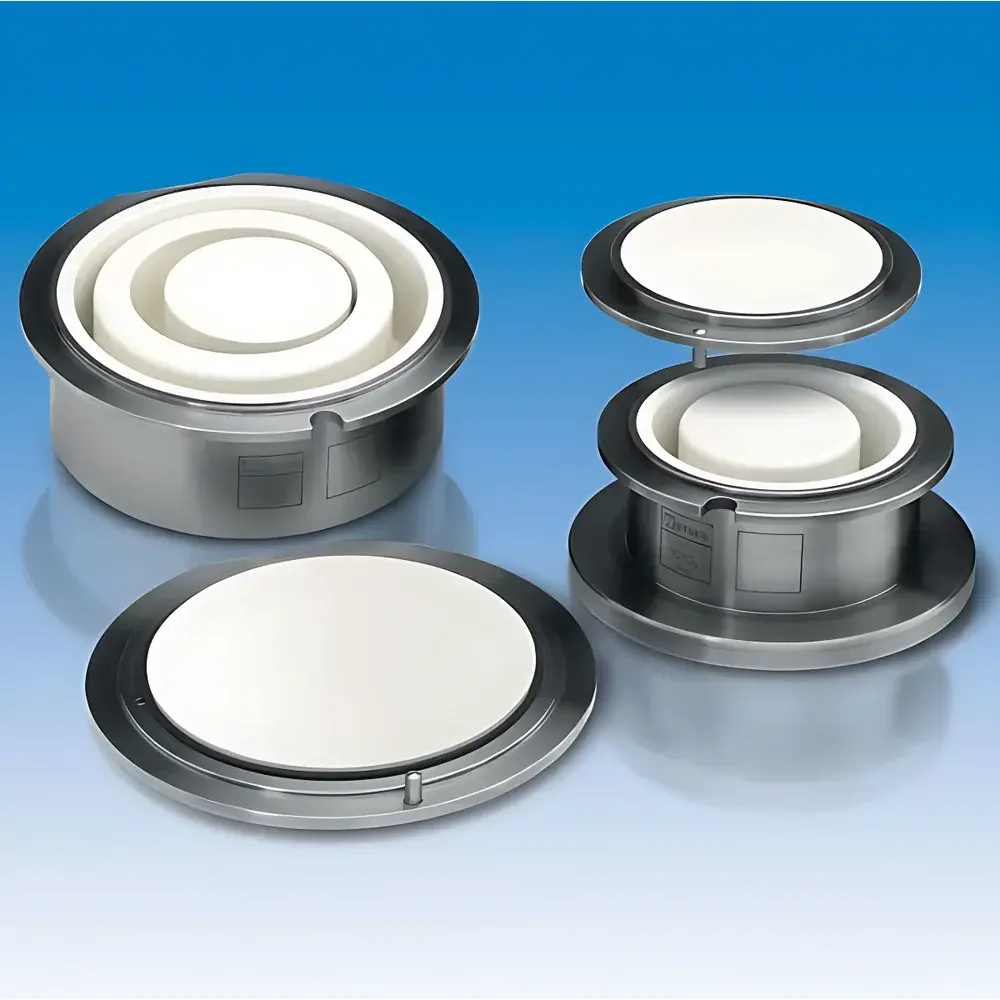
- Modular grinding kit compatibility: interchangeable bowls and inserts in tungsten carbide, zirconium oxide, agate, chrome steel, and stainless steel—ensuring chemical inertness and contamination control per application needs
- Robust cast-iron base and vibration-damped chassis—delivering high mechanical stability and low operational drift across extended duty cycles
Sample Compatibility & Compliance
The RS200 is validated for consistent processing of inorganic and organic matrices including soils, ores (e.g., hematite, bauxite), cement clinker, fly ash, slag, ceramics, glass frits, coal, graphite, plant tissue (after drying), and refractory materials such as alumina and silicon carbide. Its ability to achieve final particle sizes down to ≤20 µm—with typical D90 values below 40 µm—supports homogenization protocols required under ASTM C114 (chemical analysis of hydraulic cement), ISO 6474 (cement fineness testing), and USP (particle size distribution for pharmaceutical excipients). All wet- or dry-grinding configurations comply with GLP documentation standards when paired with Retsch’s optional digital logging module, which records timestamped parameters (speed, duration, bowl ID) for audit-ready traceability.
Software & Data Management
While the RS200 operates via an embedded microcontroller with standalone LCD interface, it integrates seamlessly with Retsch’s optional *RETSCH Control* software suite (v3.2+) via RS-232 or USB-to-serial adapter. This platform enables remote parameter configuration, batch-wise protocol storage (including speed ramps, pause intervals, and cooling triggers), and export of CSV-formatted grinding logs—including bowl identification, runtime, energy consumption estimates, and error flags. When deployed in regulated environments, the system supports 21 CFR Part 11-compliant user authentication, electronic signatures, and immutable audit trails—facilitating alignment with FDA, EMA, and ISO/IEC 17025 quality management frameworks.
Applications
- Preparation of homogenized reference materials for geochemical mapping and multi-element ICP-OES/MS analysis
- Routine fineness testing of Portland cement and blended cements per EN 196-6 and ASTM C204
- Particle size standardization prior to BET surface area measurement or laser diffraction analysis
- Homogenization of heterogeneous environmental samples (e.g., contaminated soil cores, sediment composites) for regulatory compliance testing
- Production of ultra-fine powders for ceramic sintering trials and additive manufacturing feedstock qualification
- Reduction of metallurgical slags and furnace residues for phase identification via XRD quantitative Rietveld refinement
FAQ
What materials are compatible with the RS200’s grinding bowls?
Tungsten carbide, zirconium oxide, agate, chrome steel, and stainless steel bowls are available—each selected based on hardness, chemical resistance, and contamination sensitivity of the target analyte.
Can the RS200 be used for cryogenic grinding?
No—the RS200 is not designed for liquid nitrogen cooling; its mechanical architecture and sealing system are optimized for ambient-temperature dry or low-moisture grinding only.
Is the RS200 suitable for food-grade or pharmaceutical applications?
Yes, provided stainless steel or zirconia grinding kits are used and cleaning validation (e.g., swab testing per USP ) is performed between batches.
How does the automatic agate detection function work?
An integrated capacitive sensor identifies the dielectric properties of the bowl material; upon agate detection, firmware restricts maximum rotational frequency to 700 rpm to avoid resonant fracture.
What maintenance intervals are recommended for routine operation?
Lubrication of the eccentric drive shaft every 500 operating hours and annual calibration of the speed sensor and safety interlock circuit are advised per Retsch Service Bulletin SB-RS200-2023.
Related Products



