
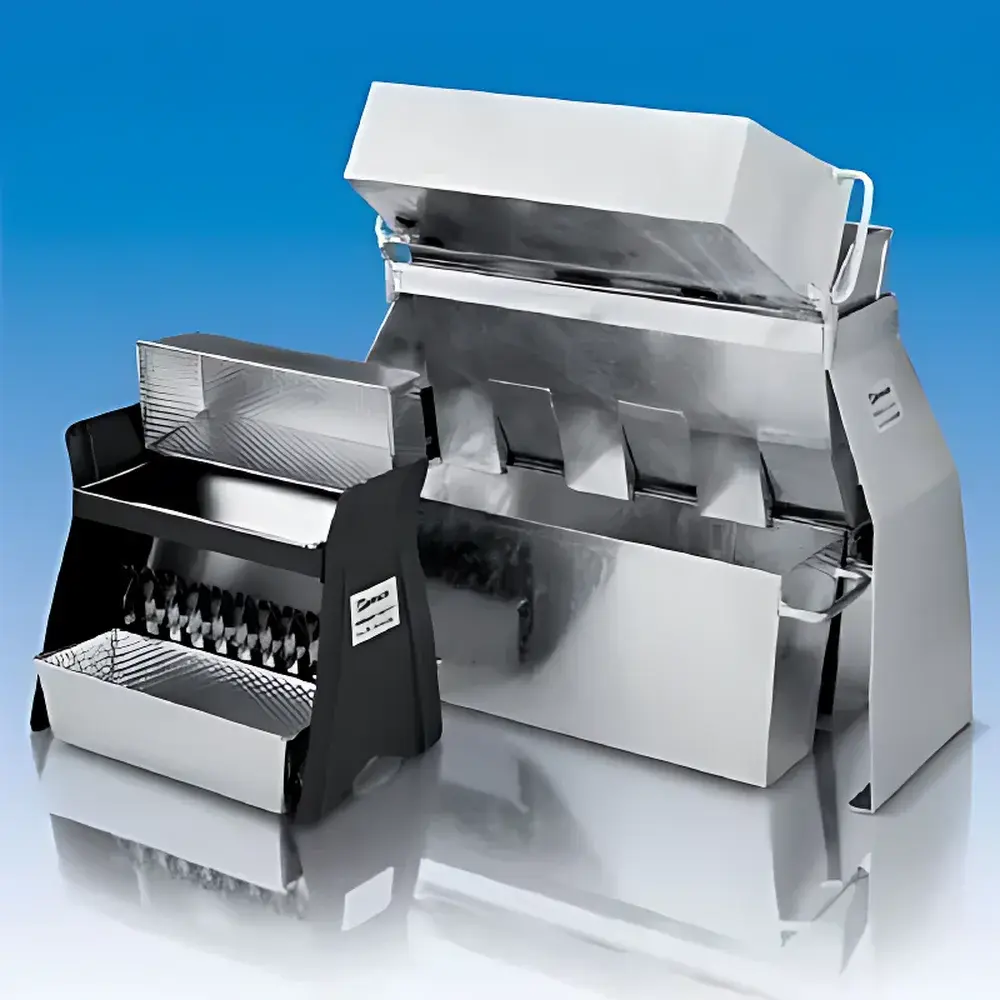
Retsch RT Grooved Sample Divider
| Brand | Retsch |
|---|---|
| Origin | Germany |
| Model | RT |
| Division Ratio | 1:1 (2-way split) |
| Max. Feed Size (RT 75) | ~50 mm |
| Max. Batch Capacity (RT 75) | 16 L |
| Dimensions (W×H×D, RT 75) | 620 × 420 × 260 mm |
| Net Weight (RT 75) | ~12.5 kg |
| Compliance | DIN 51701-4 |
Overview
The Retsch RT Grooved Sample Divider is a precision mechanical sample splitting instrument engineered for high-reproducibility subdivision of bulk granular and powdered materials in accordance with standardized sampling protocols. Operating on the principle of gravitational flow through a precisely engineered grooved divider head, the RT directs incoming material alternately into two receiving containers via a symmetrical, zigzag arrangement of chutes—ensuring equal mass distribution without bias or segregation. This physical partitioning method eliminates reliance on operator technique or electronic control, delivering inherently robust and traceable 1:1 sample division. Designed for use in laboratories, quality control facilities, mining operations, and field-based sampling stations, the RT delivers metrologically sound subsampling essential for representative analysis in compliance-driven environments.
Key Features
- True mechanical 2-way splitting with no moving parts—ensures long-term reliability and zero calibration drift
- Grooved divider head geometry optimized to minimize particle segregation and maintain compositional fidelity across split fractions
- Available in six scalable models (RT 6.5 to RT 75), each configured for defined maximum feed size and batch volume to match material handling requirements
- Compliant with DIN 51701-4 (Testing of solid fuels — Sampling — Part 4: Mechanical sample dividers), supporting auditable sampling workflows under ISO/IEC 17025 and ASTM D2234/D75
- Tool-free disassembly and smooth, non-porous stainless steel surfaces enable rapid cleaning between samples—critical for cross-contamination prevention in multi-product labs
- Stable, low-center-of-gravity construction ensures safe operation on benchtops or portable work surfaces; no power supply or compressed air required
Sample Compatibility & Compliance
The RT accommodates free-flowing, pourable particulate materials with nominal top sizes up to 50 mm (RT 75 model), including but not limited to: foundry sands, cement clinker, coal and coke, mineral ores, agricultural grains, animal feed pellets, pharmaceutical granules, metal powders, soil aggregates, and industrial catalysts. It is unsuitable for cohesive, fibrous, sticky, or highly electrostatic materials that impede uniform gravitational flow. All RT models are manufactured in Germany to EN ISO 9001-certified processes and bear CE marking. Documentation includes Declaration of Conformity and test certificates verifying geometric accuracy of groove spacing and chute alignment per DIN 51701-4 Annex B.
Software & Data Management
As a fully manual, non-electronic instrument, the RT does not incorporate embedded software, firmware, or digital interfaces. Its operation requires no data logging, user authentication, or audit trail functionality—making it inherently compliant with environments where simplicity, transparency, and absence of electronic dependency are operational priorities (e.g., GLP-compliant pre-analytical sample preparation, GMP raw material receipt inspection, or field-based ISO 13320-compliant laser diffraction feed conditioning). Sample identity and split history are maintained externally via laboratory notebooks or LIMS-integrated barcode tracking of receiving vessels.
Applications
- Reduction of large field-collected soil or sediment samples to analytical sub-samples for heavy metal or organic contaminant testing
- Preparation of representative subsamples from bulk shipments of industrial minerals prior to XRF or ICP-OES analysis
- Homogenization and splitting of coarse pharmaceutical granulations before content uniformity or dissolution testing (USP <905>)
- Quality assurance sampling of construction aggregates in accordance with EN 932-1 and ASTM C702
- Feedstock conditioning for particle size distribution analysis using laser diffraction or sieve cascade systems
- Sampling support for ISO 5725-2 accuracy validation studies requiring unbiased fractional reduction
FAQ
What standards does the Retsch RT comply with?
The RT conforms to DIN 51701-4 for mechanical sample division and supports implementation of ISO 13843, ASTM D2234, and EN 14899-1 sampling protocols.
Can the RT be used for moisture-sensitive or reactive powders?
Yes—provided the material flows freely and does not adhere to stainless steel surfaces. No internal cavities or seals retain residue, minimizing exposure time and enabling inert-atmosphere handling with external gloveboxes.
Is calibration required before use?
No routine calibration is specified; however, periodic verification of groove symmetry and chute alignment against supplied gauge templates is recommended per DIN 51701-4 Clause 6.3.
How many splitting stages are possible?
Sequential splitting is permitted—each pass reduces mass by 50%. For example, four consecutive splits yield a final fraction of 1/16th the original mass, maintaining statistical representativeness if feed homogeneity is assured.
Does Retsch provide validation documentation for regulated industries?
Yes—upon request, Retsch supplies a Factory Acceptance Test (FAT) report confirming dimensional compliance, material certification (1.4301 stainless steel), and traceable groove pitch measurements per DIN 51701-4 Annex B.



