
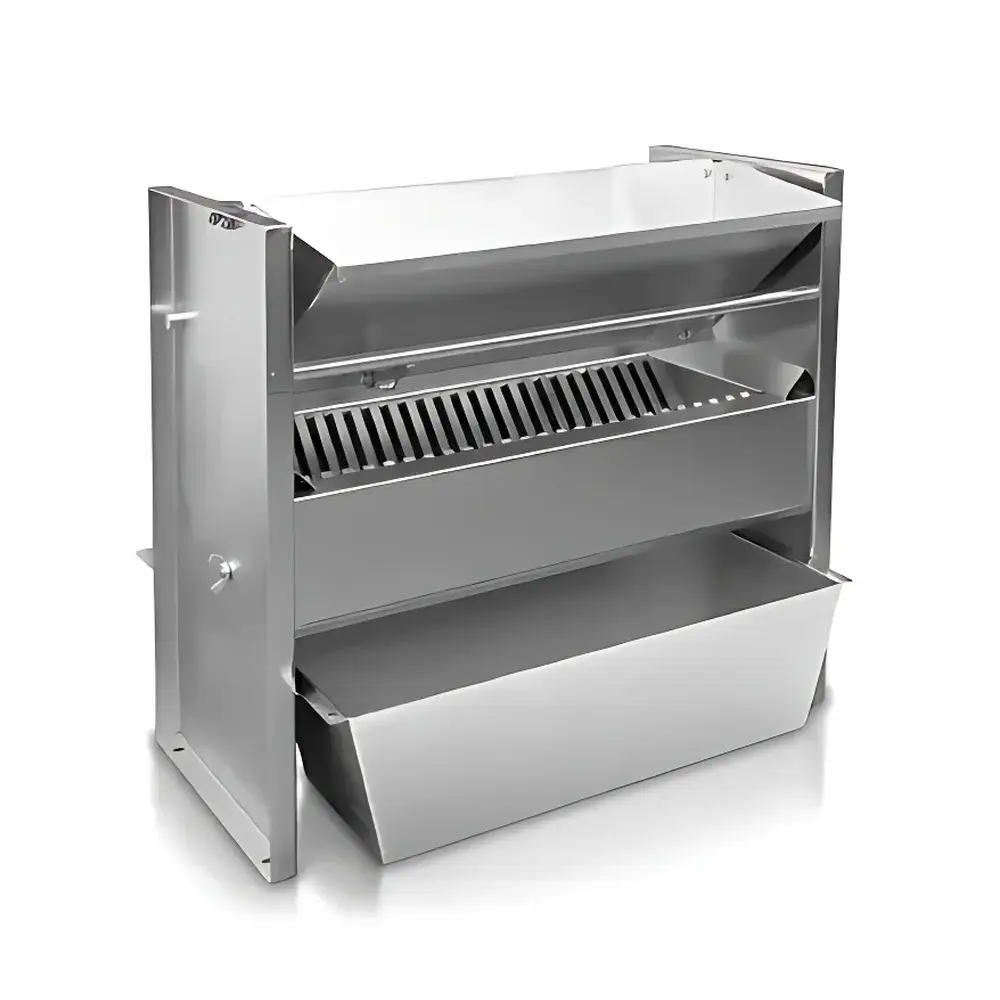
Retsch RT100 Grooved Sample Divider
| Brand | Retsch |
|---|---|
| Origin | Germany |
| Model | RT100 |
| Sample Capacity | ≤ 30 L |
| Number of Subsamples | 2 |
| Adjustable Groove Width | 12–108 mm (in 12-mm increments) |
| Dimensions (W×H×D) | 72 × 70 × 46 cm |
| Net Weight | ~55 kg |
| Compliance | DIN 51701 |
| Power Requirement | None (manual operation) |
Overview
The Retsch RT100 Grooved Sample Divider is a precision-engineered, gravity-fed mechanical sample splitter designed for representative subdivision of bulk, free-flowing granular and powdered materials. Operating on the principle of riffle splitting—where material flows uniformly across a series of parallel grooves and is distributed alternately into two receiving containers—the RT100 ensures high reproducibility and minimal segregation bias. Unlike rotary or spinning dividers, its static groove geometry eliminates centrifugal forces and particle stratification, making it especially suitable for heterogeneous, coarse, or density-variable samples encountered in mining, agriculture, construction, and environmental sampling. The device complies with DIN 51701 (“Testing of solid fuels — Sampling and sample preparation”), a standard widely referenced in quality assurance protocols for coal, ores, soils, and industrial minerals. Its entirely manual, non-electric architecture supports field-deployable operation without dependency on power infrastructure or compressed air, aligning with ISO/IEC 17025 requirements for method validation under variable logistical conditions.
Key Features
- Manually actuated discharge lever with sealed feed trough, enabling controlled initiation and termination of sample flow
- Adjustable groove width (12 mm to 108 mm in 12-mm increments) to accommodate particle sizes from fine powders to coarse aggregates up to ~50 mm
- Stainless steel and wear-resistant polymer construction ensures long-term dimensional stability and resistance to abrasion from mineral, cementitious, or metallic feeds
- Feed trough capacity of up to 30 L allows single-batch processing of large-volume field samples without intermediate reloading
- Fixed 2-way splitting ratio (1:1) with symmetrical groove layout and calibrated chute alignment to minimize flow asymmetry and cross-contamination
- Tool-free disassembly of the groove plate and collection trays for rapid cleaning and residue verification—critical for multi-analyte or regulated workflows (e.g., heavy metal screening, nutrient assays)
Sample Compatibility & Compliance
The RT100 is validated for use with dry, free-flowing particulate materials including but not limited to: agricultural grains and seeds, roasted coffee beans, soil aggregates, crushed limestone and slag, foundry sands, metal powders, pharmaceutical excipients, ceramic raw materials, and municipal solid waste fractions. It is unsuitable for cohesive, sticky, fibrous, or moisture-sensitive materials that may bridge or adhere within the groove channels. Compliance with DIN 51701 confirms its suitability for sampling procedures where statistical representativeness must be demonstrated per ISO 13909 (Coal and coke — Sampling) and ASTM D2234/D2234M (Standard Practice for Collection of a Gross Sample of Coal). While not intrinsically compliant with FDA 21 CFR Part 11, its mechanical design supports audit-ready documentation when integrated into GLP/GMP environments via procedural SOPs and equipment logbooks.
Software & Data Management
The RT100 operates independently of software or digital interfaces. All operational parameters—including groove setting, batch mass, ambient temperature, and operator ID—are recorded manually in laboratory notebooks or electronic lab notebooks (ELNs) as part of sample chain-of-custody documentation. This analog workflow avoids data integrity risks associated with firmware updates, calibration drift, or proprietary file formats. For laboratories requiring traceability, the device is compatible with barcode-labeled collection vessels and integrated with LIMS platforms via manual entry of sample IDs linked to physical subsample containers. No embedded memory, sensors, or connectivity hardware is present—ensuring electromagnetic compatibility (EMC) in high-interference field settings such as quarries or grain elevators.
Applications
- Agriculture & Food: Subdivision of cereal batches prior to NIR spectroscopy or mycotoxin testing; homogenization of seed lots for germination assays
- Geochemistry & Mining: Reduction of exploration core or drill-cutting composites while preserving lithological heterogeneity for XRF or ICP-MS analysis
- Cement & Construction: Preparation of clinker, fly ash, or slag samples for Blaine surface area or compressive strength testing per EN 196-6
- Environmental Monitoring: Field-based reduction of contaminated soil or sediment composites prior to TCLP or leaching tests (EPA Method 1311)
- Recycling & Waste Management: Representative splitting of shredded e-waste, plastic flakes, or municipal compost for elemental composition profiling
FAQ
Is the RT100 suitable for wet or damp samples?
No. The device requires free-flowing, dry material. Moisture content above 5% w/w may cause bridging or adhesion in grooves, compromising split accuracy and repeatability.
Can the RT100 be used for regulatory submissions under ISO/IEC 17025?
Yes—provided the splitting procedure is documented, verified for recovery and bias (e.g., using tracer particles), and included in the laboratory’s scope of accreditation. DIN 51701 compliance supports method validation evidence.
What maintenance is required?
Routine visual inspection of groove edges for wear or deformation; periodic cleaning with non-abrasive brushes and ethanol or isopropanol; lubrication of the lever pivot point with food-grade silicone grease every 6 months under continuous use.
Does Retsch provide calibration certificates for the RT100?
No. As a purely mechanical, non-measuring device, the RT100 does not require calibration. Verification of groove symmetry and dimensional accuracy is performed during factory acceptance testing per DIN 51701 Annex B.
How is sample mass loss accounted for during splitting?
Residue retention in grooves is minimized by optimized chute angles and smooth surface finish. Users should perform blank runs with inert reference material (e.g., glass beads) to quantify typical carryover (<0.1% under nominal conditions) and correct final analytical results accordingly.
Related Products



