
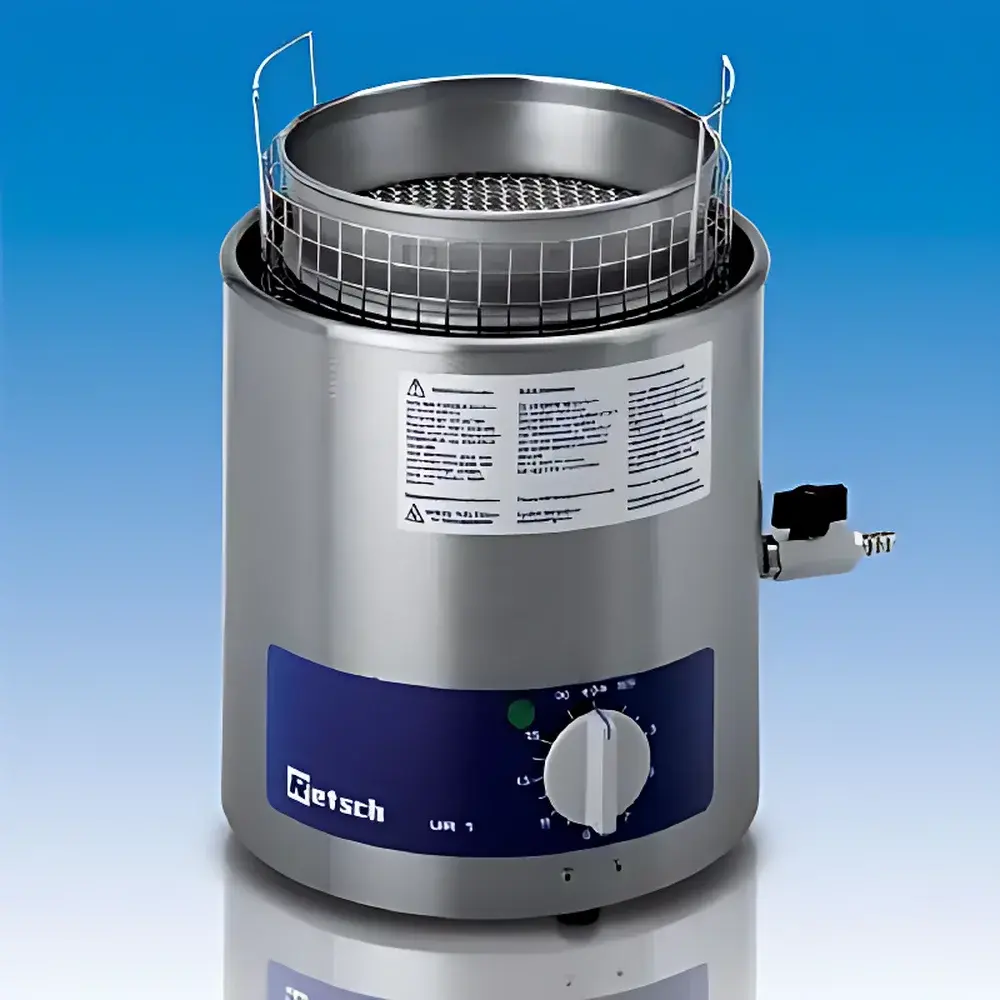
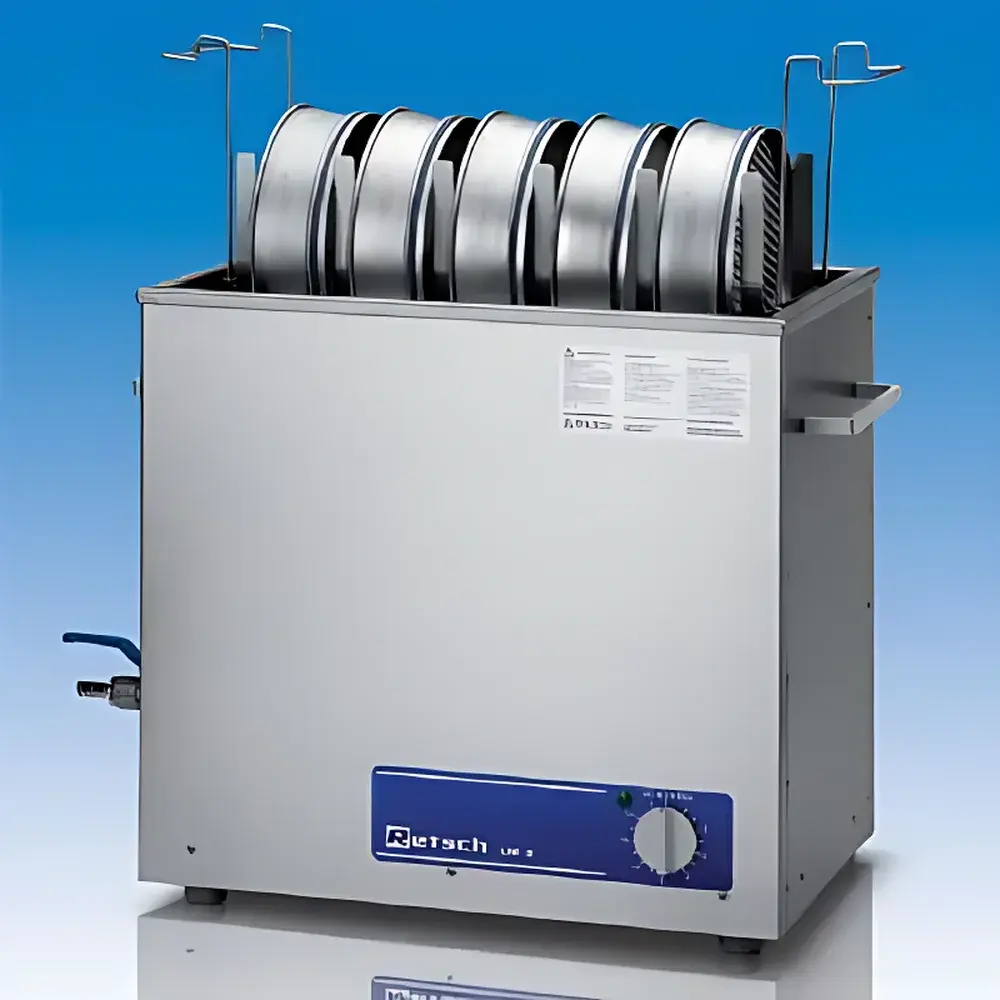
Retsch UR1/2/3 Ultrasonic Cleaner
| Brand | Retsch |
|---|---|
| Origin | Germany |
| Model | UR1 / UR2 / UR3 |
| Tank Dimensions (W×H×D) | 245×130 mm / 520×200 mm / 500×300×300 mm |
| Tank Volume | 5.7 L / 42.0 L / 45.0 L |
| Power Output (Peak, Dual Transducers) | 2 × 240 W / 2 × 600 W / 2 × 1000 W |
| Timer Range | 1–15 min or Continuous Operation |
| External Dimensions (W×H×D) | 260×260 mm / 570×460 mm / 540×500×340 mm |
| Net Weight | ~5 kg / ~21 kg / ~27.5 kg |
| Compliance | CE certified |
| Maintenance | Maintenance-free design |
| Warranty | 12 months |
Overview
The Retsch UR1/2/3 series ultrasonic cleaners are precision-engineered laboratory instruments designed for reliable, non-destructive cleaning, homogenization, dispersion, and degassing of delicate and complex samples. Based on the physical principle of high-frequency cavitation—generated by piezoelectric transducers operating at 35 kHz—the system produces intense acoustic energy within the cleaning bath. This energy induces the formation and rapid implosion of microscopic vacuum bubbles in the liquid medium, releasing localized shockwaves and micro-jets with sufficient mechanical force to dislodge contaminants from intricate surface geometries, blind holes, mesh apertures, and porous substrates. Unlike abrasive or thermal cleaning methods, ultrasonic action operates without mechanical contact or elevated temperatures, preserving sample integrity and instrument calibration—critical for analytical sieves, glassware, metal components, and suspension-based preparations used in materials science, pharmaceutical QA/QC, and geochemical analysis.
Key Features
- Three scalable models (UR1, UR2, UR3) engineered for distinct throughput and bath volume requirements—from benchtop screening validation to high-capacity batch processing.
- Dual high-efficiency piezoelectric transducers per unit ensure uniform energy distribution across the entire tank volume, minimizing dead zones and enhancing reproducibility.
- Digitally controlled timer with selectable intervals (1–15 minutes) and continuous operation mode enables precise process standardization aligned with SOPs.
- Robust stainless-steel tanks with reinforced corners and sealed transducer mounting provide long-term corrosion resistance and structural stability under repeated solvent exposure.
- Compact footprint and integrated ergonomic design reduce spatial demand in regulated lab environments where bench space is constrained and workflow efficiency is prioritized.
- Maintenance-free architecture eliminates routine servicing of moving parts or consumable components—reducing total cost of ownership and downtime risk.
Sample Compatibility & Compliance
The UR series accommodates a broad range of sample types including ASTM E11-compliant test sieves (woven wire mesh, perforated plate), borosilicate glass vials and cuvettes, stainless-steel tools, ceramic crucibles, and particulate-laden suspensions. Its gentle yet effective cavitation mechanism ensures removal of organic residues, metal oxides, polishing compounds, and dried-on precipitates without compromising dimensional accuracy or surface finish. All units comply with EU Directive 2014/30/EU (EMC) and 2014/35/EU (LVD), carry CE marking, and meet RoHS 2011/65/EU material restrictions. While not classified as medical devices, the UR platform supports GLP and GMP-aligned cleaning validation protocols when paired with documented bath solution selection, temperature control (via external thermostatic circulators), and periodic performance verification per ISO 13485 Annex A guidelines.
Software & Data Management
The UR1/2/3 operate via an embedded electromechanical control interface—no software installation or network connectivity required. This analog-digital hybrid architecture ensures deterministic timing response, electromagnetic immunity in shared instrumentation racks, and full auditability of operational parameters (timer setting, power activation, cycle completion). For laboratories implementing electronic recordkeeping per FDA 21 CFR Part 11, optional external data loggers can be interfaced to capture timestamped start/stop events and power-on duration. Process documentation—including cleaning agent composition, bath temperature (monitored separately), and post-cleaning visual or gravimetric verification—is maintained manually in accordance with internal SOPs and ISO/IEC 17025 clause 7.8.
Applications
- Cleaning of analytical sieves prior to particle size distribution analysis (e.g., laser diffraction or dynamic image analysis).
- Removal of residual catalysts or reaction byproducts from reactor vessels and sampling probes in catalysis research.
- Preparation of homogeneous colloidal dispersions for zeta potential or DLS measurements.
- Degassing of solvents and polymer solutions prior to HPLC mobile phase preparation or thin-film deposition.
- Decontamination of reusable pipette tips, microcentrifuge tubes, and filtration assemblies in molecular biology workflows.
- Supporting ASTM C136, ISO 9276-1, and USP particulate matter testing protocols through validated residue removal.
FAQ
What frequency do the Retsch UR ultrasonic cleaners operate at?
All UR models operate at a nominal frequency of 35 kHz, optimized for balanced cavitation intensity and penetration depth across aqueous and mild solvent-based media.
Can the UR series be used with flammable solvents?
No. These units are designed exclusively for use with water-based detergents or low-volatility, non-flammable cleaning solutions. Flammable solvents pose explosion hazards and may damage transducer encapsulation.
Is temperature control integrated into the UR system?
No. Bath temperature must be managed externally using a recirculating chiller or heated bath if thermal stabilization is required for specific applications.
How often should the cleaning bath be changed?
Bath solution should be replaced after each use or at least daily in high-throughput labs to prevent cross-contamination and maintain consistent cavitation efficiency.
Does Retsch provide IQ/OQ documentation support for the UR series?
Yes. Upon request, Retsch supplies vendor-issued IQ/OQ templates compliant with ISO 9001 and aligned with common pharmaceutical and academic validation frameworks.



