
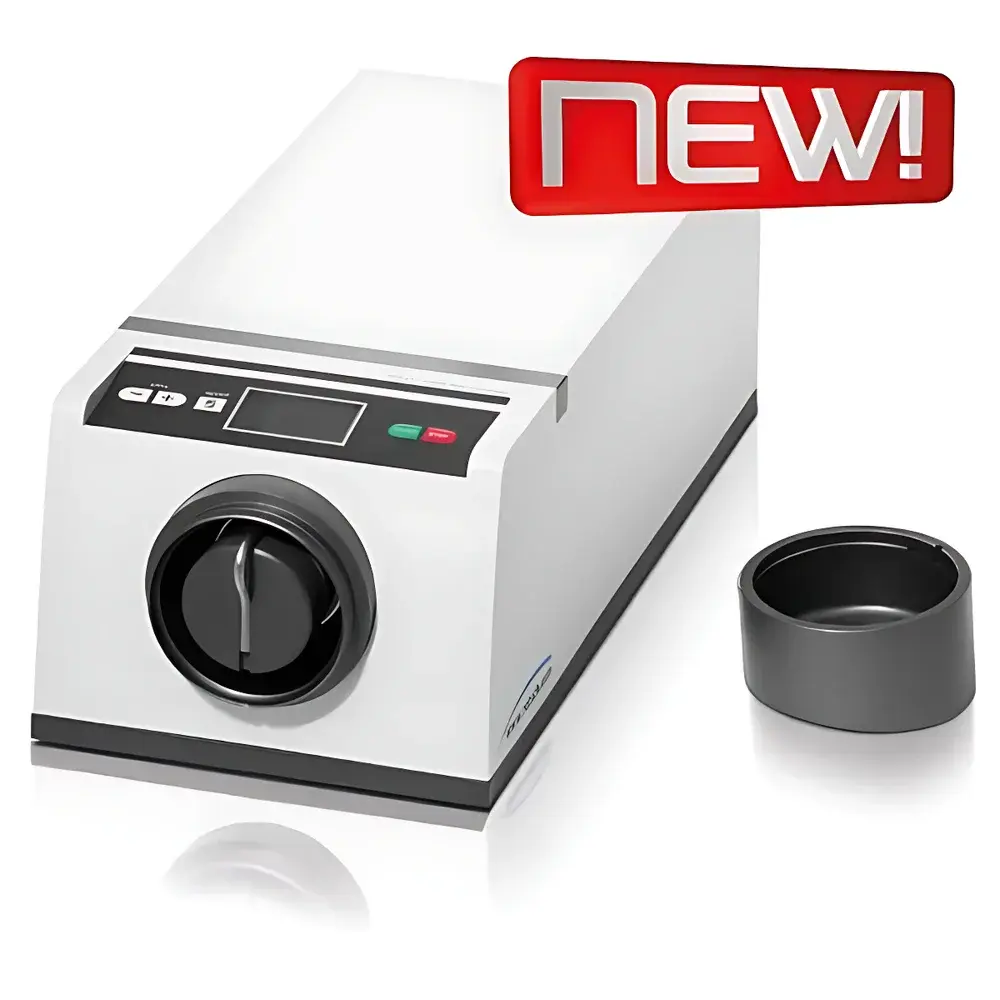
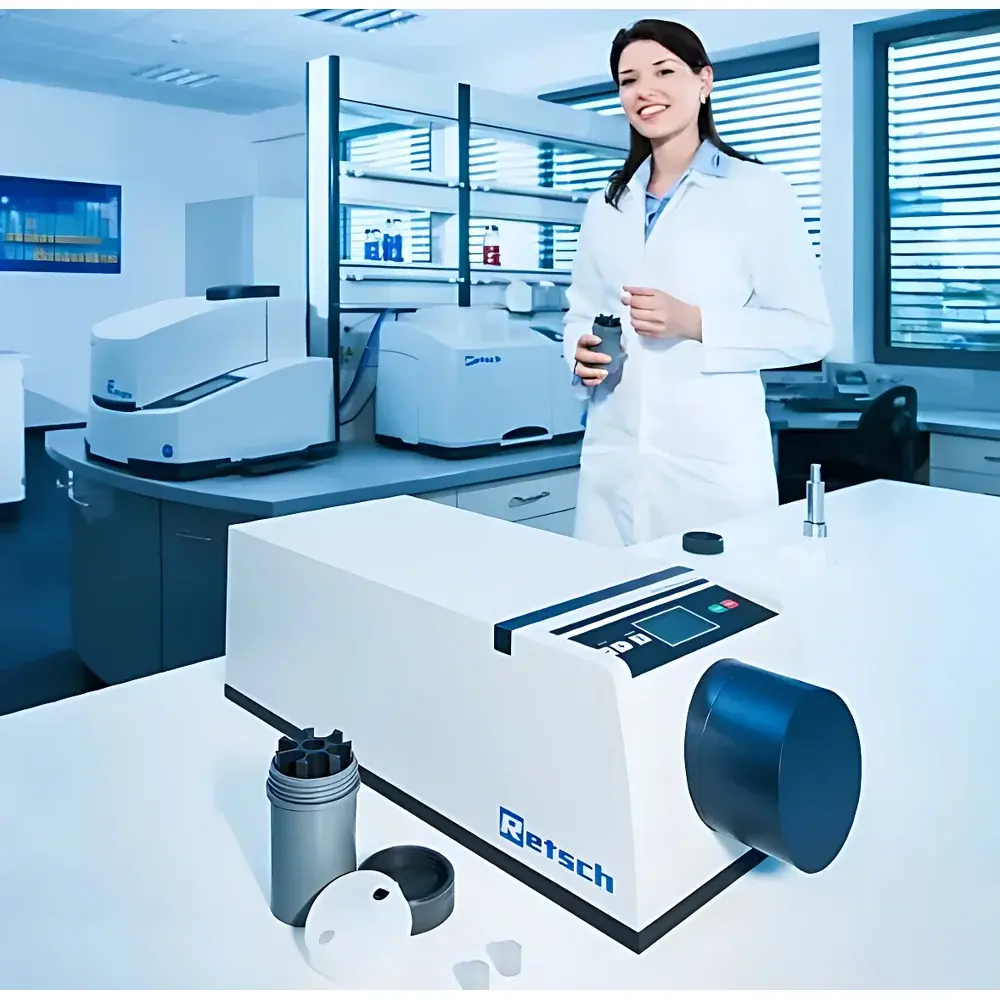
Retsch XRD-Mill McCrone
| Brand | Retsch |
|---|---|
| Origin | Germany |
| Model | XRD-Mill McCrone |
| Grinding Principle | Linear Impact and Planar Shear |
| Sample Capacity | 2–4 mL (typical), up to 160 mL (batch) |
| Feed Size | ≤ 0.5 mm |
| Final Particle Size | 10 µm (d₅₀, typical) |
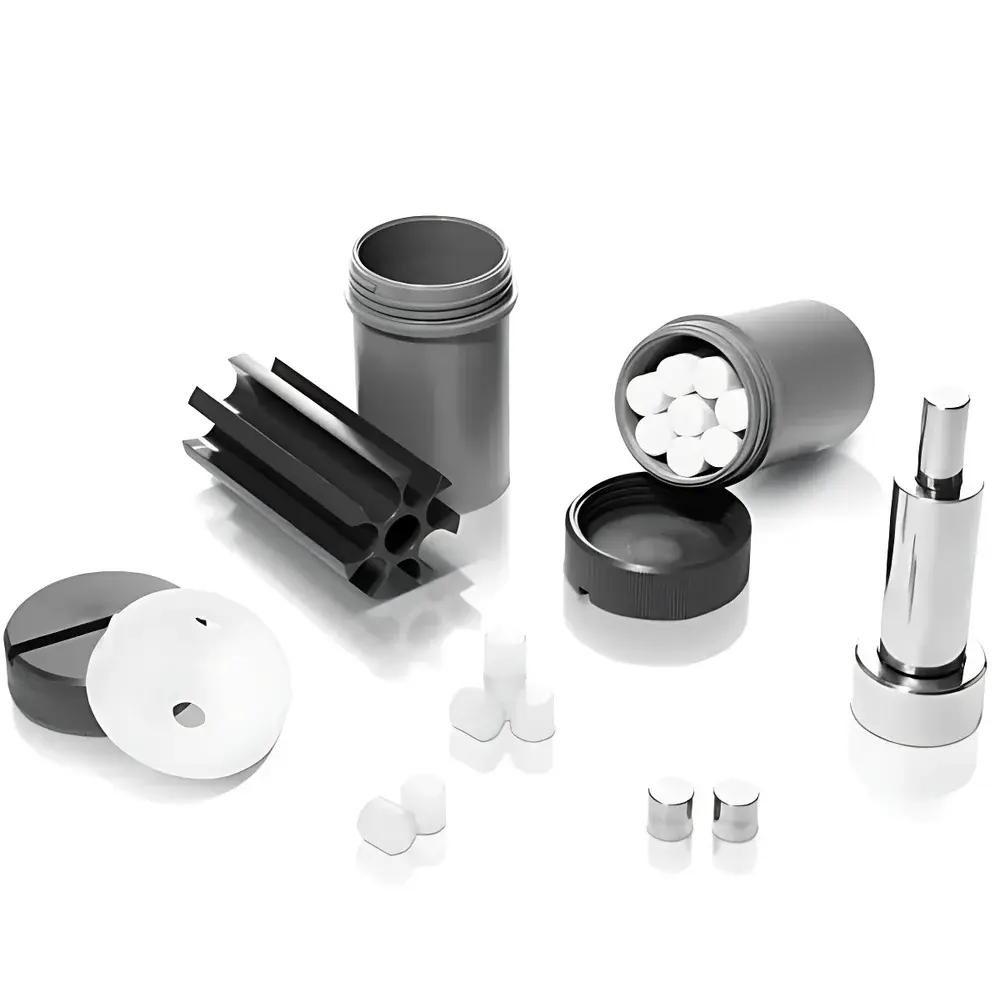
| Grinding Vessel | 125 mL polypropylene jar with polyethylene lid (seal-free design) |
| Grinding Media | 48 cylindrical media (agate, zirconia, or alumina) |
| Grinding Time Range | 3–30 min (optimized for XRD) |
| Power Adjustment | 4-step variable amplitude |
| Operation Modes | Dry grinding and wet grinding |
| Compliance | Designed for ISO/IEC 17025-compliant labs |
Overview
The Retsch XRD-Mill McCrone is a precision-engineered, desktop-scale vibratory micro-mill specifically developed for the preparation of crystalline samples prior to X-ray diffraction (XRD) analysis. Unlike conventional ball mills or mortar grinders, it employs a dual-action grinding mechanism—simultaneous linear impact and planar shear—generated by high-frequency vertical oscillation of the grinding vessel against an array of precisely arranged cylindrical media. This kinematic principle minimizes amorphization, thermal degradation, and lattice distortion, ensuring that crystallographic integrity is preserved throughout comminution. The instrument is widely deployed in geological survey laboratories, academic materials science departments, pharmaceutical QC units, and industrial R&D facilities where phase identification, quantitative phase analysis (QPA), and crystallinity assessment rely on high-fidelity diffraction patterns.
Key Features
- Dual-Mode Kinematics: Combines controlled impact energy with tangential shearing forces to achieve rapid size reduction while suppressing polymorphic transformation and preferred orientation artifacts.
- Crytallinity-Preserving Design: Low-energy input per cycle and absence of frictional heating ensure minimal lattice strain—critical for accurate unit cell parameter determination and Rietveld refinement.
- Seal-Free Vessel System: 125 mL polypropylene grinding jar with a non-gasketed polyethylene lid enables full sample recovery, eliminates sealing-related contamination risks, and simplifies cleaning between runs.
- Modular Media Selection: Interchangeable grinding media sets (agate, stabilized zirconia, or alpha-alumina) allow optimization for hardness, chemical inertness, and density—essential when processing reactive, abrasive, or trace-sensitive samples.
- Programmable Operation: Digital timer supports durations from seconds to 99 hours 59 minutes 50 seconds; four-step amplitude control permits fine-tuning of grinding intensity without mechanical recalibration.
- Low-Noise & Maintenance-Free Architecture: Electromagnetic drive system operates at <65 dB(A); no lubrication, belts, or consumable wear parts required over standard laboratory service intervals.
Sample Compatibility & Compliance
The XRD-Mill McCrone accommodates hard, brittle, and moderately tough materials—including silicates, oxides, metals, ceramics, and pharmaceutical actives—with feed sizes up to 0.5 mm. Its optimized throughput (2–4 mL typical batch volume; maximum 160 mL) aligns with standard XRD sample holder dimensions (e.g., zero-background silicon or glass slides). The instrument supports both dry and wet grinding protocols: wet milling uses low-viscosity solvents (e.g., ethanol, isopropanol) to further suppress static charge, agglomeration, and localized heating—enhancing reproducibility of d-spacing measurements. All vessel and media configurations comply with ISO 13320 (particle size analysis via laser diffraction) and ASTM E1361 (standard practice for XRD sample preparation). When integrated into validated workflows, the system meets documentation requirements for FDA 21 CFR Part 11-compliant electronic records and audit trails under GLP and GMP frameworks.
Software & Data Management
While the XRD-Mill McCrone operates as a standalone hardware platform without embedded software, its operational parameters—including time, amplitude setting, and media type—are documented manually or via LIMS-integrated SOP templates. Retsch provides downloadable PDF protocols, calibration certificates for optional media batches, and material compatibility charts aligned with USP , ISO 8573-1, and ICH Q5C guidelines. For laboratories implementing digital sample tracking, the mill’s consistent repeatability (CV <3% for d₅₀ across replicate runs) supports automated data linkage to downstream XRD instruments via CSV or XML export from diffractometer control software (e.g., PANalytical HighScore, Bruker DIFFRAC.EVA).
Applications
- Preparation of mineralogical standards for quantitative phase analysis in geotechnical and mining laboratories
- Routine homogenization of ceramic precursors prior to sintering and structural characterization
- Generation of representative, non-preferentially oriented powders for pharmaceutical polymorph screening
- Fragmentation of metallurgical alloys for residual stress and texture analysis via synchrotron XRD
- Processing of battery cathode/anode materials (e.g., NMC, LFP) without inducing transition metal dissolution or oxygen loss
- Supporting ISO/IEC 17025 accreditation through documented, repeatable sample preparation SOPs
FAQ
What distinguishes the XRD-Mill McCrone from conventional vibratory disc mills?
It utilizes a fixed-array cylindrical media configuration within a vertically oscillating vessel—eliminating rotational inertia and enabling superior control over impact vector distribution compared to eccentrically driven disc mills.
Can the mill be used for cryogenic grinding?
No—it is not designed for liquid nitrogen integration; however, ambient-temperature wet grinding achieves comparable lattice preservation for most XRD applications.
Is the 125 mL jar suitable for regulatory submissions?
Yes—its geometry and material composition are certified for extractables testing per USP , and batch-specific certificates of conformance are available upon request.
How is cross-contamination minimized between dissimilar samples?
The seal-free lid design allows complete visual inspection and solvent rinsing; Retsch recommends sequential ethanol/acetone washes followed by vacuum drying—validated to reduce carryover to <0.01% w/w.
Does Retsch provide method transfer support for GLP audits?
Yes—application notes, validation templates, and third-party interlaboratory study data are included in the technical documentation package supplied with each unit.



