
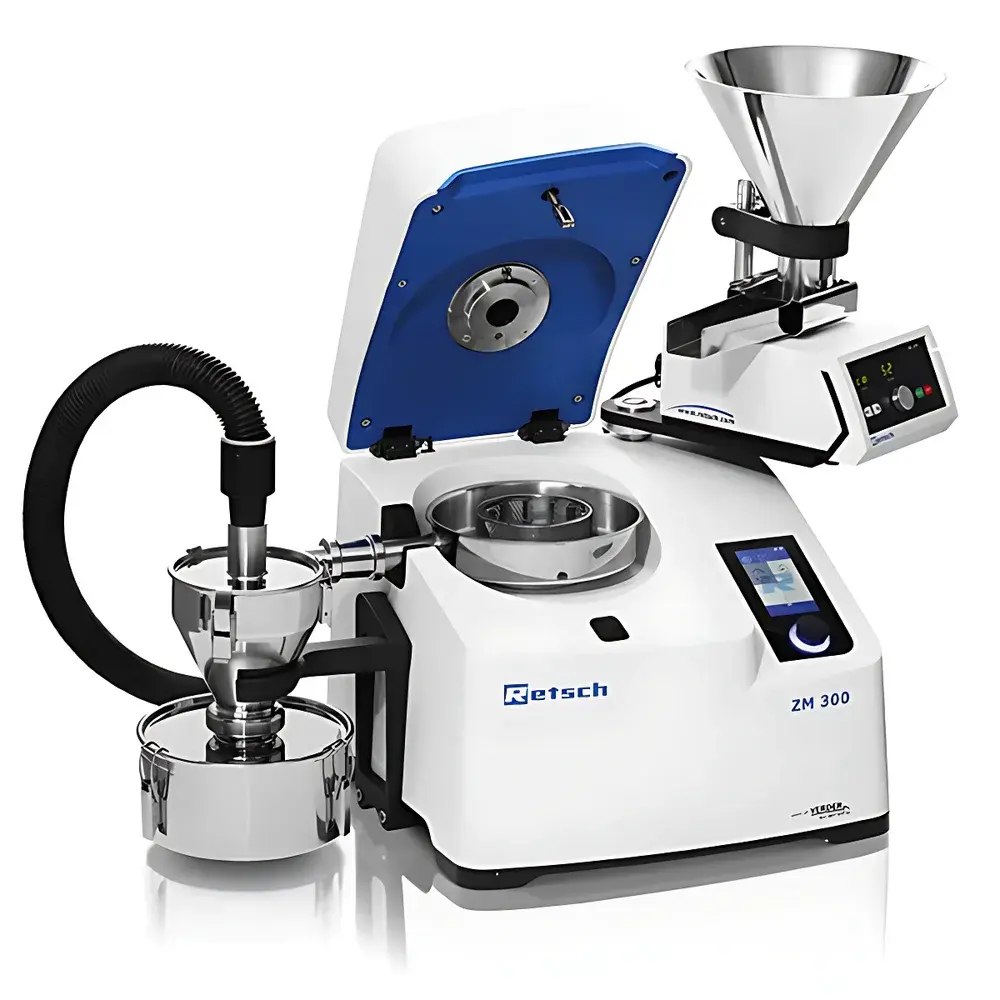
Retsch ZM 300 Ultra-Centrifugal Grinder
| Brand | Retsch |
|---|---|
| Origin | Germany |
| Model | ZM 300 |
| Grinding Principle | Ultra-centrifugal impact milling |
| Max. Speed | 23,000 rpm |
| Feed Size | < 10 mm |
| Final Particle Size | < 40 µm (down to 10 µm typical) |
| Batch Capacity | 300 mL (standard collection pan), 600 mL (high-capacity pan), or up to 4,500 mL (cyclone separator configuration) |
| Temperature Monitoring | Integrated real-time sensor |
| Cryogenic Compatibility | Yes, liquid nitrogen-compatible operation |
| Compliance | CE, ISO 9001, ASTM E11–22 (for sieve analysis preparation), GLP-ready documentation support |
Overview
The Retsch ZM 300 Ultra-Centrifugal Grinder is a high-precision, laboratory-scale impact mill engineered for rapid, reproducible size reduction of diverse solid materials—from brittle minerals and pharmaceutical powders to fibrous plant tissues and temperature-sensitive polymers. Operating on the principle of ultra-centrifugal impact grinding, the instrument accelerates sample particles into a hardened steel or tungsten carbide grinding ring at rotational speeds up to 23,000 rpm. Kinetic energy transfer induces repeated particle–ring and particle–particle collisions, achieving fine comminution through controlled fracture rather than thermal degradation. Unlike rotor-stator mills or planetary ball mills, the ZM 300 delivers sub-40 µm output with minimal heat accumulation—critical for preserving crystallinity, enzymatic activity, or volatile compound integrity. Its modular design accommodates cryogenic operation (e.g., with liquid nitrogen pre-cooling), enabling consistent processing of thermolabile or elastic samples such as collagen, rubber, or frozen biological tissue.
Key Features
- Ultra-high-speed rotor system (6,000–23,000 rpm) with electronic speed control and real-time tachometer feedback
- Integrated PT100 temperature sensor in the grinding chamber, logging thermal profiles for each run to support method validation and GLP traceability
- Cyclone separator module (optional) for continuous, dust-free collection of fine fractions down to 10 µm—ideal for low-density or electrostatic-prone materials (e.g., polymers, spices, dried herbs)
- Three interchangeable collection configurations: standard 300 mL stainless-steel pan, high-capacity 600 mL pan, and scalable cyclone setups (230 mL, 450 mL, 2,500 mL, or 4,500 mL volumes)
- Tool-free chamber disassembly and smooth-surface grinding components compliant with ISO 8573-1 (cleanroom-grade surface finish) for rapid cleaning and cross-contamination prevention
- Programmable grinding time (0.01–99:59 min), automatic shutdown upon lid opening or overtemperature detection (≥ 60 °C), and overload protection per IEC 61000-4-5
Sample Compatibility & Compliance
The ZM 300 processes heterogeneous, anisotropic, and mechanically challenging samples—including bone, coal, graphite, pharmaceutical tablets, feed pellets, and composite electronic waste—without requiring pre-drying or size pre-selection (feed size ≤ 10 mm). Its cryo-adapted geometry allows direct grinding of frozen or LN2-cooled specimens, maintaining structural fidelity during preparation for SEM, XRD, or elemental analysis. All contact parts are certified non-reactive per USP Class VI and comply with FDA 21 CFR Part 11 requirements for audit trails when paired with Retsch’s optional software package. The instrument meets CE marking directives (2014/30/EU EMC, 2014/35/EU LVD), conforms to ISO 9001:2015 manufacturing standards, and supports ASTM E11–22 compliance for particle size distribution reference material preparation.
Software & Data Management
Retsch’s proprietary RETSCHcontrol software (v4.2+) enables full remote operation, parameter logging (speed, time, temperature, torque), and automated report generation in PDF or CSV format. Each grinding cycle generates a timestamped digital record—including operator ID, calibration status, and environmental metadata—satisfying ALCOA+ data integrity principles. Audit trail functionality complies with 21 CFR Part 11 for electronic signatures and change history retention. Optional integration with LIMS via OPC UA protocol permits seamless workflow synchronization in regulated QC laboratories.
Applications
- Preparation of homogenized powders for X-ray fluorescence (XRF) and inductively coupled plasma (ICP) analysis
- Routine particle size reduction prior to laser diffraction (e.g., Mastersizer) or sieve analysis per ISO 9276
- Cryogenic milling of biopolymers and freeze-dried APIs to prevent amorphization
- High-throughput sample conditioning for pharmacopeial dissolution testing (USP )
- Fragmentation of composite materials (e.g., PCBs, battery cathodes) for metal recovery assays
- Standardized comminution of agricultural commodities (grains, coffee beans, spices) for moisture, fat, or mycotoxin analysis
FAQ
What is the smallest achievable particle size with the ZM 300?
Typical D90 values range from 10 to 40 µm depending on material hardness, elasticity, and moisture content; optimal fineness requires empirical optimization of speed, time, and cooling strategy.
Can the ZM 300 be used for GMP-regulated pharmaceutical sample prep?
Yes—when operated with validated parameters, logged via RETSCHcontrol, and maintained under documented calibration schedules, it fulfills ICH Q5A and USP requirements for equipment qualification.
Is the cyclone separator compatible with all ZM 300 configurations?
The cyclone module requires the dedicated ZM 300-CY adapter kit and is not retrofittable to legacy ZM 200 systems.
How does temperature monitoring improve method reproducibility?
Real-time thermal profiling identifies exothermic transitions (e.g., polymer softening) and enables dynamic speed modulation to maintain target T ≤ 40 °C—reducing batch-to-batch variability in heat-sensitive matrices.
What maintenance intervals are recommended for routine operation?
Rotor balance verification every 200 operating hours; grinding ring replacement after 500–1,000 cycles (depending on abrasive load); annual factory calibration for speed and temperature sensors.



