
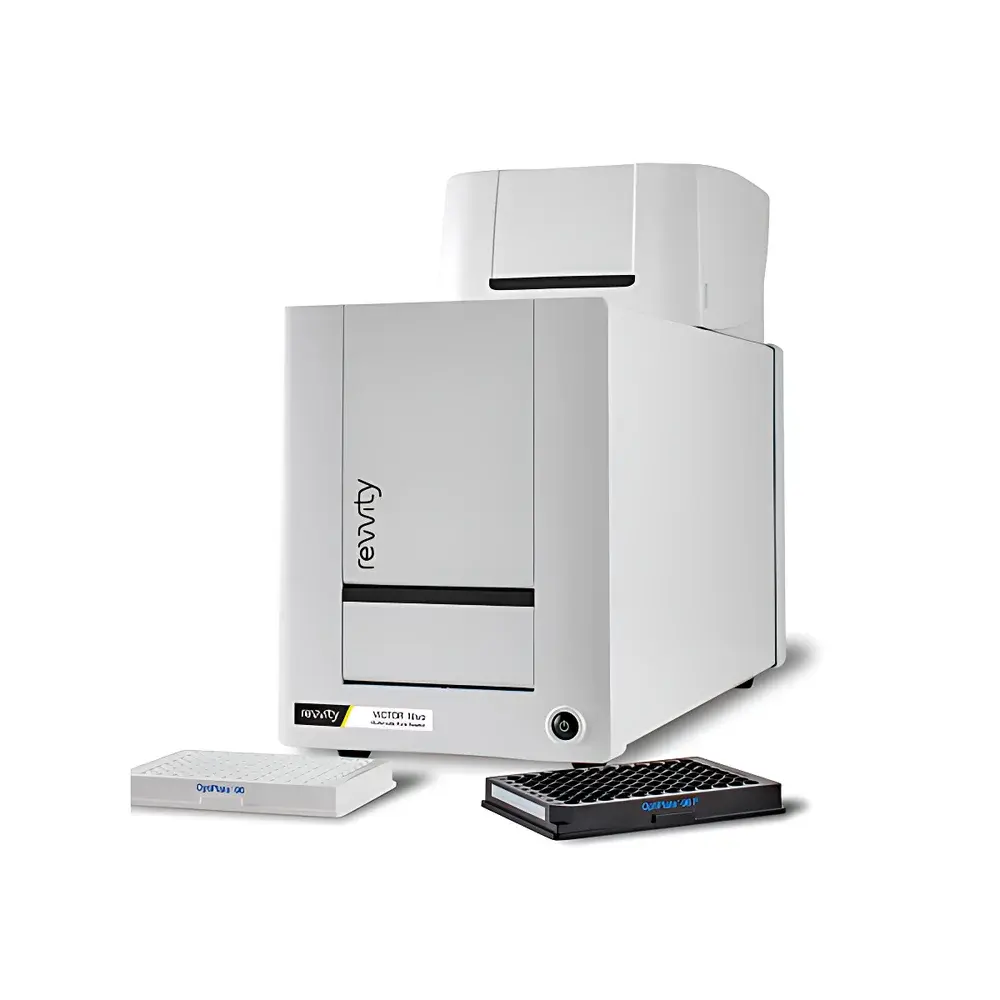
Revvity VICTOR Nivo Multimode Microplate Reader
| Brand | Revvity |
|---|---|
| Origin | USA |
| Model | VICTOR Nivo |
| Function Type | Multimode |
| Detection Modes | Luminescence (Top/Bottom), Fluorescence (Top/Bottom), Time-Resolved Fluorescence (TRF), Fluorescence Polarization (FP), AlphaLISA®/AlphaScreen®, Absorbance (230–1,000 nm, spectral or filter-based) |
| Filter Capacity | 32-position dynamic dual-wheel filter system |
| Temperature Control | Ambient to 65 °C (integrated) |
| Optional Modules | Gas control (O₂/CO₂), Reagent Dispensers (dual-channel), Plate Stacker (20-plate capacity) |
| Software Platform | Browser-based MyAssays® Desktop Pro with 21 CFR Part 11 compliance support |
| Connectivity | Wi-Fi, Ethernet, OS-agnostic (Chrome/Edge compatible) |
Overview
The Revvity VICTOR Nivo Multimode Microplate Reader is an engineered platform for quantitative life science assays requiring high flexibility, reproducibility, and regulatory readiness. Built upon a modular optical architecture, it supports six core detection modalities—luminescence (top and bottom reading), fluorescence intensity (FI), time-resolved fluorescence (TRF), fluorescence polarization (FP), Alpha technology (AlphaLISA®/AlphaScreen®), and absorbance—with independent optimization paths for each. Its measurement principle relies on precision photomultiplier tube (PMT)-based detection for luminescence and fluorescence, coupled with either interference filter-based excitation/emission selection or monochromator-based full-spectrum acquisition (230–1,000 nm). This dual-path optical design enables method development across diverse probe chemistries—from conventional dyes to lanthanide chelates and energy-transfer systems—while maintaining assay fidelity under physiologically relevant conditions.
Key Features
- Dynamic 32-position dual-wheel filter system: Enables rapid switching between excitation and emission filters without mechanical drift; filters are mechanically locked in position to prevent misalignment in shared-lab environments.
- Spectral absorbance capability: Full-wavelength scanning at ≤1 second per well (230–1,000 nm); selectable bandwidths (2 nm, 5 nm, 10 nm) optimize signal-to-noise for both narrow-peak and broad-absorption analytes.
- Integrated thermal control: Precise temperature regulation from ambient to 65 °C, calibrated and validated per ASTM E2877, supporting kinetic assays with thermosensitive enzymes or long-term cell viability studies.
- Optional gas modulation module: Programmable O₂ and CO₂ control enables hypoxic, normoxic, or hyperoxic incubation during real-time plate reading—critical for primary cell, organoid, and stem cell assays.
- Dual-channel reagent dispenser: Supports sequential or simultaneous addition of up to two reagents with programmable delay times (10 ms resolution); includes automatic plate presence verification, tip priming, and wash cycles to minimize carryover.
- 20-plate unattended operation: Compatible with robotic plate stackers for walk-away processing—ideal for high-throughput screening (HTS) workflows aligned with SLAS/ANSI standards.
Sample Compatibility & Compliance
The VICTOR Nivo accommodates standard microplate formats (6–1536-well), including opaque, clear-bottom, and black-walled plates optimized for cell-based assays. Its bottom-reading optics employ collimated illumination and high-numerical-aperture collection to maximize signal from adherent cultures while minimizing edge effects and well-to-well crosstalk. All hardware and software components comply with IEC 61000-4 electromagnetic compatibility standards and meet UL/CSA safety requirements. The system supports GLP/GMP-aligned operations through optional Enhanced Security software, which enforces role-based user access, electronic signatures, immutable audit trails, and data integrity safeguards compliant with FDA 21 CFR Part 11 and EU Annex 11.
Software & Data Management
Control and analysis are unified via MyAssays® Desktop Pro—a browser-native application compatible with Windows®, macOS®, and Android™ tablets using Chrome or Edge. The interface follows ISO/IEC 17025-aligned workflow logic, offering preconfigured protocols for ELISA, dsDNA quantification (Qubit®-style), HTRF®, LANCE®, DELFIA®, ATP-lite™, and Alpha assays. Real-time data visualization includes kinetic overlays, spectral heatmaps, 3D dose-response surfaces, and customizable report generation (DOCX, XLSX, PDF, HTML). Raw data export preserves metadata (timestamp, instrument ID, filter set, gain settings) in MIAME-compliant format. For regulated environments, the Enhanced Security edition provides cryptographic hashing of datasets, session logging, and revision-controlled protocol templates—fully auditable for internal QA reviews or external inspections.
Applications
The VICTOR Nivo serves as a central detection platform across academic, pharmaceutical, and diagnostic laboratories. It is routinely deployed in: G-protein-coupled receptor (GPCR) functional profiling using cAMP or Ca²⁺ biosensors; cytotoxicity assessment via real-time ATP monitoring in co-culture models; kinase activity screening with TR-FRET readouts; viral neutralization assays leveraging AlphaLISA® proximity detection; and label-free nucleic acid quantification via UV absorbance. Its thermal and gas control capabilities make it suitable for longitudinal studies of metabolic flux, mitochondrial respiration, and hypoxia-inducible factor (HIF) signaling—applications demanding sustained cellular functionality over multi-hour kinetics.
FAQ
Does the VICTOR Nivo support both top- and bottom-reading for all detection modes?
Yes—fluorescence, luminescence, TRF, FP, and Alpha technologies support configurable top or bottom reading; absorbance is top-read only.
Can I perform spectral scanning and filter-based detection in the same run?
No—spectral and filter-based absorbance acquisitions are separate measurement types, but both can be scheduled sequentially within one protocol.
Is the gas control module required for routine cell-based assays?
Not mandatory, but strongly recommended for assays exceeding 2 hours or involving primary cells, where physiological O₂ tension directly impacts phenotype and assay window.
How does the system ensure data traceability in regulated labs?
Through optional Enhanced Security software, which implements electronic signatures, automated audit logs, and write-protected raw data archives—fully aligned with 21 CFR Part 11 Subpart B requirements.
What file formats are supported for data export and integration with LIMS?
Native exports include .xlsx (with metadata), .csv (tabular), .pdf (formatted reports), and .html (interactive dashboards); API access is available for direct LIMS synchronization via RESTful endpoints.



