
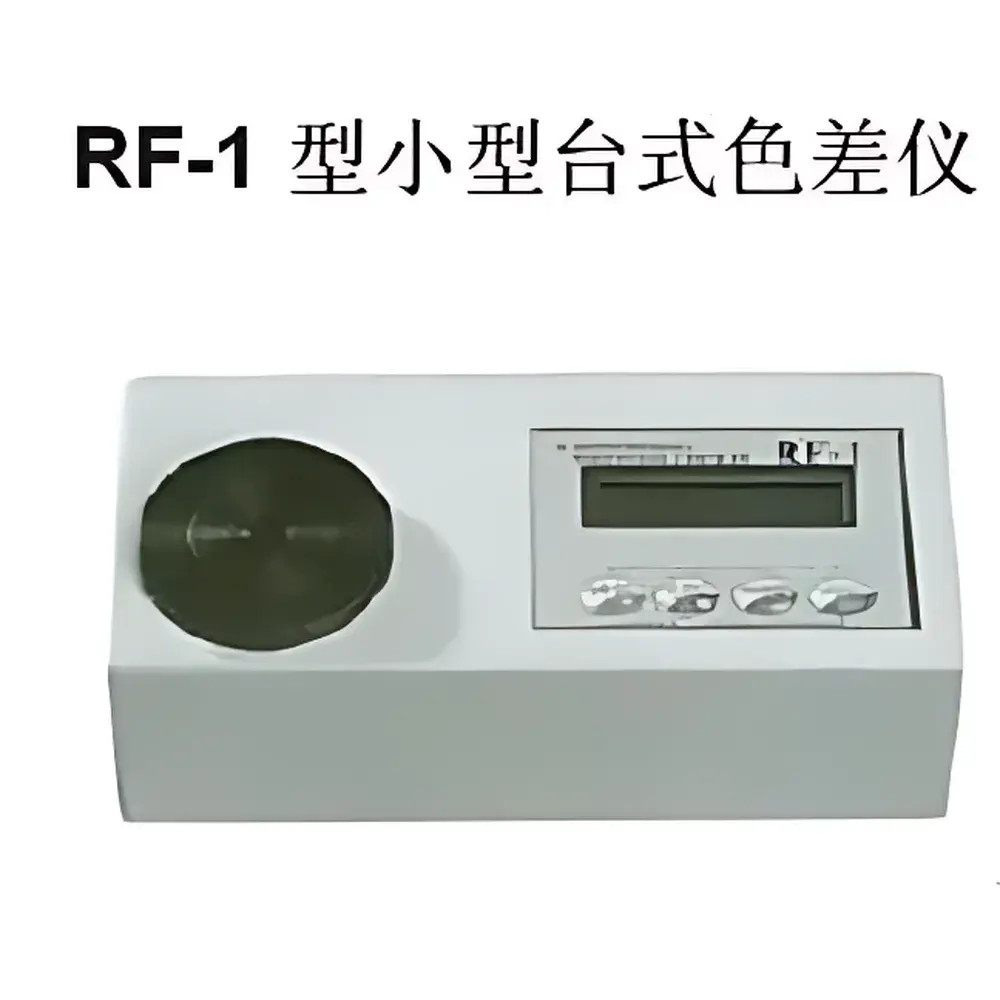
RF-1 Compact Desktop Color Difference Meter
| Origin | Japan |
|---|---|
| Manufacturer Type | Authorized Distributor |
| Origin Category | Imported |
| Model | RF-1 |
| Pricing | Upon Request |
| Dimensions | 200 mm (W) × 90 mm (H) × 75 mm (D) |
| Weight | 820 g (without batteries) |
| Housing Material | Sheet Metal |
| Power Supply | 4 × AA alkaline batteries (Ni-Cd rechargeable compatible) |
| Display | 16-character × 2-line LCD |
| Operation Keys | 4 tactile buttons |
| Illumination/Viewing Geometry | 0°/45° |
| Light Source | Tungsten-halogen lamp |
| Detector | Silicon photodiode array |
| Measurement Aperture | 10 mm diameter |
| Sample Holders | Glass cuvette, glass plate, solid test plate |
| Sample Types | Powders, liquids, transparent viscous pastes, clay-like solids, hydrated solids (*with optional plastic film or transparent bag) |
| Standard White Tile | Removable, mounts directly onto glass cuvette |
| Output Color Spaces | CIE XYZ, CIE L*a*b*, CIELAB, Whiteness (WB), ISO Brightness (W), Tint (Tw) |
| Color Differences | ΔXYZ, ΔL*a*b*, ΔE*ab, ΔE*00, ΔWB, ΔW, ΔTw (*WB valid only under C/2° |
| Display Resolution | 0.1 unit |
| Repeatability | ΔE*ab ≤ 0.1 (SD of 20 measurements on certified white tile) |
| Instrument Accuracy | ΔE*ab ≤ 1.0 (mean error across NIST-traceable R/G/B/Y ceramic tiles) |
| Observer Angle | 2° (C illuminant), 10° (D65 illuminant) |
| Calibration Method | Reflectance-based, using factory-certified white tile with XYZ input |
| Reference Standard | Single user-defined reference |
| Averaging Function | Up to 9 consecutive readings |
| Battery Indicator | Multi-segment real-time level display |
| Auto Power-Off | After 5 minutes of inactivity |
| Interface | RS-232C serial port (9600 bps), 8-pin circular DIN connector |
| Standard Accessories | Glass cuvette, glass calibration plate, solid test plate, removable white calibration tile, light-shielding hood, printed operation manual |
| Optional Accessories | Thermal printer, RS-232 cable, protective carrying case |
Overview
The RF-1 Compact Desktop Color Difference Meter is an entry-level, portable spectrophotometric instrument engineered for rapid, repeatable color assessment in quality control laboratories and production environments where space, portability, and operational simplicity are critical. Unlike full-spectrum benchtop spectrophotometers, the RF-1 employs a fixed-geometry 0°/45° optical configuration with a stabilized tungsten-halogen illumination source and silicon photodiode detection system. This design ensures consistent angular illumination and directional collection—minimizing directional reflectance artifacts common in textured or glossy samples—while maintaining high signal-to-noise ratio under ambient lighting conditions. Its primary application domain centers on whiteness evaluation (ISO 2470-1, TAPPI T452), particularly for paper, textiles, pharmaceutical excipients, and ceramic glazes, but it also supports general-purpose color difference analysis per CIE 1976 L*a*b* and CIEDE2000 (ΔE*00) metrics. The device complies with fundamental requirements of ISO 5-4:2019 (Color measurement instruments — Part 4: Criteria for performance verification) and aligns with measurement traceability frameworks referenced in ISO/IEC 17025-accredited labs.
Key Features
- Compact footprint (200 × 90 × 75 mm) and lightweight construction (820 g without batteries) enable flexible placement on lab benches, QC stations, or mobile carts.
- Robust sheet-metal housing provides mechanical stability and EMI shielding essential for consistent photometric output in industrial settings.
- Dedicated 0°/45° optical path eliminates influence from specular reflectance, delivering reliable data for matte, semi-gloss, and lightly textured surfaces.
- Four tactile operation keys support intuitive navigation through measurement, calibration, averaging, and data recall functions—no touchscreen dependency reduces maintenance complexity.
- Multi-condition reporting includes CIE XYZ, L*a*b*, ISO Whiteness (WB), ISO Brightness (W), and Tint (Tw), each calculated under standardized illuminants (C/2° and D65/10°) per ISO/CIE conventions.
- Onboard averaging (up to 9 readings) improves statistical confidence for heterogeneous samples such as powdered APIs or granulated polymers.
- RS-232C interface enables direct integration into LIMS or MES systems for automated data logging and audit trail generation—supporting GLP-compliant documentation workflows.
Sample Compatibility & Compliance
The RF-1 accommodates diverse physical forms via interchangeable sample holders: a glass cuvette for liquids and low-viscosity suspensions; a glass plate for powders and transparent gels (when covered with optically clear film); and a solid test plate for rigid or semi-rigid materials including tablets, molded plastics, and coated substrates. All sample interfaces maintain strict aperture definition (10 mm diameter) and reproducible sample-to-sensor distance, satisfying repeatability criteria outlined in ASTM D2244 and ISO 11664-4. The instrument’s stated repeatability (ΔE*ab ≤ 0.1) and accuracy (ΔE*ab ≤ 1.0) were verified against NIST-traceable ceramic color standards and conform to manufacturer calibration protocols aligned with ISO 9001:2015 clause 7.1.5. While not FDA 21 CFR Part 11–validated out-of-the-box, its RS-232 data export supports validated third-party software solutions for regulated industries requiring electronic record integrity.
Software & Data Management
Data acquisition occurs via ASCII-based RS-232 protocol at 9600 bps, enabling seamless transmission to spreadsheet applications, custom QA databases, or validated laboratory informatics platforms. Each measurement packet contains timestamp (if host-supplied), sample ID, geometry, illuminant/observer, and all computed values—including ΔE*ab, ΔE*00, WB, W, and Tw—with resolution to 0.1 units. The built-in LCD displays real-time battery status via segmented indicator and triggers “LOW BATTERY” alert prior to voltage drop below operational threshold—ensuring uninterrupted measurement continuity. Automatic power-off after five minutes of inactivity conserves battery life without compromising data retention; all active calibration and reference parameters persist in non-volatile memory across power cycles.
Applications
- Whiteness qualification of paper grades, bleached cotton, and titanium dioxide–based pigments per ISO 2470-1 and TAPPI T452.
- Batch-to-batch color consistency verification for pharmaceutical tablet coatings, cosmetic emulsions, and food-grade packaging films.
- In-process monitoring of pigment dispersion homogeneity in inkjet inks and water-based paints.
- Stability testing of light-sensitive materials (e.g., photochromic polymers) via periodic ΔE*ab tracking under controlled storage conditions.
- Educational use in material science and textile engineering labs for foundational colorimetry instruction aligned with CIE technical reports.
FAQ
What standard illuminants and observers does the RF-1 support?
The RF-1 implements C/2° (illuminant C, 2° observer) for Whiteness (WB) calculations and D65/10° (illuminant D65, 10° observer) for Tint (Tw) and general L*a*b* reporting—fully compliant with ISO 11664 series definitions.
Can the RF-1 measure opaque solids without surface preparation?
Yes—using the solid test plate holder, the instrument measures opaque, non-reflective solids directly. For highly reflective or curved surfaces, use of the included light-shielding hood is mandatory to exclude ambient stray light.
Is calibration traceable to national standards?
The supplied white calibration tile is factory-certified against NIST SRM 2035 (Diffuse Reflectance Standard) and documented with XYZ values traceable to CIE daylight and tungsten-halogen spectral irradiance functions.
Does the RF-1 support GLP-compliant data archiving?
While the meter itself lacks internal audit trail functionality, its RS-232 output supports integration with validated external software that records operator ID, timestamp, calibration history, and raw measurement data—fulfilling core GLP data integrity requirements per OECD Principles.
How frequently should the white calibration tile be recalibrated?
Annual recalibration by an ISO/IEC 17025-accredited provider is recommended; daily verification against the installed tile is required before critical measurements per ISO 9001 clause 8.5.1.




